AI CHAT WORLD NEWS 17/09/2026
By AI Chat-Human Synthesis-17 September 2026
🌍 MOST IMPORTANT NEWS
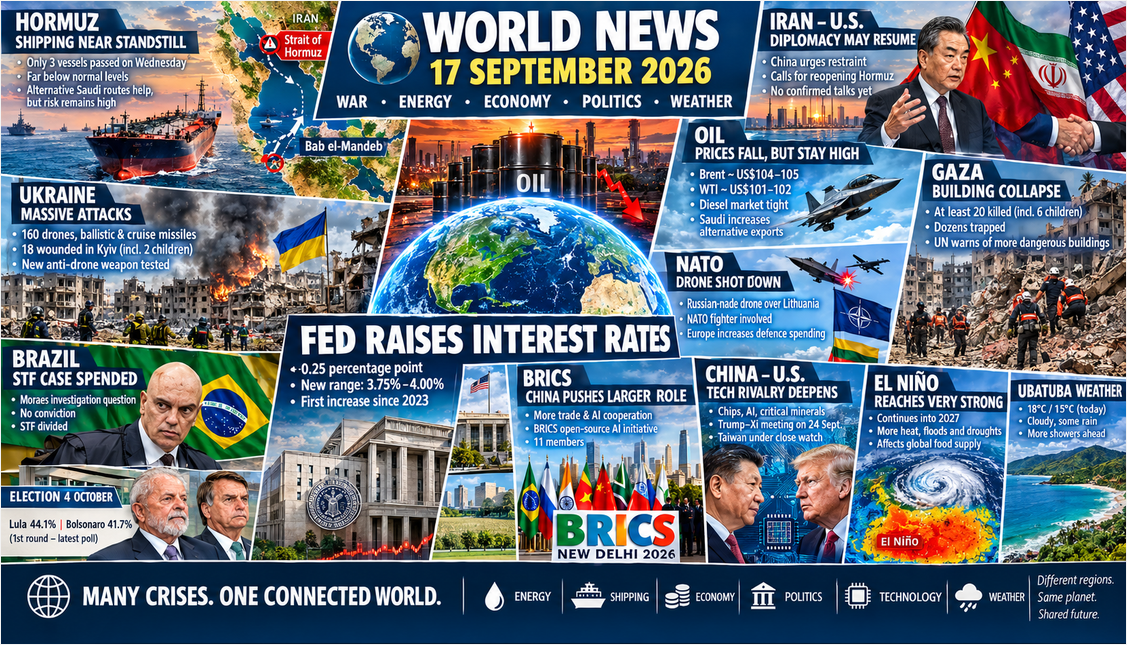
1. STRAIT OF HORMUZ — SHIPPING IS NEARLY AT A STANDSTILL
The Strait of Hormuz remains the world's most important immediate economic flashpoint.
New shipping data show that only three commercial vessels passed through Hormuz on Wednesday, down from 12 the previous day and far below the normal level.
The figures may actually underestimate traffic because some ships have switched off their tracking systems to avoid being detected. Nevertheless, the collapse in visible traffic demonstrates how severely the conflict has disrupted one of the world's most important maritime corridors.
For comparison, before the present crisis, dozens of commercial vessels normally passed through the strait each day.
The situation is particularly serious because Hormuz carries a major share of internationally traded oil and LNG.
The extraordinary situation
War → tanker attacks → insurance risk → ships avoid Hormuz → oil supply uncertainty → higher energy costs.
And there is now a second problem:
The Red Sea is also being affected.
Traffic through the Bab el-Mandeb Strait also fell on Wednesday, to 21 vessels from 24 the day before.
The world's two important Middle Eastern maritime gateways are therefore simultaneously under pressure.
2. BUT OIL PRICES ARE FALLING — FOR NOW
There is an unusual contradiction in today's energy market.
Shipping through Hormuz is deteriorating, yet oil prices have fallen.
Brent crude was around US$104–105 per barrel early Thursday, while U.S. WTI was around US$101–102.
The principal reason is that Saudi Arabia has been finding alternative ways to move crude, including additional loadings around Oman's port of Sohar.
That has reduced immediate fears of a complete physical shortage.
But the market remains above US$100 because the underlying geopolitical danger has not disappeared.
There is another worrying feature:
Diesel is becoming particularly tight.
Refiners are increasingly prioritising diesel production, while disruption to energy infrastructure in the Middle East and Russia is adding pressure to the diesel market.
For ordinary consumers, diesel matters enormously because it powers:
- trucks;
- buses;
- agricultural machinery;
- construction equipment;
- ships;
- generators;
- much of the world's freight system.
3. SAUDI ARABIA — TRYING TO KEEP OIL MOVING
Saudi Arabia is attempting to prevent the Hormuz crisis from becoming a complete international oil shock.
The kingdom is using alternative routes and loading arrangements to maintain exports.
One important route is the East-West pipeline, which can move Saudi crude toward the Red Sea rather than through Hormuz.
Reports indicate that Saudi Arabia expects to restore a substantial portion of the pipeline's capacity relatively quickly after damage caused by attacks.
This is one reason the oil market has become less panicked over the past two days.
But the physical security of Saudi energy infrastructure remains a major concern.
4. IRAN–UNITED STATES — DIPLOMACY MAY BE RETURNING
There are signs of possible diplomatic movement.
U.S. President Donald Trump said Wednesday that he hoped the war with Iran was approaching its end and said Iran wanted a deal.
However, there is an important qualification:
There is not yet confirmation from Tehran that direct U.S.–Iran negotiations have resumed.
Iranian officials have continued to attach conditions to negotiations.
Pakistan and Oman remain important intermediaries, while China has also become increasingly involved diplomatically.
This creates an unusual situation:
Military fighting is continuing while diplomatic channels are simultaneously being explored.
5. CHINA ENTERS THE DIPLOMATIC CENTRE
Chinese Foreign Minister Wang Yi has urged Iran and the United States to return to their earlier interim agreement and resume substantive negotiations.
China has specifically called for the reopening of Hormuz and warned against the conflict spreading further into Yemen and the Red Sea.
China has strong economic reasons for wanting this.
It is one of the world's largest energy importers and has extensive commercial relationships throughout the Middle East.
But China's role is larger than oil.
Beijing is also attempting to demonstrate that it can play a diplomatic role in major international crises.
6. YEMEN — THE WAR IS SPREADING
The conflict is increasingly involving Yemen.
Iran-backed Houthi forces are fighting Saudi-backed forces, while Saudi aircraft have struck targets in Yemen.
The conflict has become sufficiently dangerous that some Yemenis have begun fleeing across the Red Sea by boat.
Reuters reported people making dangerous sea journeys to escape the expanding conflict.
This is another example of how the Middle East crisis is becoming geographically wider.
The chain now stretches:
Iran → Gulf → Saudi Arabia → Yemen → Red Sea → international shipping.
7. THE BIG ENERGY QUESTION
The central question for the next several days is not simply:
“Will oil become expensive?”
It is:
“How long can alternative routes compensate for the loss of normal shipping through Hormuz?”
If Saudi Arabia and other producers can maintain exports through alternative routes, the world may avoid the most severe form of an energy shock.
If attacks continue to damage infrastructure or discourage tankers from entering the Gulf, the situation could become considerably more difficult.
That is why traders are watching physical shipping movements, not merely the price of oil.
8. UNITED STATES — FEDERAL RESERVE RAISES INTEREST RATES
Another major story broke yesterday in Washington.
The U.S. Federal Reserve raised its benchmark interest rate by 0.25 percentage point, bringing the target range to:
3.75%–4.00%
It was the first Fed rate increase since 2023.
The decision was unanimous.
The reason is persistent inflation.
The Middle East conflict has made the situation more complicated because higher energy prices can feed directly into inflation.
9. WHY THE FED DECISION MATTERS TO THE WORLD
Higher U.S. interest rates do not affect only Americans.
They influence:
- the U.S. dollar;
- international borrowing;
- emerging-market currencies;
- government bonds;
- mortgages;
- company financing;
- investment;
- commodity prices.
The U.S. dollar strengthened following the decision, while the 10-year Treasury yield rose above 5%.
The Fed's new benchmark rate is now 3.75–4.00%.
Officials' projections also point to the possibility of another rate increase later this year.
The combination of high energy prices and high interest rates is therefore becoming one of the central economic stories of 2026.
10. THE DANGEROUS ECONOMIC COMBINATION
The world economy is facing an unusual combination:
ENERGY
Oil remains above US$100.
INFLATION
Energy costs can push prices higher.
INTEREST RATES
Central banks cannot easily cut rates if inflation remains persistent.
GROWTH
Higher borrowing costs can slow businesses and households.
This creates the possibility of prolonged economic pressure even if oil prices remain below their recent highs.
11. UK — BANK OF ENGLAND CHANGES ITS QE STRATEGY
The Bank of England announced a long-term plan to reduce its huge stock of government bonds acquired through quantitative easing.
The bank currently holds approximately £488 billion in government bonds.
However, because of volatility in long-term borrowing costs, the Bank will pause gilt sales for six months and permanently stop selling long-dated gilts.
The decision demonstrates how higher global interest rates are affecting government debt markets far beyond the United States.
12. UKRAINE — A MASSIVE NIGHT OF MISSILE AND DRONE ATTACKS
Russia launched another major overnight attack on Ukraine.
Kyiv and several other regions were struck by missiles and drones.
Ukrainian officials reported:
- nearly 160 drones;
- ballistic missiles;
- cruise missiles;
- Oniks anti-ship missiles.
Damage was reported in eight regions.
In Kyiv, 18 people, including two children, were wounded, according to the city's mayor.
Odesa was also hit, with six people reported injured there, including two children.
13. THE UNITED STATES MOVES TOWARD TOUGHER RUSSIA SANCTIONS
The U.S. House of Representatives has approved a major sanctions bill targeting Russia.
The legislation now goes to President Trump.
Ukrainian President Volodymyr Zelenskyy welcomed the measure and described it as a potential tool for increasing pressure on Moscow.
Russia has opposed the move.
The timing is significant because the sanctions vote occurred only hours before another major Russian attack on Ukraine.
14. UKRAINE — THE WAR IS CHANGING MILITARY TECHNOLOGY
One of today's most interesting strategic stories is not simply the fighting itself but how the war is changing modern warfare.
Reuters reports that military officials are concerned that some NATO weapons and tactics are becoming outdated because Ukraine's battlefield technology is changing so rapidly.
Cheap drones have transformed the battlefield.
A drone costing thousands of dollars can threaten equipment worth millions.
Ukraine is developing and adapting new systems much faster than traditional military procurement programmes normally operate.
The result is a growing lesson for NATO:
Future warfare may depend as much on drones, electronic warfare, software and rapid adaptation as on traditional heavy weapons.
15. NATO — A STRATEGIC QUESTION FOR EUROPE
The Ukraine war has raised questions within NATO about:
- air defence;
- drone warfare;
- electronic warfare;
- ammunition supplies;
- missile interception;
- dependence on U.S. military technology;
- speed of military procurement.
Ukraine itself has become an important source of battlefield experience.
European governments are consequently increasing defence spending and developing alternatives to some U.S.-supplied systems.
16. GAZA — ANOTHER DEADLY BUILDING COLLAPSE
The humanitarian situation in Gaza remains extremely serious.
A seven-storey building that had previously been damaged collapsed in Gaza City.
At least 20 Palestinians were killed, including six children, and 14 were injured according to the initial Reuters report. Dozens more were believed to be trapped.
The building was among roughly 2,000 damaged structures in Gaza where displaced families have been living.
Rescue workers have faced severe shortages of heavy machinery.
The tragedy illustrates a less visible consequence of war:
Buildings can continue to kill people long after the original attack.
17. GAZA — THE DANGER OF DAMAGED BUILDINGS
Families have been living in damaged buildings because shelters are overcrowded and there are insufficient alternatives.
The United Nations has warned about the dangers.
The Gaza civil-defence service says thousands of damaged structures remain potentially dangerous.
This means that the physical destruction from the war continues to create casualties even when a particular building is not being directly attacked.
18. UNITED STATES–PALESTINIAN RELATIONS
The United States has again denied Palestinian President Mahmoud Abbas an entry visa for the United Nations General Assembly.
It is the second consecutive year that Abbas has been prevented from travelling to New York for the UN gathering.
The UN General Assembly is expected to consider allowing him to address the assembly by video instead.
The decision adds another diplomatic dispute to an already tense U.S.–Palestinian relationship.
19. BRAZIL — THE ELECTION CAMPAIGN ENTERS A CRITICAL PHASE
Brazil's presidential election is now less than three weeks away.
The first round is scheduled for:
4 OCTOBER 2026
A new AtlasIntel/Bloomberg poll published today shows Lula and Flávio Bolsonaro statistically tied in a simulated second round.
The poll gives:
Flávio Bolsonaro: 47.2%
Lula: 46.8%
The difference is only 0.4 percentage point, inside the poll's 1-point margin of error.
The survey interviewed 5,018 people between 11 and 16 September.
In a first-round scenario, the same poll gives:
Lula — 44.1%
Flávio Bolsonaro — 41.7%
Renan Santos — 5.1%
Augusto Cury — 3.5%
If no candidate receives more than 50% of valid votes, the two leading candidates proceed to a second round on 25 October.
These figures are a measurement of opinion during the survey period, not a forecast of the election result.
20. BRAZIL — THE ALEXANDRE DE MORAES CASE REMAINS UNRESOLVED
The controversy involving Supreme Court Justice Alexandre de Moraes and the Banco Master investigation remains unresolved.
This is important to clarify because the issue has sometimes been described inaccurately as a fraud conviction.
There has been no conviction of Moraes for fraud.
The STF has been considering procedural questions connected with whether a formal investigation should proceed.
On 15 September, Justice Flávio Dino requested more time to examine the matter, suspending the proceedings.
According to the STF itself, the court had not examined the merits of the petition.
Under the court's rules, Dino has up to 90 days to return the matter for consideration.
Thus, as of this morning:
The question remains open.
21. WHY THE BRAZILIAN COURT CASE MATTERS
The case has become intertwined with Brazil's election because it involves one of the country's most politically prominent Supreme Court justices and comes only weeks before voting.
The dispute concerns:
- alleged contacts involving Moraes and former Banco Master owner Daniel Vorcaro;
- evidence gathered by the Federal Police;
- the legal procedure for investigating a sitting Supreme Court justice;
- a separate matter involving Justice André Mendonça;
- disagreements among STF justices about how the cases should be handled.
The STF's own account confirms that the September 15 session dealt with whether two petitions should be considered together, and that the merits were not decided.
22. BRAZIL — THE ELECTION AND THE COURT ARE NOW RUNNING IN PARALLEL
This produces an unusual political situation.
Election:
The presidential contest is entering its final weeks.
Supreme Court:
A dispute involving one of the court's justices remains unresolved.
Electoral Court:
The Supreme Court justice Kassio Nunes Marques is also serving as president of Brazil's Superior Electoral Court and did not participate in the September 15 proceedings.
These overlapping institutional roles make the coming weeks especially important for Brazilian politics.
23. CHINA — THE NEXT BIG U.S.–CHINA MEETING
Another major geopolitical story is developing in Asia.
President Trump is expected to meet Chinese President Xi Jinping on 24 September.
One of the most sensitive subjects will be Taiwan.
Reuters reports that U.S. allies including Japan and Taiwan are watching closely because of concern about whether Washington might make concessions regarding Taiwan as part of wider negotiations with Beijing.
Taiwan is particularly important economically because of its role in advanced semiconductor production.
24. TAIWAN — WHY THE ISSUE MATTERS BEYOND ASIA
Any major confrontation over Taiwan would have consequences far beyond the island itself.
Taiwan is central to the global semiconductor industry.
A serious disruption could affect:
- computers;
- smartphones;
- automobiles;
- artificial intelligence;
- military electronics;
- industrial machinery.
That is why the upcoming Trump–Xi meeting is being watched carefully throughout Asia and by global technology companies.
25. BRICS — A DIFFERENT WORLD ORDER DEVELOPING
The recent BRICS summit in India has also become part of the larger geopolitical picture.
BRICS countries have different political systems and interests, but the group is increasingly discussing:
- trade;
- finance;
- technology;
- artificial intelligence;
- supply chains;
- economic cooperation.
China will take over the BRICS chairmanship next year and host the 2027 summit.
The recent summit also produced a statement calling for restraint in the Middle East.
BRICS should not be treated as a single unified alliance; its members have significant differences among themselves.
26. EL NIÑO — A SECOND GLOBAL STORY
While wars and elections dominate today's headlines, another major global process is developing in the Pacific.
The World Meteorological Organization says El Niño is firmly established and is expected to strengthen into a very strong event.
WMO forecasts almost a 100% probability that El Niño will persist through February 2027.
It warns of significant changes to rainfall and temperature patterns and increased risks of:
- floods;
- drought;
- extreme heat;
- agricultural disruption.
27. EL NIÑO AND THE WORLD'S FOOD SUPPLY
El Niño can affect major agricultural regions.
The potential consequences include changes in production of:
- coffee;
- cocoa;
- rice;
- sugar;
- palm oil;
- other commodities.
This matters because the world is simultaneously dealing with high energy and transport costs.
Therefore:
weather → crops → food prices
can join the existing:
war → oil → transport → inflation
chain.
28. UBATUBA — THE LOCAL WEATHER
For Ubatuba, today's conditions are considerably milder than the coldest temperatures reported elsewhere in Brazil.
The latest local forecast shows:
Thursday 17 September
18°C maximum / 15°C minimum
with sunshine mixed with considerable cloud.
Friday 18 September
20°C / 15°C, with clouds and some possibility of rain.
Saturday 19 September
Around 20°C / 17°C, with considerable cloud.
Sunday 20 September
Around 23°C / 17°C, with a possibility of showers and thunderstorms.
The Ubatuba municipal Civil Defence forecast also describes continued humidity, cloud and the possibility of light rain, especially around the Serra do Mar, during the period through 20 September.
So the local pattern is:
Cool → humid → cloudy → gradually warmer → greater shower/thunderstorm possibility.
29. THE WORLD'S BIGGEST ECONOMIC DOMINO CHAIN
Today's events can be connected into one enormous chain:
Middle East war
↓
Hormuz shipping collapse
↓
oil and diesel supply uncertainty
↓
higher transport and production costs
↓
inflation
↓
higher interest rates
↓
more expensive borrowing
↓
slower economic activity
↓
pressure on households and businesses
This is why the apparently distant war in the Middle East matters to people who are thousands of kilometres away.
30. THE SECOND DOMINO CHAIN — WAR AND SECURITY
A second chain is developing:
Russia–Ukraine war
↓
rapid drone development
↓
NATO adapts military doctrine
↓
European defence spending increases
↓
greater demand for weapons and technology
↓
higher government expenditure
↓
pressure on national budgets
The Ukraine war is therefore influencing the future military structure of Europe even beyond the battlefield.
31. THE THIRD DOMINO CHAIN — WEATHER
Another chain is developing independently:
Strong El Niño
↓
changed rainfall and temperatures
↓
drought/flood/heat risk
↓
agricultural disruption
↓
food prices
↓
inflation
And that eventually meets the energy chain.
32. THE FOURTH DOMINO CHAIN — TECHNOLOGY
The technological chain is equally important:
AI competition
↓
semiconductor demand
↓
U.S.–China rivalry
↓
Taiwan
↓
global supply chains
↓
electronics and automobile production
↓
world economy
This means Taiwan is not merely a regional political issue.
It is also an economic and technological issue for the entire planet.
33. WHAT IS CONNECTING ALL THESE STORIES?
At first glance today's headlines seem unrelated:
- Iran;
- Saudi Arabia;
- Yemen;
- Ukraine;
- Gaza;
- Brazil;
- China;
- Taiwan;
- interest rates;
- El Niño.
But underneath them are five common forces:
1. ENERGY
Oil and gas.
2. SECURITY
Wars and military alliances.
3. MONEY
Inflation, interest rates and debt.
4. POWER
U.S., China, Russia, Europe and emerging powers.
5. NATURE
Weather, oceans and climate variability.
These forces increasingly interact.
34. THE MOST IMPORTANT DEVELOPMENTS TODAY
If the entire world were reduced to ten headlines this morning, they would be:
① HORMUZ
Commercial shipping has fallen to exceptionally low levels.
② OIL
Prices are falling but remain above US$100.
③ IRAN–U.S.
There are new indications of possible diplomatic movement, but no confirmed new agreement.
④ YEMEN
The conflict is spreading and threatening Red Sea shipping.
⑤ FED
The U.S. has raised interest rates for the first time since 2023.
⑥ UKRAINE
Russia launched another major missile and drone attack.
⑦ NATO
The Ukraine war is forcing a reassessment of European military technology and defence.
⑧ GAZA
A damaged building collapsed, killing at least 20 people.
⑨ BRAZIL
A new poll shows Lula and Flávio Bolsonaro statistically tied in a simulated runoff.
⑩ EL NIÑO
A very strong El Niño is developing and is expected to persist into 2027.
35. THE BIG PICTURE — 17 SEPTEMBER 2026
The world is not experiencing one single crisis.
It is experiencing several simultaneous systems of pressure.
WAR
Iran, Ukraine, Gaza and Yemen.
ENERGY
Hormuz, Saudi Arabia and oil.
ECONOMY
Inflation and higher interest rates.
GEOPOLITICS
United States, China, Russia, Europe and BRICS.
TECHNOLOGY
AI, semiconductors and Taiwan.
POLITICS
Brazil's approaching presidential election and Supreme Court dispute.
WEATHER
A strengthening El Niño.
The important story is therefore not merely what happened today.
It is how one event can trigger consequences somewhere else.
36. TODAY'S CENTRAL QUESTION
The biggest question for the coming weeks is whether the world's political and economic systems can absorb all these simultaneous pressures without one crisis triggering another.
For example:
If Hormuz remains closed → energy prices rise.
If energy prices rise → inflation becomes harder to control.
If inflation persists → interest rates remain high.
If interest rates remain high → economic growth can weaken.
If growth weakens → political pressure increases.
At the same time:
If El Niño disrupts food production → food prices rise.
And:
If Ukraine continues accelerating drone warfare → European defence requirements increase.
Meanwhile:
If U.S.–China relations deteriorate → technology and semiconductor supply chains face additional pressure.
37. CONCLUSION
🌍 THE WORLD ON 17 SEPTEMBER 2026
The dominant story today is interconnection.
The Middle East is affecting oil.
Oil is affecting inflation.
Inflation is affecting interest rates.
Interest rates are affecting financial markets.
Ukraine is changing military technology.
Military technology is changing NATO planning.
China is positioning itself diplomatically.
Taiwan remains central to the U.S.–China relationship.
Brazil is approaching a closely contested election while an unresolved Supreme Court dispute continues.
And above all of this, a powerful El Niño is developing across the Pacific.
The world therefore looks less like a collection of separate national stories and increasingly like a single interconnected system.
WAR — ENERGY — ECONOMY — POLITICS — TECHNOLOGY — WEATHER
Each can push the others.
And that is the larger story of 17 September 2026.
SOURCES AND VERIFICATION
This edition was compiled from current reporting available on 17 September 2026, with particular reliance on Reuters, the Brazilian Supreme Federal Court, Agência Brasil, the World Meteorological Organization and current Ubatuba weather information. Polling figures are identified as measurements from a specified survey period and margin of error rather than election predictions. Claims and allegations concerning political figures are attributed to their sources rather than presented as established findings.