AI CHAT WORLD NEWS 16/09/2026
By AI Chat-Human Synthesis-16 September 2026
THE MOST IMPORTANT WORLD NEWS TODAY
WAR • ENERGY • ECONOMY • POLITICS • WEATHER
Here is today's updated picture, with particular attention to the developments that have changed since yesterday.
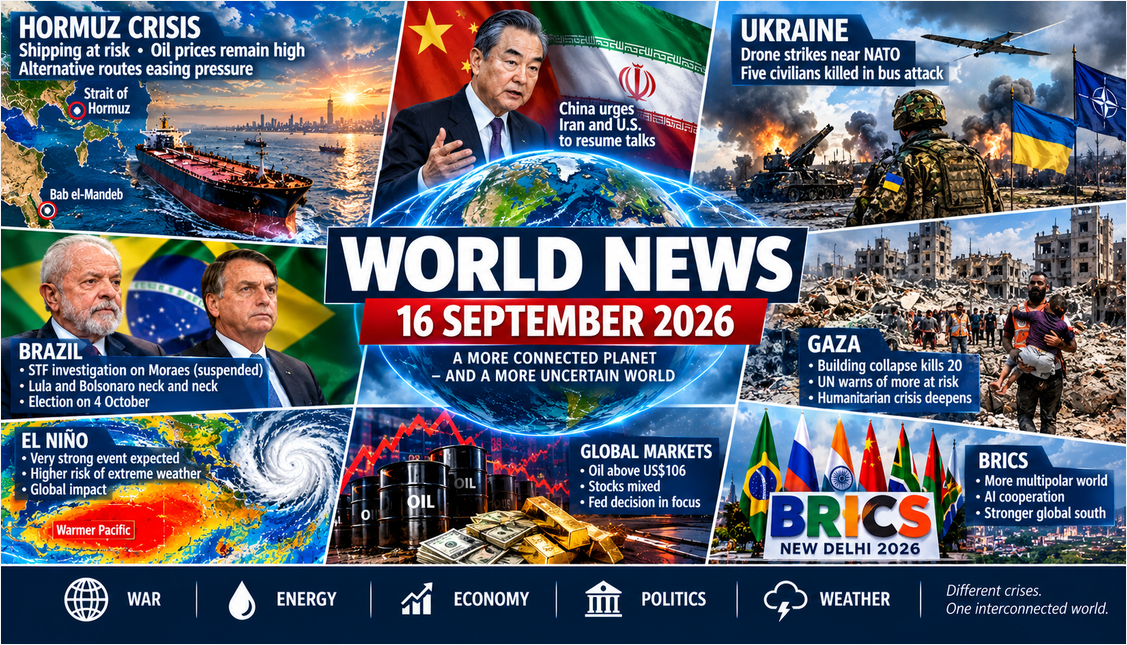
🌍 WORLD NEWS — 16 SEPTEMBER 2026
The major events shaping the world today
Wednesday, 16 September 2026
1. THE STRAIT OF HORMUZ — THE WORLD'S MOST IMPORTANT ENERGY FLASHPOINT
The Middle East war remains the most immediate threat to the international economy because the conflict is affecting the movement of oil and gas through the Strait of Hormuz.
Shipping through the strait has fallen dramatically compared with normal levels. The disruption is particularly important because Hormuz normally carries a very large share of internationally traded crude oil and liquefied natural gas.
The latest development is an attempt by Saudi Arabia to reduce the pressure by offering additional crude shipments to Asian buyers using ship-to-ship transfers off Oman. This helped push oil prices lower on Wednesday, although prices remain exceptionally high.
Brent crude was around US$107 a barrel, while U.S. crude was around US$103–104, after recent prices had risen sharply.
The Saudi alternative route is significant because it demonstrates that some oil can bypass the most dangerous part of the Gulf. But it cannot immediately replace the full capacity of Hormuz.
The crisis therefore remains extremely sensitive to every new attack, mine incident, tanker movement or diplomatic development.
Why Hormuz matters
A prolonged disruption would eventually affect:
- petrol and diesel prices;
- aviation fuel;
- shipping costs;
- electricity generation;
- industrial production;
- food transportation;
- inflation;
- interest rates;
- household living costs.
The important point is that oil does not need to stop completely for the world economy to suffer. Insurance premiums, shipping delays and uncertainty can themselves raise prices.
2. CHINA CALLS FOR U.S.–IRAN TALKS
China has moved more visibly into the diplomatic picture.
Chinese Foreign Minister Wang Yi called on Iran and the United States to show restraint, return to negotiations and reopen the Strait of Hormuz.
Beijing's position is particularly important because China is a major importer of energy from the region and has extensive economic relations with Iran.
China is therefore attempting to protect both its own energy supplies and wider international trade while avoiding direct military involvement.
Wang also warned about the danger of the conflict spreading into Yemen and the Red Sea.
The diplomatic message from Beijing is essentially:
contain the war → reopen shipping → protect energy supplies → prevent a wider regional conflict.
3. YEMEN — THE HOUTHI FRONT IS BECOMING MORE IMPORTANT
The war is no longer confined to Iran, Israel and the Gulf.
Iran-aligned Houthi forces in Yemen have expanded their military activity and have recently made significant territorial gains around the Bab el-Mandeb Strait, another critical maritime gateway.
That gives the Houthis greater ability to threaten shipping entering or leaving the Red Sea.
Saudi Arabia has responded militarily, while Saudi cities have also faced attacks.
Saudi authorities have issued security alerts covering areas including Mecca and Jeddah after a series of attacks by Iran-aligned forces.
The strategic problem is becoming increasingly complicated:
Hormuz affects the Persian Gulf.
Bab el-Mandeb affects the Red Sea.
Together they form two critical gateways connecting Middle Eastern energy with the world economy.
4. SECRET U.S.–HOUTHI CONTACTS
There is also an interesting diplomatic development beneath the military confrontation.
Reuters reports that U.S. officials met representatives of the Iran-aligned Houthis in Oman during the weekend.
The meetings indicate that, despite the fighting, channels of communication remain open.
Oman has historically played an important intermediary role in sensitive U.S.–Iran and regional negotiations.
The significance is not that a peace agreement has been reached — it has not — but that diplomacy is continuing alongside military operations.
5. OIL — THE ECONOMIC DOMINO EFFECT
The energy crisis is now moving into financial markets.
Oil has remained above US$100 per barrel, while markets are watching the Federal Reserve very closely.
On Wednesday, global stocks recovered modestly as oil prices fell from their recent highs.
The decline in oil was partly connected with Saudi Arabia's effort to increase alternative supplies.
But investors remain concerned about a difficult combination:
high oil prices + inflation + high interest rates + weaker economic growth.
That combination can create what economists call stagflationary pressure.
Central banks then face a difficult choice:
- raising interest rates can help control inflation;
- but higher rates can slow investment and economic growth.
The energy shock therefore reaches far beyond the Middle East.
6. THE U.S. FEDERAL RESERVE
The U.S. Federal Reserve's interest-rate decision is one of today's major financial events.
Markets have been pricing a high probability of a 25-basis-point rate increase.
The central problem for the Fed is that the Middle East energy shock is pushing inflationary pressure upward at exactly the time when policymakers would normally like to see inflation falling.
Markets are therefore watching not only the decision itself but also what Fed Chair Kevin Warsh says about future policy.
Oil, inflation, interest rates and government bond yields are now closely connected.
7. UKRAINE — FIVE CIVILIANS KILLED IN DRONE ATTACK
The war in Ukraine continues with heavy Russian drone activity.
A Russian drone attack in southeastern Ukraine killed at least five people and injured at least seven, according to Ukrainian authorities.
A passenger minibus was struck.
A train and locomotive in the Mykolaiv region were also hit, although passengers and crew were evacuated safely.
The attacks demonstrate the continuing vulnerability of civilian transport infrastructure even away from the immediate front line.
8. NATO — RUSSIAN-TYPE DRONE SHOT DOWN OVER LITHUANIA
A particularly important development occurred inside NATO territory.
An Italian NATO fighter jet shot down a drone that entered Lithuanian airspace.
Lithuanian President Gitanas Nausėda said the drone was probably heading toward Ukraine.
The drone was a Russian-used type, although officials were still investigating exactly how it entered Lithuania and what its mission was.
The incident is significant because Lithuania is a NATO member.
It illustrates how easily the Ukraine conflict can create incidents beyond Ukraine's borders.
This is precisely the kind of event NATO countries are watching carefully:
Ukraine war → drone navigation → neighbouring airspace → NATO response.
9. GAZA — BUILDING COLLAPSE KILLS AT LEAST 20
A seven-storey apartment building in Gaza collapsed overnight, killing at least 20 Palestinians, including six children, and injuring 14 others.
Dozens were believed to remain trapped beneath the rubble.
The building had already been damaged during the war and was being used by displaced families because there are few safe alternatives.
Rescue workers face severe shortages of heavy equipment.
The United Nations has warned that many other damaged buildings remain dangerous.
The tragedy illustrates a second-order consequence of prolonged warfare: even when fighting temporarily decreases, previously damaged buildings can continue killing people.
10. GAZA'S WIDER HUMANITARIAN PROBLEM
The building collapse is part of a much larger problem.
Large numbers of Palestinians remain displaced and many are living in damaged or overcrowded structures.
The UN has repeatedly warned about inadequate access to humanitarian assistance and the enormous difficulty of recovering bodies from destroyed buildings.
The Palestinian Civil Defence has reported recovering hundreds of bodies and human remains from beneath destroyed structures, while many more are believed to remain under rubble.
The humanitarian consequences are therefore continuing even when individual battles receive less international attention.
11. BRAZIL — THE SUPREME COURT CRISIS
Brazil has one of the most unusual political-judicial stories in the world today.
The Supreme Federal Court (STF) has postponed a decision on whether to open an investigation involving Justice Alexandre de Moraes.
The case concerns allegations involving his relationship with people connected to the failed Banco Master and its former banker Daniel Vorcaro.
Moraes denies wrongdoing and says he is the target of politically motivated attacks.
On Tuesday, the court became deeply divided during the proceedings.
Justice Flávio Dino requested more time to examine the case, suspending the decision.
The important clarification is:
Moraes has not been convicted of fraud.
The issue currently concerns whether a formal investigation should proceed.
The STF's internal disagreement has itself become a major Brazilian political story.
12. BRAZIL'S PRESIDENTIAL ELECTION
Brazil's presidential election is approaching its first round on 4 October.
Recent polling has shown a very close contest between President Luiz Inácio Lula da Silva and Senator Flávio Bolsonaro.
A recent Quaest poll reported a potential second-round result of:
Flávio Bolsonaro — 42%
Lula — 40%
The difference was within the poll's margin of error, so it should be interpreted as a measurement of opinion at the time of the survey, not as a prediction of the election result.
Other recent surveys have produced different numerical results.
That is important: polls measure public opinion at a particular moment; they do not determine the eventual result.
The STF controversy has become intertwined with the election campaign because Moraes has been a major figure in Brazil's political and judicial conflicts involving the Bolsonaro family.
13. BRAZIL — A DEEPER INSTITUTIONAL CONFLICT
The dispute is larger than one judge.
The present confrontation involves questions about:
- judicial independence;
- conflicts of interest;
- investigations of sitting Supreme Court justices;
- the limits of judicial authority;
- relations between the Supreme Court and federal police;
- political pressure before an election.
Different Brazilian political groups interpret the events very differently.
Moraes and his supporters reject allegations of improper conduct.
His critics argue that the investigation should be allowed to proceed.
The Supreme Court itself is now having to manage the dispute internally.
That makes this a significant institutional story regardless of one's political position.
14. BRICS — CHINA PUSHES A LARGER GLOBAL ROLE
The recent BRICS summit in New Delhi has placed China at the centre of a renewed discussion about the future of the Global South.
Chinese President Xi Jinping has called for stronger economic cooperation among BRICS members and partner countries.
China has promoted:
- stronger supply chains;
- increased trade;
- manufacturing cooperation;
- artificial-intelligence cooperation;
- greater economic integration.
China has also proposed a BRICS AI open-source community.
The broader objective is to strengthen economic cooperation among countries outside the traditional Western-led institutions.
However, BRICS remains a diverse group whose members have very different political and economic interests.
It should therefore not be regarded as a single unified political bloc.
15. CHINA–U.S. TECHNOLOGY COMPETITION
Another major long-term story is the growing technological competition between China and the United States.
Artificial intelligence has become one of the principal areas of competition.
The two countries are simultaneously:
- competing for advanced computer chips;
- developing increasingly powerful AI systems;
- discussing AI safety;
- restricting sensitive technology transfers;
- trying to maintain their technological advantages.
This creates an unusual situation in which Washington and Beijing are competitors while also having a shared interest in preventing dangerous AI developments.
The technology competition is therefore likely to remain one of the defining geopolitical issues of the coming decade.
16. EL NIÑO — A SECOND GLOBAL CRISIS DEVELOPING ABOVE OUR HEADS
The world's political crises are occurring at the same time as another global phenomenon: a rapidly strengthening El Niño.
The World Meteorological Organization says El Niño is expected to become very strong and to continue into early 2027.
WMO forecasts unusually warm conditions across much of the world's land areas and major changes in rainfall patterns.
El Niño can influence:
- rainfall;
- drought;
- floods;
- tropical storms;
- agricultural production;
- food prices;
- water supplies;
- fisheries;
- wildfire risk;
- heat extremes.
The exact effects vary greatly by region.
17. SOUTH AMERICA AND BRAZIL
For Brazil, El Niño can alter the normal distribution of rainfall and temperature.
That does not mean every Brazilian region will become hotter or wetter at the same time.
Brazil is enormous, and the effect differs between the South, Southeast, Central-West, Northeast and Amazon region.
For coastal São Paulo, including the Ubatuba region, local weather will still depend heavily on Atlantic conditions, frontal systems and local topography.
Nevertheless, a strong El Niño adds another large-scale atmospheric influence to the background climate.
18. UBATUBA — THE LOCAL PICTURE
For Ubatuba, the immediate situation is much quieter than the dramatic global headlines.
The present pattern is relatively cool and unsettled for mid-September, with temperatures around the low 20s Celsius and periods of cloud.
The coming days show a tendency toward increasing humidity and intermittent rain, with a greater possibility of showers and thunderstorms later in the period.
The important distinction is:
The extreme Brazilian cold reported recently in parts of the country does not mean Ubatuba itself has experienced temperatures near 5°C.
Ubatuba's maritime climate moderates temperature considerably.
19. THE WORLD ECONOMY — ONE EVENT FEEDS ANOTHER
The most important theme of today's news may actually be the connection between apparently separate events.
Consider the chain:
Middle East war
↓
Hormuz shipping disruption
↓
Higher oil and transport costs
↓
Inflation pressure
↓
Central banks keep interest rates higher
↓
Borrowing becomes more expensive
↓
Investment and consumer spending can weaken
At the same time:
Ukraine war
↓
NATO security concerns
↓
Higher defence spending
↓
Pressure on government budgets
And:
El Niño
↓
Weather disruption
↓
Agricultural losses in some regions
↓
Food-price pressure
Three apparently separate stories therefore meet in the same place:
THE GLOBAL ECONOMY.
20. SHIPPING — THE OFTEN FORGOTTEN LINK
There is another domino chain that is particularly important for someone with a maritime background.
A tanker does not operate in isolation.
Its cost includes:
- fuel;
- crew;
- insurance;
- port charges;
- security;
- navigation;
- cargo insurance;
- financing;
- delays;
- alternative routes.
When a strategic waterway becomes dangerous, all of these costs can increase.
The result can eventually reach the price of an ordinary product thousands of kilometres away.
This is why events in Hormuz, Bab el-Mandeb and the Red Sea can affect consumers who have never heard of the ships carrying the cargo.
21. THE FIVE BIG GLOBAL DOMINO CHAINS
CHAIN 1 — ENERGY
Iran conflict → Hormuz → oil → inflation → interest rates → consumers
CHAIN 2 — SHIPPING
Hormuz + Bab el-Mandeb → rerouting → delays → insurance → higher freight costs
CHAIN 3 — SECURITY
Ukraine → drones → NATO airspace → European defence concerns
CHAIN 4 — POLITICS
Brazil Supreme Court dispute → public controversy → election campaign → institutional debate
CHAIN 5 — WEATHER
El Niño → altered atmospheric circulation → rainfall/heat changes → agriculture → food prices
These chains can interact with one another.
That is what makes 2026 such an interconnected year.
22. A WORLD OF MULTIPLE CRISES
There is no single event today that explains everything happening in the world.
Instead, several systems are operating simultaneously:
WAR
Middle East, Ukraine, Gaza and Yemen.
ENERGY
Hormuz, oil, gas and shipping.
ECONOMY
Inflation, interest rates, currencies and markets.
POLITICS
Brazil's election and Supreme Court crisis.
GEOPOLITICS
China, United States, Iran, Russia, NATO and BRICS.
TECHNOLOGY
AI and the U.S.–China technological competition.
WEATHER
A powerful El Niño developing toward 2027.
These systems are not independent.
They continuously push against one another.
23. THE BIGGER PICTURE
The most striking feature of the world on 16 September 2026 is therefore not simply that there are many crises.
It is that the crises are increasingly interconnected.
A military event can become an energy event.
An energy event can become an inflation event.
Inflation can become an interest-rate event.
Interest rates can become an economic event.
Economic pressure can become a political event.
At the same time, weather can add another layer of pressure through food, water and infrastructure.
This is the modern world operating as one enormous interconnected system.
24. TODAY'S WORLD IN ONE SENTENCE
The world on 16 September 2026 is being shaped simultaneously by war, energy insecurity, economic pressure, political confrontation, technological competition and a strengthening El Niño — with events in one part of the planet increasingly producing consequences somewhere else.
That is the story behind the headlines.
SOURCES
Reuters, Associated Press, World Meteorological Organization, United Nations-related reporting and Brazilian election polling published or updated during September 2026. The political sections above distinguish reported facts, allegations and polling measurements from conclusions or predictions.