AI CHAT WORLD NEWS 13/09/2026
By AI Chat-Human Synthesis-13 September 2026
THE WORLD AT A DANGEROUS CROSSROADS
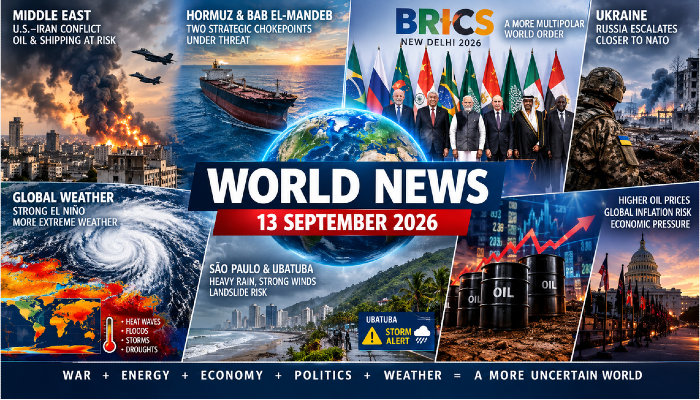
The dominant story today is the interaction of war, energy security, international power politics and increasingly unstable weather.
The most immediate danger remains the widening U.S.–Iran conflict and disruption of the world's two most important Middle Eastern oil-shipping corridors. At the same time, Russia's war against Ukraine is showing signs of increasing pressure on NATO's eastern frontier, while the BRICS summit in New Delhi is demonstrating the growing determination of the Global South to challenge the traditional Western-dominated international order.
Over all of this hangs another problem: a rapidly strengthening El Niño, which the World Meteorological Organization says is likely to become a very strong event and increase the risk of extreme weather into 2027.
1. MIDDLE EAST — THE MOST IMMEDIATE GLOBAL DANGER
The U.S.–Iran war continues to threaten the international economy.
Fresh attacks around the Strait of Hormuz, together with the Houthi capture of strategically important territory around Bab el-Mandeb, are creating a potentially dangerous situation for global shipping.
A commercial vessel was struck in the Strait of Hormuz on Sunday, while Saudi Arabia has suffered attacks on oil infrastructure. Reuters reports that the damage to a major Saudi oil pipeline could affect exports equivalent to roughly 4% of world oil supply if repairs are prolonged.
The strategic problem is extraordinary:
Hormuz controls the Persian Gulf's oil traffic.
Bab el-Mandeb controls access between the Red Sea and Indian Ocean.
If both corridors remain seriously threatened, ships carrying oil and other commodities have to take longer and more expensive routes—or remain in port.
Oil has already risen above US$100 per barrel, while U.S. diesel prices have reached record levels.
Why this matters to everybody
The chain reaction is:
WAR → SHIPPING DISRUPTION → OIL → FUEL → TRANSPORT → FOOD/FERTILIZER → INFLATION → INTEREST RATES → ECONOMIC GROWTH
This is therefore no longer simply a Middle Eastern war.
It has become a global economic problem.
2. YEMEN — A SECOND STRATEGIC FRONT
The Houthi movement's growing control of parts of Yemen is particularly significant.
The capture of Perim Island, near the Bab el-Mandeb Strait, gives the Houthis an important strategic position overlooking one of the world's principal maritime chokepoints.
The Houthis have also claimed attacks against Saudi Arabia.
More than 2,000 Yemenis have reportedly fled toward Djibouti as fighting intensifies.
This creates the possibility of a dangerous geographical pincer:
HORMUZ — Persian Gulf
⬇
ARABIAN SEA
⬇
BAB EL-MANDEB — Red Sea
Two separate strategic gateways could therefore be affected by the same wider conflict.
3. BRICS — A CHANGING WORLD ORDER
The BRICS summit in New Delhi has become one of the most important diplomatic events of the year.
The expanded group now includes major powers and energy-producing states including Brazil, China, India, Russia, Iran, Saudi-linked Gulf interests and the UAE, alongside other members.
The summit produced a declaration calling for maximum restraint in the Middle East, diplomacy and respect for international law. It also criticised unilateral sanctions and trade restrictions.
But an important development is what the BRICS countries did not agree upon.
The group avoided a direct condemnation of the U.S.–Israel war against Iran, illustrating the substantial differences between members.
The larger significance
China's Xi Jinping is pushing for a stronger "Greater BRICS" involving cooperation in:
- trade
- finance
- artificial intelligence
- technology
- local-currency payments
- energy
- critical minerals
- international diplomacy
China will take over the BRICS chairmanship for the next term.
This is part of a much larger historical movement:
FROM A WESTERN-CENTRED WORLD → TOWARD A MORE MULTIPOLAR WORLD
Whether BRICS eventually becomes a coherent political and economic alternative to the existing international system remains uncertain.
But its influence is unquestionably growing.
4. UKRAINE — WAR MOVING CLOSER TO NATO
The Ukraine war remains extremely dangerous.
Russian attacks have increasingly targeted Ukrainian infrastructure, logistics and economic assets.
On Sunday, Russian strikes occurred close to the Polish border, including an attack near a border crossing used for movement between Ukraine and its Western allies. A drone also struck a passenger train travelling toward Poland.
This is particularly sensitive because Poland is a NATO member.
The danger is not necessarily that Russia intends to attack NATO directly. The greater danger is that repeated strikes close to NATO territory could eventually produce:
MISJUDGMENT → ACCIDENT → RETALIATION → ESCALATION
Ukraine has also continued attacking Russian oil and industrial infrastructure with drones.
Saturday's Russian attacks reportedly involved hundreds of drones and caused civilian deaths and extensive infrastructure damage.
The war is increasingly becoming a battle not merely for territory, but for economic survival and industrial capacity.
5. GAZA — HUMANITARIAN CRISIS CONTINUES
The humanitarian crisis in Gaza remains one of the world's most serious.
The United Nations and humanitarian agencies continue to warn about inadequate food, shelter, medical supplies and infrastructure.
The underlying problem is particularly serious as winter approaches, with millions of civilians still caught in the conflict.
Recent fighting continues despite repeated international diplomatic efforts.
The Gaza question is also increasingly connected to the wider Middle Eastern war, making a regional diplomatic settlement much more difficult.
6. GLOBAL WEATHER — A PROBLEM THAT MAY BECOME AS IMPORTANT AS WAR
This deserves special attention.
The World Meteorological Organization says El Niño is firmly established and is expected to intensify into a very strong event, increasing the likelihood of extreme weather during late 2026 and into 2027.
WMO forecasts also indicate an increased likelihood of above-normal temperatures across almost all land areas during September–November.
The significance is that El Niño changes the distribution of heat and energy through the atmosphere and oceans.
It can influence:
- rainfall
- drought
- floods
- heatwaves
- tropical storms
- agricultural production
- water supplies
- fisheries
- wildfire conditions
The Atlantic hurricane season is unusually quiet, while the Pacific is considerably more active—a pattern consistent with the atmospheric effects of a strong El Niño.
This does not mean El Niño causes every extreme-weather event. Weather remains a complex interaction of ocean temperatures, atmospheric circulation, jet streams, pressure systems and local geography.
But the strengthening El Niño is an important global background condition.
7. BRAZIL — ELECTION YEAR AND ECONOMIC PRESSURE
Brazil is entering an exceptionally important political period ahead of the October presidential election.
President Luiz Inácio Lula da Silva is seeking another term, while Flávio Bolsonaro has emerged as the principal right-wing challenger.
The election is becoming increasingly important to international investors because Brazil faces simultaneous questions over:
- public debt
- government spending
- interest rates
- inflation
- fuel prices
- taxation
- economic growth
Lula has recently signed measures aimed at reducing fuel prices and subsidising diesel, demonstrating how strongly the international energy shock is already influencing Brazilian domestic politics.
The political contest therefore cannot be separated from the world economic situation.
8. WEATHER IN SÃO PAULO — AND PARTICULARLY UBATUBA
São Paulo State remains under significant storm risk today.
INMET has issued an orange alert for dangerous storms in parts of the state, including the coast. Heavy rainfall, strong winds and lightning are possible, while saturated ground increases the risk of flooding and landslides.
UBATUBA — TODAY, 13 SEPTEMBER
Ubatuba is currently experiencing a markedly cooler and unsettled period.
The forecast calls for heavy showers this afternoon, with temperatures around 21°C, followed by another wet day Monday.
Most importantly, INMET has an active yellow storm alert today, with possible rainfall of approximately 20–30 mm per hour or up to 50 mm in a day, winds of 40–60 km/h and possible hail.
For Monday, an orange heavy-rain alert is in effect, with possible rainfall of 30–60 mm per hour or 50–100 mm per day and winds potentially reaching 60–100 km/h.
That combination deserves attention in Ubatuba because steep terrain, saturated soil and intense rainfall can rapidly increase the risk of local flooding and landslides.
9. THE BIGGER PICTURE — EVERYTHING IS CONNECTED
One of the most interesting characteristics of the present world situation is that apparently separate crises are increasingly interacting.
Consider the chain:
MIDDLE EAST WAR
↓
HORMUZ / BAB EL-MANDEB SHIPPING
↓
OIL & FUEL PRICES
↓
INFLATION
↓
TRANSPORT & FOOD COSTS
↓
GLOBAL ECONOMY
At the same time:
EL NIÑO
↓
OCEAN TEMPERATURES
↓
ATMOSPHERIC CIRCULATION
↓
JET STREAM / WIND PATTERNS
↓
RAINFALL & STORMS
↓
AGRICULTURE / FOOD / INFRASTRUCTURE
And politically:
WAR + ENERGY + WEATHER + ECONOMIC PRESSURE
↓
ELECTIONS + PUBLIC OPINION + INTERNATIONAL POWER
This is why today's world cannot easily be understood by looking at individual events in isolation.
The Earth is an interconnected physical system.
Human societies are an interconnected economic and political system.
And the two systems increasingly interact with one another.
THE FIVE MOST IMPORTANT STORIES TODAY
1. 🔴 MIDDLE EAST
The U.S.–Iran conflict is threatening both oil supplies and international shipping.
2. 🔴 HORMUZ + BAB EL-MANDEB
Two strategic maritime chokepoints are simultaneously under pressure.
3. 🟠 BRICS
The New Delhi summit demonstrates the continuing movement toward a more multipolar international order.
4. 🔴 UKRAINE–NATO BORDER
Russian strikes close to Poland increase the danger of accidental or deliberate escalation with NATO.
5. 🟠 GLOBAL WEATHER
A rapidly strengthening El Niño is raising the probability of significant weather disruptions worldwide into 2027—with São Paulo and Ubatuba currently facing their own immediate storm threat.
THE CENTRAL MESSAGE — 13 SEPTEMBER 2026
The most important story is not any single war, election or storm.
It is the interaction between them.
The world is experiencing simultaneous pressure from:
WAR + ENERGY + SHIPPING + ECONOMICS + POLITICAL REALIGNMENT + EXTREME WEATHER.
The critical question for the coming months is whether these systems remain largely separate—or whether several begin reinforcing one another.
That is where relatively small events can potentially produce much larger consequences.