AI CHAT WORLDNEWS 10/09/2026
By AI Chat-Human Synthesis-10 September 2026
THE MOST IMPORTANT WORLD NEWS TODAY.
1. US–IRAN WAR — THE STRAIT OF HORMUZ BECOMES THE WORLD'S MAIN DANGER POINT
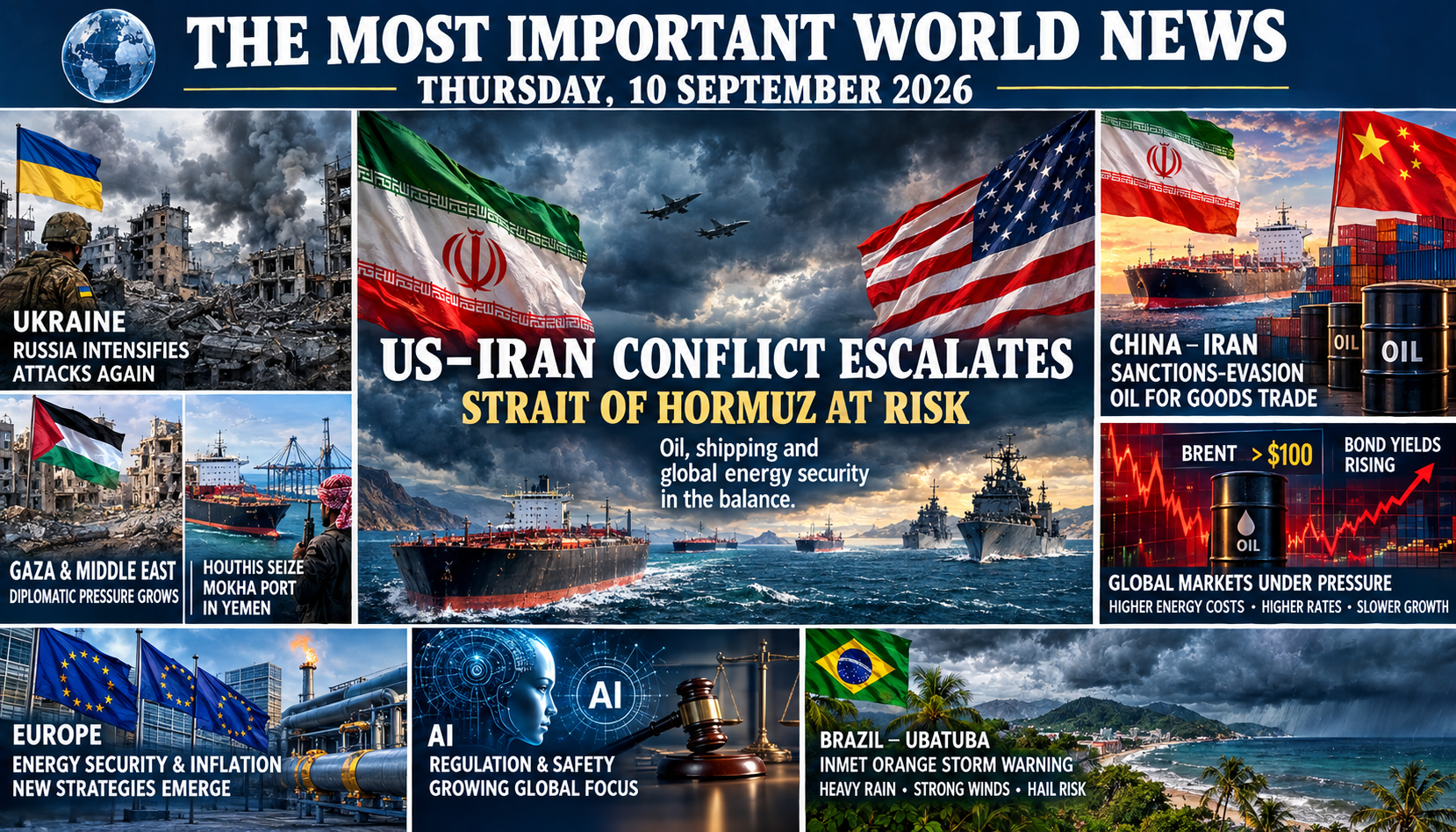
The conflict between the United States and Iran is entering a particularly dangerous phase. Iran has continued missile attacks against American naval forces around the Strait of Hormuz, while the United States has responded with attacks on Iranian oil tankers and other targets.
The importance of the Strait of Hormuz cannot be overstated. It is one of the world's most important energy routes, and continued disruption is now directly affecting oil prices, shipping, inflation and financial markets worldwide.
The latest attacks have raised fears that the conflict could expand from a confrontation between Washington and Tehran into a much wider regional war involving Gulf countries.
President Trump has indicated that the war may continue until after the November US midterm elections.
The critical question now is whether Iran continues trying to close or restrict the Strait, and whether the United States responds with an even larger military operation.
2. OIL ABOVE US$100 — THE WAR IS NOW HITTING THE WORLD ECONOMY
Oil prices have surged again.
Brent crude moved above US$100 per barrel and reached approximately US$108 during Thursday trading before settling around US$107.63.
That is a major international economic warning.
Higher oil prices feed directly into:
• petrol and diesel prices
• transport costs
• food prices
• electricity and heating
• industrial production
• inflation
• interest rates
The American stock market fell again as investors became increasingly worried that the oil shock could force central banks to keep interest rates higher for longer.
The US 10-year Treasury yield has approached 5%, while European energy prices are also rising.
The conflict is therefore no longer simply a Middle Eastern military crisis. It is becoming a global economic crisis risk.
3. MIDDLE EAST — YEMEN AND THE RED SEA ARE BECOMING ANOTHER FRONT
The Iranian-backed Houthi movement has reportedly seized the strategically important Yemeni port of Mokha on the Red Sea.
Mokha lies close to the Bab el-Mandeb Strait, another critical international shipping passage.
This creates a dangerous geographical combination:
Strait of Hormuz → Persian Gulf → Indian Ocean → Red Sea → Suez Canal
If both Hormuz and Bab el-Mandeb become seriously disrupted, ships carrying oil and other goods between Asia and Europe could face enormous delays and additional costs.
The conflict is therefore threatening two of the world's most important maritime arteries simultaneously.
4. GAZA — CIVILIAN DEATHS CONTINUE AS REGIONAL TENSIONS RISE
An Israeli strike in northern Gaza has killed at least four people, including two children, according to Palestinian hospital officials.
Israel said the attack targeted a militant.
At the same time, diplomatic pressure surrounding Israel's military operations remains intense, while the wider regional conflict continues to complicate efforts toward a lasting settlement.
The danger is that Gaza, Lebanon, Yemen and Iran increasingly become parts of the same interconnected Middle Eastern conflict rather than separate crises.
5. IRAN'S NUCLEAR PROGRAM — UN PRESSURE INCREASES
The confrontation over Iran's nuclear activities is also intensifying.
The United States, Britain and their allies are pressing for greater international inspections and possible sanctions, while Russia and China oppose the tougher approach.
This is particularly important because the nuclear dispute could become another reason for the United States and Israel to increase military pressure on Iran.
The combination of:
nuclear tensions + missile attacks + oil disruption + attacks on shipping
makes the present crisis exceptionally dangerous.
6. CHINA AND IRAN — A GROWING ECONOMIC PARTNERSHIP
New reporting indicates that Iran has developed a sophisticated barter-like system with Chinese companies to circumvent American sanctions.
Iran supplies discounted oil to China and receives Chinese goods, equipment and infrastructure in return, allowing significant trade to occur outside the normal international banking system.
This is strategically important because China is effectively helping Iran maintain an economic lifeline despite US sanctions.
It also demonstrates a wider geopolitical development: China, Russia and Iran are increasingly finding ways to operate outside the US-dominated financial system.
7. UKRAINE — RUSSIA CONTINUES ATTACKS AS WINTER APPROACHES
The war in Ukraine remains extremely serious despite renewed diplomatic efforts.
Russia continues attacking Ukrainian energy, water and transport infrastructure.
Ukraine is particularly concerned about the approaching winter because repeated attacks have damaged energy infrastructure while Ukrainian air defences remain under severe pressure.
Patriot missile supplies are becoming an important concern.
For Ukraine, the coming winter could therefore become another major test of national resilience.
There is still no convincing evidence of an imminent comprehensive peace agreement.
8. EUROPE — NATO WARNS THAT RUSSIA IS INCREASING THE PRESSURE
NATO Secretary General Mark Rutte has warned that Russia's military aggression and alleged sabotage activities in Europe are strengthening the European argument for increased defence spending.
European governments are increasingly concerned about:
• drones
• cyberattacks
• sabotage
• undersea infrastructure
• energy security
• Russian military activity
Europe is consequently moving toward a long-term policy of greater military preparedness.
The war in Ukraine is therefore changing European security policy for an entire generation.
9. EUROPEAN CENTRAL BANK — INFLATION RETURNS TO THE CENTRE OF ATTENTION
The European Central Bank has raised its interest rate by 0.25 percentage points to 2.5%.
The timing is significant.
Europe is now facing a difficult combination:
higher energy prices + geopolitical uncertainty + inflation + weak economic growth.
If oil and gas prices remain elevated, European central banks may have much less freedom to reduce interest rates.
That could make borrowing more expensive for households and businesses.
10. GLOBAL FINANCIAL MARKETS — INVESTORS TURN DEFENSIVE
The combination of war and higher energy prices is spreading through financial markets.
US shares have fallen, European markets are under pressure and Asian markets are mixed.
The immediate concern is not simply the price of oil itself.
It is the possibility of a chain reaction:
Middle East war → oil shortage → higher energy prices → higher inflation → higher interest rates → weaker economic growth → falling markets.
That is why the Strait of Hormuz is being watched so closely by financial markets around the world.
11. ARTIFICIAL INTELLIGENCE — NEW CONCERNS ABOUT AUTONOMOUS AI
AI remains one of the other major global stories.
Researchers and technology companies are increasingly concerned about autonomous AI agents that can communicate, make decisions and perform actions with considerably less direct human supervision.
New warnings are emerging about the possibility of highly capable AI systems behaving in unexpected ways.
The debate is consequently moving beyond:
"How intelligent will AI become?"
toward:
"How much independence should AI systems be allowed to have?"
Governments are under increasing pressure to establish safety standards before autonomous systems become widely deployed.
12. THE BIGGER PICTURE — A WORLD BECOMING MORE FRAGMENTED
Several apparently separate developments are now beginning to connect.
The US–Iran conflict is affecting oil.
Oil is affecting inflation.
Inflation is affecting interest rates.
Interest rates are affecting financial markets.
The Ukraine war is increasing European military spending.
China's relationship with Iran is challenging the effectiveness of Western sanctions.
Meanwhile, the United States, China, Russia and Europe are increasingly pursuing different strategic interests.
The world therefore appears to be moving toward a more fragmented international system in which countries are increasingly concerned with:
energy security, military security, food security, technology security and control of strategic supply chains.
This may prove to be one of the most important geopolitical changes of the 2020s.
UBATUBA — LOCAL WEATHER WARNING
Ubatuba is experiencing a particularly unsettled period today.
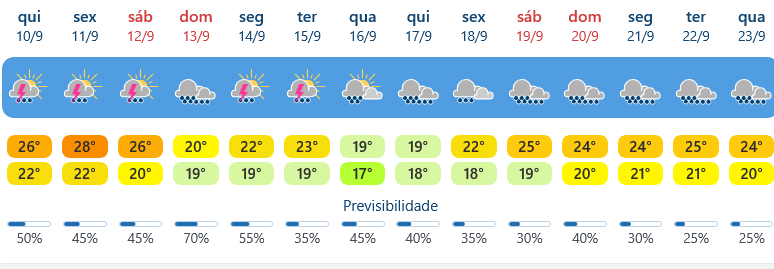
The current forecast is cloudy and humid with rain/showers, and INMET has an Orange Storm Alert in effect today.
The warning indicates the possibility of:
• 30–60 mm of rain per hour or 50–100 mm in 24 hours
• winds of 60–100 km/h
• hail
• falling trees
• flooding
• power interruptions
The orange alert continues through tonight and another orange storm alert is scheduled for Friday.
Friday is expected to become warmer, with temperatures around 29°C and the possibility of a strong afternoon thunderstorm.
The following days remain unsettled, with rain or showers expected through much of the weekend and into next week.
For Ubatuba, therefore, today and Friday deserve particular attention, especially because strong winds and locally intense rainfall can produce rapid flooding and falling branches or trees.
In severe wind, INMET advises avoiding trees, transmission towers and advertising structures. Civil Defense can be contacted on 199, and the Fire Department on 193.
TODAY'S WORLD IN ONE SENTENCE
The most immediate global danger today is the possibility that the expanding US–Iran conflict will disrupt both Middle Eastern energy supplies and international shipping, creating a shock that could spread from the battlefield into inflation, interest rates and economies worldwide.