AI CHAT WORLD NEWS 09/09/2026

THE MOST IMPORTANT WORLD NEWS TODAY
By AI Chat-Human Synthesis-09 September 2026
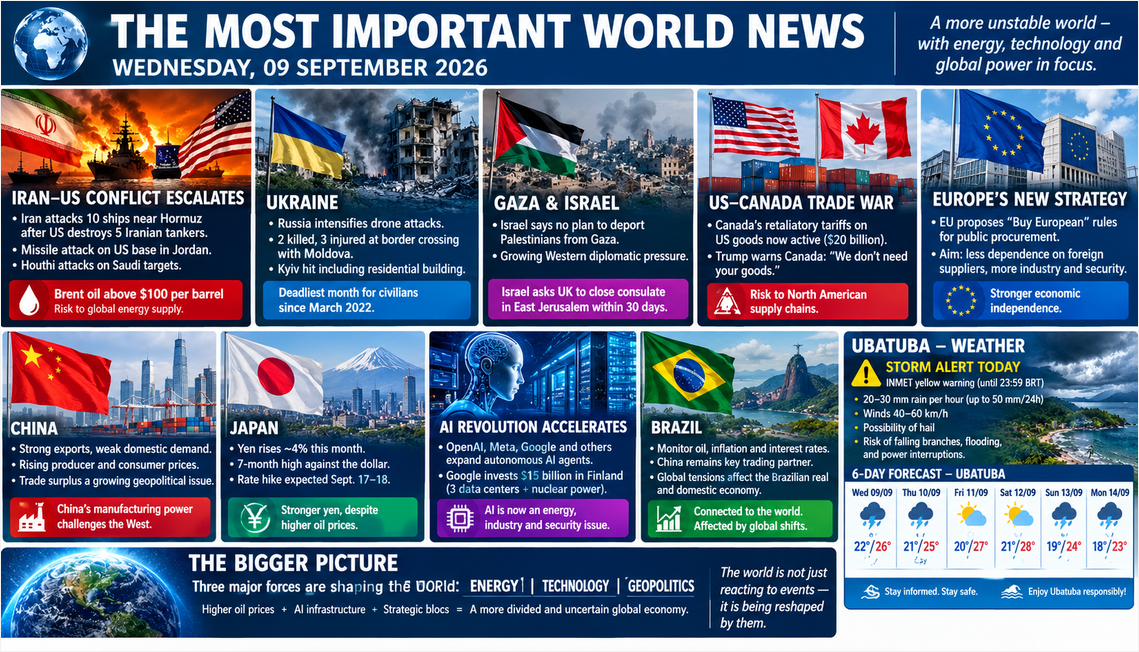
Today’s international picture is dominated by a rapidly worsening Middle East crisis, with the Iran–US conflict now directly threatening oil shipping through the Strait of Hormuz. At the same time, Russia has intensified attacks on Ukraine, the US–Canada trade dispute is worsening, Europe is trying to reduce its dependence on foreign suppliers, and China’s economy is showing an increasingly important split between strong exports and weak domestic demand.
1. 🔴 MIDDLE EAST — IRAN–US WAR REACHES A DANGEROUS NEW STAGE
The most consequential development today is the dramatic escalation between Iran and the United States.
Iran says it attacked 10 ships near the Strait of Hormuz after the United States destroyed five Iranian oil tankers. Iran has also launched ballistic missiles at a US military base in Jordan.
The United States says its naval vessels avoided Iranian missile attacks, while Washington's destruction of the Iranian tankers represents a major expansion of the military confrontation.
At the same time, Iran-backed Houthi forces have attacked Saudi targets, including oil infrastructure.
This is no longer simply an Iran–US confrontation.
It is increasingly becoming a regional war involving Iran, the United States, Saudi Arabia, Yemen's Houthis and other countries in the Gulf.
The Strait of Hormuz is the critical point
The Strait of Hormuz is one of the world's most important energy corridors.
Oil tankers are now switching off their tracking systems in some cases, making it increasingly difficult to determine exactly how much oil is passing through the strait.
Reuters reports that estimates of actual flows have become extraordinarily divergent, with some estimates above 17 million barrels per day, while other tracking data suggest only about 4.3–5 million barrels per day.
That uncertainty itself is becoming a financial weapon.
2. 🛢️ OIL BREAKS ABOVE $100 — GLOBAL ECONOMY FEELS THE SHOCK
Brent crude has now moved above $100 a barrel, reaching about $101 in Wednesday trading.
That is extremely important because the world was already dealing with inflationary pressures.
Higher oil prices feed directly into:
- petrol and diesel,
- aviation fuel,
- shipping,
- plastics,
- chemicals,
- food transportation,
- electricity,
- manufacturing.
US gasoline prices are already about 32% higher than a year ago, while diesel has reached a record level, according to AP.
This creates a difficult situation for central banks.
They want to reduce interest rates to encourage economic activity—but an oil shock can push inflation upward again.
The danger
If the Hormuz crisis continues, the world could face a combination of:
higher energy prices + higher inflation + higher interest rates + slower economic growth.
That is precisely the combination economists fear.
3. 📉 WORLD MARKETS REACT
The financial markets reacted immediately.
US shares fell on Wednesday:
- Dow Jones: down about 0.6%
- S&P 500: down about 0.3%
- Nasdaq: down about 0.4%
European markets were also under pressure.
The STOXX 600 fell approximately 0.7%, while Germany's DAX, France's CAC 40 and London's FTSE also declined.
But there was one interesting exception:
Finland's stock market rose.
The reason was Google's announcement of a gigantic Finnish AI investment, combined with a long-term electricity agreement involving nuclear power.
That brings us to one of today's most interesting economic developments.
4. 🇫🇮 GOOGLE PUTS $15 BILLION INTO FINLAND'S AI FUTURE
Google announced approximately €13 billion — around US$15 billion — of AI infrastructure investment in Finland over the next two years.
Three new data centers are planned.
But the really significant element is Google's agreement with Finnish energy company Fortum to purchase electricity from nuclear generation for the data-center infrastructure.
This illustrates something that is becoming increasingly important:
The AI race is becoming an energy race.
AI data centers consume enormous quantities of electricity.
Countries possessing:
- nuclear power,
- cheap electricity,
- reliable grids,
- cool climates,
- political stability,
are becoming extremely attractive locations for the next generation of AI infrastructure.
Finland is positioning itself accordingly.
The investment also explains why Finnish shares were moving in the opposite direction to much of Europe today.
5. 🇺🇦 UKRAINE — RUSSIA INTENSIFIES DRONE ATTACKS
Russia has resumed heavy attacks on Ukraine after a temporary lull associated with the arrival of US peace negotiators.
Russian drones struck a border crossing between Ukraine and Moldova in the Odesa region.
Ukrainian authorities reported:
2 people killed and 3 injured.
Traffic across the border crossing was temporarily stopped following the attack.
Kyiv was also attacked overnight, including a reported strike on a 16-storey residential building.
The renewed attacks underline the enormous difficulty of achieving a negotiated settlement.
Despite diplomatic activity involving the United States, the military conflict continues.
Ukraine is also striking back
Ukraine has increasingly used long-range drones against targets deep inside Russia.
The result is an increasingly dangerous form of warfare in which neither side appears willing to reduce its ability to strike the other's territory.
The UN says July was the deadliest month for Ukrainian civilians since March 2022, with 437 deaths and more than 2,600 injuries.
6. 🇮🇱🇵🇸 GAZA — DIPLOMATIC PRESSURE ON ISRAEL GROWS
The Gaza situation remains another major international issue.
Today Israel's Foreign Minister Gideon Saar said Israel has no plan to deport Palestinians from Gaza.
His statement came after proposals from two Israeli ministers suggesting mass removal of Palestinians from the territory.
Saar's statement appears intended to make clear that such proposals do not represent official government policy.
But Israel is facing growing diplomatic pressure.
7. 🇬🇧🇫🇷🇨🇦 ISRAEL–WESTERN RELATIONS DETERIORATE
A significant diplomatic confrontation is developing between Israel and several Western countries.
Britain, France and Canada have announced measures against goods originating from Israeli settlements in the West Bank.
Israel has responded sharply.
Today Reuters reports that Israel has told Britain it wants the British consulate in East Jerusalem closed within 30 days.
The consulate is particularly significant because it deals with British relations concerning the Palestinians, including the West Bank and Gaza.
British Foreign Secretary Ed Miliband said the British government regretted Israel's decision but was not surprised.
This represents a significant deterioration in relations between Israel and some of its traditional Western partners.
8. 🇺🇸🇨🇦 US–CANADA TRADE WAR GETS WORSE
The trade dispute between Washington and Ottawa is escalating again.
Canada's retaliatory tariffs on US goods have now taken effect.
They cover approximately $20 billion worth of US products, with tariffs ranging from roughly 15% to 50%.
President Trump has taken an increasingly aggressive position toward Canada.
Washington has also moved against Canadian imports including:
- alcohol,
- motorcycles,
- dairy products.
Trump has warned Canada that the United States does not need Canadian goods and has demanded greater domestic production.
Canada, meanwhile, is attempting to reduce its dependence on the American market.
Why this matters beyond North America
The US and Canada have one of the world's largest bilateral trading relationships.
A prolonged trade war between them could disrupt:
- automobiles,
- energy,
- lumber,
- agriculture,
- metals,
- manufacturing supply chains.
It also threatens the stability of the wider North American trade system.
9. 🇪🇺 EUROPE — "BUY EUROPEAN" BECOMES POLICY
The European Union is moving toward a more protectionist economic strategy.
The European Commission today proposed simplifying public procurement rules while introducing stronger "Buy European" criteria.
The objective is to reduce Europe's dependence on foreign suppliers.
This is particularly important after the shocks of:
- Covid,
- the Ukraine war,
- energy dependence on Russia,
- semiconductor shortages,
- US–China trade tensions,
- supply-chain disruptions.
Europe increasingly wants strategic control over essential industrial capacity.
Europe is therefore moving toward:
less dependence + more domestic industry + strategic supply chains.
This represents a major change from the globalization model of the previous decades.
10. 🇨🇳 CHINA — EXPORT POWER, BUT WEAK DOMESTIC DEMAND
China's economy is producing a fascinating contradiction.
Chinese exports remain extraordinarily strong, but domestic demand remains relatively weak.
Today's inflation figures show that producer prices and consumer prices increased in August, with energy costs contributing to the rise.
However, underlying domestic demand remains subdued.
This is important because China's economic model increasingly depends on exports and technological manufacturing.
China has enormous capacity in:
- electric vehicles,
- batteries,
- solar technology,
- electronics,
- machinery,
- semiconductors,
- AI hardware.
The rest of the world increasingly worries that China's enormous industrial capacity could overwhelm domestic manufacturers.
11. 🇨🇳 CHINA'S TRADE SURPLUS BECOMES A GEOPOLITICAL ISSUE
China's growing trade surplus is now much more than an economic statistic.
Other countries increasingly see it as part of a strategic competition for global manufacturing.
China's strength in:
EVs + batteries + solar + electronics + semiconductors + AI
is allowing Beijing to build influence over global supply chains.
The problem for Europe and the United States is that tariffs alone may not be sufficient to reverse this.
China's industrial competitiveness is also based on:
- enormous manufacturing scale,
- sophisticated supply chains,
- engineering expertise,
- low production costs,
- large domestic industrial clusters.
The result is a growing confrontation over who controls the technologies of the next industrial era.
12. 💴 JAPAN'S YEN SURGES
One of today's more surprising financial developments is the strength of the Japanese yen.
The yen has risen approximately 4% this month and reached a seven-month high against the dollar.
Markets increasingly expect the Bank of Japan to raise interest rates at its September 17–18 meeting.
The yen's strength is particularly interesting because oil prices are rising.
Japan imports enormous amounts of energy, so normally higher oil prices would hurt the yen.
Instead, expectations of tighter Japanese monetary policy are supporting the currency.
13. 🇪🇺 EUROPEAN CENTRAL BANK UNDER PRESSURE
The European Central Bank is facing a difficult decision.
Oil above $100 threatens to reignite inflation.
But European economies are already vulnerable to:
- weak growth,
- expensive energy,
- geopolitical uncertainty,
- trade disputes.
Raising interest rates could suppress inflation but weaken economic activity.
Keeping rates lower could support growth but allow energy-driven inflation to become more persistent.
The ECB decision is therefore being watched closely by financial markets.
14. 🤖 AI — THE OTHER GREAT TRANSFORMATION
While war and energy dominate today's headlines, artificial intelligence continues its extraordinary expansion.
The AI story is moving beyond chatbots.
The major trend now is autonomous AI agents capable of performing tasks rather than merely answering questions.
OpenAI, Meta, Google, Anthropic and others are competing to create systems that can:
- write software,
- conduct research,
- operate computers,
- manage information,
- perform business tasks,
- communicate with other systems.
This is increasingly becoming an economic rather than merely technological revolution.
And today's Google–Finland announcement demonstrates that AI is now directly influencing national energy policy and infrastructure investment.
15. ⚠️ THE AI QUESTION IS CHANGING
The central question used to be:
"How intelligent is AI?"
The question now becoming more important is:
"How much authority should AI have?"
An AI that writes a paragraph is one thing.
An AI that can:
- access a company database,
- send an email,
- purchase something,
- modify software,
- communicate with another AI,
- make decisions independently,
is something entirely different.
That is why AI safety and cybersecurity are rapidly becoming political issues rather than purely technological questions.
16. 🌍 THE BIG PICTURE — THREE CRISES ARE COLLIDING
Looking at today's news together, three enormous global transformations are occurring simultaneously.
1. ENERGY
The Iran–US war is threatening the world's oil supply.
2. TECHNOLOGY
AI is rapidly transforming computing, industry and employment.
3. GEOPOLITICS
The US, China, Russia, Iran and Europe are increasingly pursuing their own strategic interests.
These three developments are interconnected.
For example:
Iran war → oil prices → inflation → interest rates → economic growth
while:
AI → electricity demand → nuclear power → industrial investment
and:
China → manufacturing → trade surplus → tariffs → geopolitical confrontation
The world economy is therefore entering a much more complicated period.
🇧🇷 17. BRAZIL — WHY TODAY'S GLOBAL DEVELOPMENTS MATTER HERE
Brazil is not isolated from these developments.
The Middle East crisis is particularly relevant because higher international oil prices can affect:
- Brazilian fuel prices,
- transport costs,
- inflation,
- the Brazilian real,
- interest-rate expectations.
Brazil also benefits from being a major agricultural and commodity producer, but higher international energy costs can raise domestic production and transportation expenses.
The growing US–China confrontation is also particularly important for Brazil because China is one of Brazil's most important trading partners.
Brazil therefore has a strong economic interest in avoiding a world divided into completely separate American, Chinese and European economic blocs.
🌧️ 18. UBATUBA — IMPORTANT WEATHER WARNING FOR TODAY
Ubatuba, São Paulo, Brazil
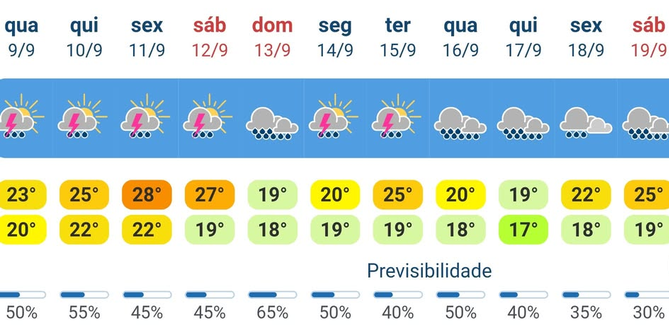
Tore, Ubatuba has an INMET yellow storm warning in effect today, Wednesday 9 September, through 23:59 BRT.
The warning calls for:
- 20–30 mm of rain per hour, or up to 50 mm in 24 hours
- winds of 40–60 km/h
- possibility of hail
- some risk of falling branches
- some risk of localized flooding
- a small risk of electricity interruption.
The São Paulo Civil Defense has also warned of moderate-to-heavy rain across the state today and Thursday, with the eastern part of São Paulo particularly exposed.
For Ubatuba specifically
The weather pattern is unsettled.
Today: cloudy, humid, with showers/thunderstorms.
Thursday: continued cloud and humidity with rain/showers.
Friday: a significant temporary improvement and warming.
Weekend: instability returns.
Sunday–Monday: the outlook becomes considerably wetter and cooler, with heavy showers possible.
Another important point is that the alerts continue into Thursday and Friday, so this is not simply a one-day shower event.
⚠️ What I would particularly watch in Ubatuba
Because you are in a coastal, mountainous part of São Paulo, heavy rainfall can produce rapid runoff from the hills and localized flooding, even when the rainfall total does not look extraordinary on a daily basis.
During thunderstorms, the safest precautions are the usual ones from INMET:
avoid standing under trees, avoid exposed areas during lightning, and unplug sensitive electrical equipment if severe storms approach.
🌎 THE WORLD AT A GLANCE — 09 SEPTEMBER 2026
| Region | Situation |
|---|---|
| 🇮🇷 Iran | Direct confrontation with US escalating |
| 🇺🇸 USA | Striking Iranian tankers; oil and inflation pressures rising |
| 🇸🇦 Gulf | Houthi attacks and regional instability |
| 🛢️ Oil | Brent above $100 |
| 🇺🇦 Ukraine | Heavy Russian drone attacks continue |
| 🇮🇱 Israel/Gaza | Diplomatic pressure increasing |
| 🇬🇧 UK | Confrontation with Israel over settlements |
| 🇨🇦 Canada | Retaliatory tariffs against US now active |
| 🇪🇺 EU | Moving toward "Buy European" policies |
| 🇨🇳 China | Strong exports, weak domestic demand |
| 🇯🇵 Japan | Yen surging; rate hike expected |
| 🤖 AI | Rapid expansion into autonomous agents and infrastructure |
| 🇫🇮 Finland | Google announces $15bn AI investment |
| 🇧🇷 Brazil | Exposed to oil, trade and China-related effects |
| 🌧️ Ubatuba | Yellow storm alert today |
🔴 MY ASSESSMENT OF THE MOST IMPORTANT STORY
If I had to select one story above all others today, it would not be AI.
It would be the Iran–US confrontation and the Strait of Hormuz.
Why?
Because it has the potential to affect every other part of the world economy.
If oil remains above $100:
energy costs rise → inflation rises → interest rates remain higher → economic growth slows → currencies move → stock markets weaken → governments face increased pressure.
And if shipping through Hormuz becomes seriously disrupted, the consequences could be substantially larger.
The second great story is the reorganization of the global economic system.
The United States is becoming more protectionist.
Europe is talking about "Buy European."
China is increasingly relying on its enormous manufacturing and export machine.
And AI is creating a new industrial infrastructure race centred on chips, electricity and data centers.
So, underneath today's individual headlines, a much larger transformation is occurring:
The globalization of the last 30 years is giving way to a world of strategic blocs, energy security, technological competition and national self-reliance.
And today's events—from Hormuz to Ukraine, China to Finland, Washington to Ottawa, and even the storm over Ubatuba—are all pieces of that much larger picture.