AI CHAT WORLD NEWS 06/09/2026
THE MOST IMPORTANT WORLD NEWS SUNDAY 06/09/2026
By AI Chat-Human Synthesis-06 September 2026
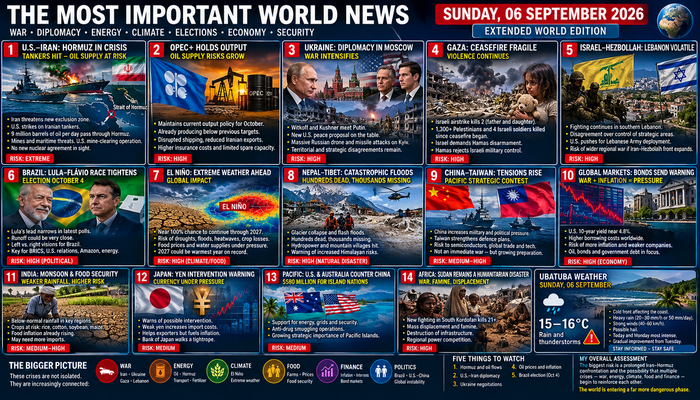
Today’s biggest story is unmistakably the rapid deterioration of the U.S.–Iran confrontation around the Strait of Hormuz. At the same time, the Russia–Ukraine war is again producing intense diplomacy without a ceasefire, Gaza remains unstable despite the ceasefire framework, and extreme weather is becoming a major global strategic issue.
1. 🇺🇸🇮🇷 U.S.–IRAN: HORMUZ IS NOW THE WORLD’S MOST DANGEROUS FLASHPOINT
The confrontation between Washington and Tehran has entered a particularly dangerous phase.
Iran says it will establish a new exclusion zone near the Strait of Hormuz, threatening vessels entering the designated area. This follows U.S. strikes on three Iranian oil tankers after Iranian missile attacks on U.S. naval forces.
The significance goes far beyond Iran itself. Hormuz carries roughly 9 million barrels of oil per day, making the waterway one of the most important energy arteries on Earth. Shipping remains severely disrupted, while insurance costs and the risks to commercial vessels are rising.
The United States is also confronting a less visible problem: mines and maritime threats. The U.S. has reportedly conducted a months-long covert mine-clearing operation using SEALs, unmanned vessels and submersibles.
The diplomatic outlook is poor. U.S. Energy Secretary Chris Wright said Sunday that Washington may not reach a new nuclear agreement with Iran, while maintaining that military pressure remains an option.
Why it matters:
This is no longer simply a dispute over Iran's nuclear programme. It has become a struggle over oil exports, naval control, sanctions and freedom of navigation.
2. 🛢️ OPEC+ HOLDS ITS POSITION AS OIL SUPPLY RISKS GROW
OPEC+ decided Sunday to maintain its current oil-output policy for October.
That decision comes while the organisation is already producing substantially below some previous targets because of the disruption caused by the Iran conflict.
The market is therefore facing an unusual combination:
- disrupted shipping;
- reduced Iranian exports;
- military risk around Hormuz;
- higher insurance costs;
- uncertainty over U.S. military operations;
- and limited spare production capacity.
The danger is not necessarily an immediate oil-price explosion. The bigger danger is that a prolonged Hormuz crisis begins feeding into transport, manufacturing, food prices and inflation worldwide.
3. 🇺🇦🇷🇺 UKRAINE: DIPLOMACY IN MOSCOW, WAR IN THE AIR
U.S. envoys Steve Witkoff and Jared Kushner have been in Moscow meeting Vladimir Putin in an attempt to move the Russia–Ukraine conflict toward a settlement.
But the contradiction is striking: diplomacy is advancing at the same moment that Russian attacks are intensifying.
President Zelenskyy has linked Russian attacks on Kyiv and Boryspil airports to the presence of the American envoys and their possible subsequent visit to Ukraine. Russia recently launched a major wave involving ballistic missiles and 167 attack drones, according to Ukrainian officials.
Putin says Russia is making battlefield progress and insists that the “root causes” of the conflict must be addressed.
The central obstacle remains the same:
Moscow wants territorial and strategic concessions. Kyiv does not want to surrender territory or its long-term Western alignment.
My assessment
There is now a genuine diplomatic channel, but a negotiated peace still looks considerably further away than the existence of talks might suggest.
4. 🇵🇸🇮🇱 GAZA: CEASEFIRE EXISTS — BUT THE VIOLENCE HAS NOT ENDED
An Israeli airstrike in western Gaza City on Sunday killed a man and his eight-year-old daughter, according to Palestinian medical officials. Israel said it was targeting a Hamas militant and was still assessing the result.
The situation illustrates the fundamental weakness of the existing ceasefire arrangement.
Since the ceasefire began, more than 1,300 Palestinians and four Israeli soldiers have reportedly been killed, according to Reuters' latest account.
The wider disagreement remains enormous:
- Israel demands security and Hamas disarmament.
- Hamas rejects Israeli military control.
- Palestinians fear permanent displacement.
- Israel's far-right political forces continue to discuss population removal.
- Washington is attempting to keep the broader peace framework alive.
The ceasefire is therefore better understood as a fragile containment mechanism, rather than genuine peace.
5. 🇱🇧 ISRAEL–HEZBOLLAH: SOUTHERN LEBANON REMAINS VOLATILE
The Israel–Hezbollah confrontation is another potential route toward a much wider regional war.
Despite the ceasefire framework, fighting around strategic positions in southern Lebanon has continued. Israel and Hezbollah disagree fundamentally over who should control strategically important territory.
Washington has been pushing for the Lebanese Army to take greater control.
If the Lebanon front expands simultaneously with the Iran confrontation, the strategic situation becomes dramatically more dangerous because Hezbollah is closely connected to Tehran.
6. 🇧🇷 BRAZIL: LULA–FLÁVIO ELECTION RACE TIGHTENS
Brazil is moving rapidly toward its October presidential election.
The latest Datafolha poll reported by Reuters shows Lula's advantage over Flávio Bolsonaro narrowing sharply.
This is politically significant because the election is increasingly becoming a direct contest between two very different visions of Brazil:
Lula
- centre-left economic and social programme;
- stronger state involvement;
- closer ties with BRICS and the Global South;
- emphasis on international diplomacy.
Flávio Bolsonaro
- conservative electorate;
- stronger security emphasis;
- closer political relationship with the United States;
- continuation of the Bolsonaro political movement.
The narrowing margin means Brazil's election is becoming one of the world's most consequential political contests for 2026.
7. 🌎 EL NIÑO: A GLOBAL WEATHER WARNING
The World Meteorological Organization says the current El Niño has a near-100% probability of continuing through February 2027 and could become the strongest El Niño ever recorded.
This matters because El Niño can produce radically different effects in different parts of the world:
- drought in some agricultural regions;
- extreme rainfall elsewhere;
- flooding;
- heatwaves;
- disruption of food production;
- pressure on water supplies;
- stronger climate extremes.
The WMO has already warned that 2027 could become the warmest year on record.
This is not merely a climate story. It is increasingly an economic and geopolitical story.
8. 🏔️ NEPAL–TIBET: THE CATASTROPHIC FLOOD DISASTER
The enormous Himalayan disaster caused by glacier collapse and flash flooding continues to reveal an extraordinarily large humanitarian toll.
Reports from late August placed the combined Nepal–Tibet death toll in the hundreds, with thousands reported missing as rescue and recovery operations continued.
The disaster is particularly disturbing because of the vulnerability of hydropower projects, mountain settlements and infrastructure concentrated in narrow valleys.
It is another warning about the combination of:
rapidly changing Himalayan conditions + glacial instability + heavily developed mountain valleys.
9. 🇨🇳🇹🇼 CHINA–TAIWAN: THE LONG-TERM FLASHPOINT
Taiwan remains one of the world's most dangerous potential conflict zones.
China continues to apply military and political pressure against Taiwan, while Taiwan is adapting its defence planning to the possibility of a prolonged conflict.
The significance extends far beyond Taiwan itself.
A war there could simultaneously disrupt:
- semiconductor production;
- global shipping;
- Japanese security;
- U.S.–China relations;
- global technology supply chains;
- financial markets.
For now, this remains a strategic confrontation rather than an immediate war, but the military preparation on both sides is increasingly serious.
10. 💰 GLOBAL ECONOMY: GEOPOLITICS IS BECOMING INFLATIONARY
The Iran confrontation is now affecting financial markets directly.
Gulf stock markets ended Sunday mixed as investors assessed the possibility of further U.S.–Iran escalation.
The dangerous combination is:
war → oil disruption → higher energy prices → inflation → higher interest rates → weaker economies.
And this comes at a time when global bond markets have already been under pressure.
The world economy therefore faces a strange paradox: governments want lower interest rates and stronger growth, but geopolitical shocks are pushing inflation in the opposite direction.
11. 🇮🇳 INDIA: MONSOON AND FOOD SECURITY
India remains vulnerable to increasingly uneven weather patterns.
Weak or irregular rainfall during important crop-development periods can affect cotton, soybean, maize and rice production and subsequently influence food prices.
This becomes particularly important in a year when El Niño is strengthening.
India is therefore one of the countries I would watch closely for the intersection between climate, agriculture and inflation.
12. 🇯🇵 JAPAN: THE YEN AND THE INTERVENTION QUESTION
Japan continues to face pressure from a weak yen and the resulting increase in import costs.
Tokyo has repeatedly warned that it is prepared to intervene if currency movements become excessive.
A renewed intervention could become significant for global financial markets because Japan remains one of the world's largest pools of capital.
🇧🇷 Ubatuba Weather — Sunday, 6 September
Ubatuba is experiencing the other side of today's global weather story: a strong cold front and unsettled coastal conditions.
Current conditions are around 15–16°C with rain, and INMET has yellow alerts for storms, heavy rainfall, coastal winds and falling temperatures. Rainfall may reach 20–30 mm/hour or 50 mm/day, with winds of 40–60 km/h and possible hail.
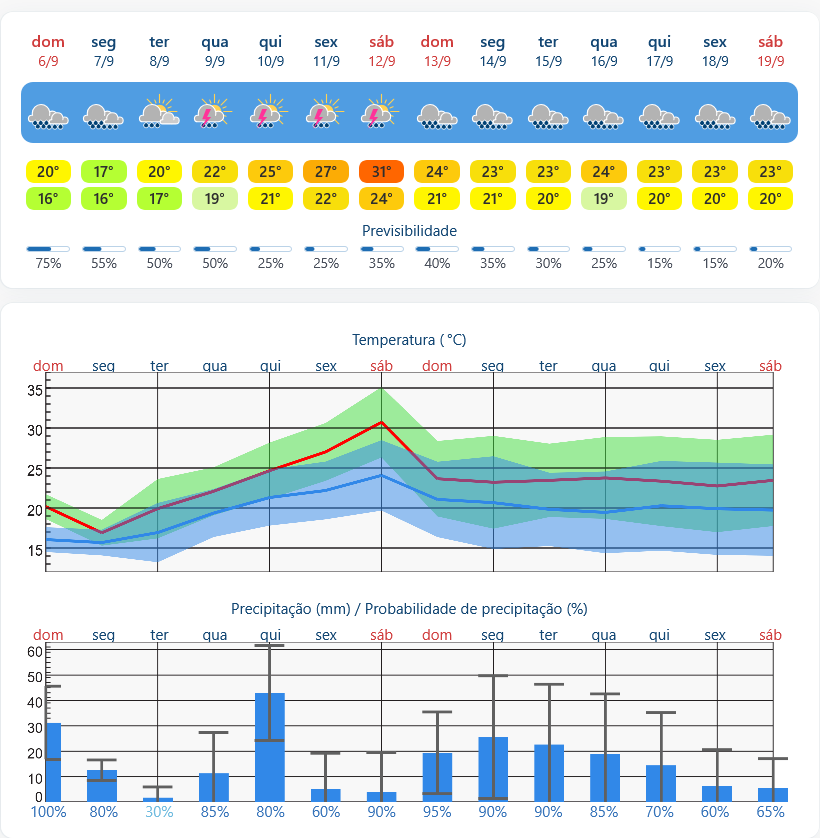
The important point for Ubatuba is that today and Monday are the uncomfortable part of the weather sequence. The temperature should begin recovering Tuesday, with considerably warmer conditions later in the week.
🌍 THE BIGGER PICTURE
What is striking about Sunday, 6 September 2026 is how many apparently separate crises are beginning to interact.
The central chain is:
Iran/Hormuz → oil → inflation → financial markets
while simultaneously:
Ukraine → Russia/West confrontation → European security
and:
El Niño → food → water → migration → political instability
At the same time:
Gaza + Lebanon + Iran → risk of a wider Middle Eastern war
And beneath all of this:
U.S.–China rivalry → Taiwan → technology → global trade
These are no longer completely separate stories.
🔭 FIVE THINGS I WOULD WATCH THIS WEEK
1. Hormuz
Does commercial shipping begin returning to normal — or does Iran actually enforce its proposed exclusion zone?
2. U.S.–Iran diplomacy
Can Washington and Tehran establish a credible channel before another major military exchange?
3. Ukraine
Do the Moscow talks produce a framework for negotiations, or merely another diplomatic pause?
4. Oil
Any sustained move toward a major oil-price spike would quickly become a global economic story.
5. Brazil
Watch the next Brazilian polls carefully. If the Lula–Flávio race continues tightening, Brazil's election will become an increasingly important global political event.
MY OVERALL ASSESSMENT — 6 SEPTEMBER 2026
The most dangerous development today is not Gaza or Ukraine individually. It is the possibility that the Iran–Hormuz confrontation becomes a prolonged international economic crisis.
The world is simultaneously dealing with three forms of instability:
military instability — Iran, Ukraine, Gaza, Lebanon
economic instability — oil, inflation, currencies and bonds
environmental instability — El Niño, floods, heat and food production
The greatest risk is therefore interaction between crises.
A contained war can be absorbed.
A contained climate event can be managed.
A contained financial shock can be stabilised.
But when war + energy + inflation + climate + food begin reinforcing one another, the consequences become much harder to control.