TODAYS AI CHAT WORLD NEWS 04/09/2026
By AI Chat-Human Synthesis-04 September 2026
THE MOST IMPORTANT WORLD NEWS TODAY
EXTENDED EDITION
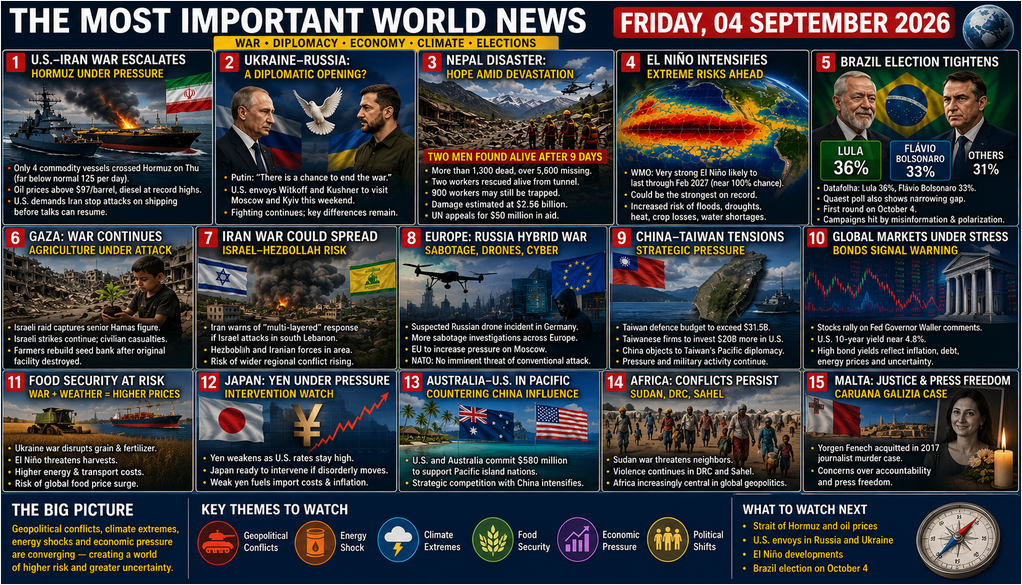
The dominant story remains the U.S.–Iran war and the crisis around the Strait of Hormuz, but three other developments deserve almost equal attention: a possible new opening in Russia–Ukraine diplomacy, the catastrophic Nepal/Tibet floods, and the emergence of an exceptionally powerful El Niño.
🔴 1. U.S.–IRAN WAR — HORMUZ BECOMES THE WORLD'S BIGGEST ECONOMIC PRESSURE POINT
The Middle East remains the most dangerous geopolitical flashpoint.
The United States and Iran have resumed serious military exchanges, while Washington is demanding that Iran stop attacks on commercial shipping before talks can resume. Vice President JD Vance said the U.S. still has military options available.
Iran, meanwhile, is warning that any further American attack could produce an “asymmetrical” and “multi-layered” response.
The most worrying development for the world economy is the Strait of Hormuz.
Only four commodity vessels crossed the strait on Thursday, dramatically below the recent 10-day average of about 15. Before the war, roughly 125 commercial vessels a day passed through the waterway.
This matters enormously because Hormuz carries a major portion of the world's oil and LNG trade.
Oil and fuel
Oil prices are now heading for their strongest weekly rise since mid-July, with Brent moving above $97 per barrel. U.S. diesel prices have reached record levels.
That creates a dangerous chain:
Iran war → shipping disruption → higher oil → higher diesel → higher transport costs → higher food prices → renewed inflation → higher interest rates.
My assessment
This is no longer simply a regional war.
Hormuz has become a potential global economic weapon.
If the disruption persists into the autumn, governments will increasingly have to choose between fighting inflation and protecting economic growth.
🟠 2. UKRAINE–RUSSIA — A SMALL BUT IMPORTANT OPENING FOR PEACE
There is unexpectedly more diplomatic movement around Ukraine.
Russian President Vladimir Putin said Thursday that there is a possibility of reaching an agreement to end the war.
At the same time, Ukrainian President Volodymyr Zelenskyy said U.S. negotiators are expected to visit both Kyiv and Moscow in the coming days.
Reuters reports that Trump's envoys Steve Witkoff and Jared Kushner are expected to travel to Russia and Ukraine this weekend, although the Kremlin has not confirmed the schedule.
But don't mistake diplomacy for peace
The fighting has not stopped.
Russia and Ukraine continue long-range attacks, and serious disagreements remain over territory, security guarantees and the future status of Ukrainian territory.
Nevertheless, this is one of the more significant diplomatic openings seen for some time.
The bigger significance
If Washington could achieve a meaningful Ukraine settlement while simultaneously dealing with Iran, Trump's administration would gain a major foreign-policy achievement.
But the opposite is also possible:
If the Iran war consumes American diplomatic and military attention, Ukraine could become secondary again.
🔴 3. NEPAL/TIBET — CATASTROPHIC FLOOD DISASTER
The Himalayan disaster continues to become more extraordinary.
A glacier collapse and enormous flash flood struck the Trishuli River region on 26 August.
The latest reports put the death toll at more than 1,300, with over 5,600 people still missing. Around 900 workers may still be trapped in tunnels associated with hydropower projects.
But Friday brought an extraordinary moment of hope.
TWO MEN FOUND ALIVE
Nine days after the disaster, rescuers pulled two hydropower workers alive from a buried tunnel.
They had survived deep underground after the flood destroyed much of the surrounding infrastructure. Both were taken for medical treatment.
The disaster has destroyed thousands of homes and caused an estimated $2.56 billion in damage.
The UN has launched an appeal of roughly $50 million for emergency assistance.
Why this matters beyond Nepal
This is not merely a natural disaster.
It is another warning about the increasing vulnerability of Himalayan communities to:
- glacier instability
- extreme rainfall
- flash flooding
- landslides
- hydropower infrastructure failure
- rapidly changing mountain environments
And it arrives just as the WMO is warning of an exceptionally strong El Niño.
🔴 4. EL NIÑO — THE CLIMATE STORY THAT COULD DOMINATE 2027
This may ultimately prove to be one of the most consequential stories of the year.
The World Meteorological Organization says the current El Niño is expected to intensify into a very strong event.
The probability that it will continue through February 2027 is close to 100%.
Sea-surface temperatures in the tropical Pacific are already exceptionally high.
The WMO warns of increased risks of:
floods + drought + extreme heat + disrupted agriculture + fisheries disruption + water shortages + supply-chain problems.
Reuters reports that the event could potentially become the strongest El Niño ever recorded.
Particularly important for South America
El Niño has major consequences for Latin America.
Different regions experience opposite effects — some receive excessive rainfall and flooding while others suffer drought.
For Brazil, therefore, this deserves close attention during the coming months.
A particularly striking warning
The WMO has suggested that 2027 could potentially become the warmest year on record, depending on how the El Niño develops.
🟠 5. BRAZIL — LULA VS. FLÁVIO BOLSONARO GETS MUCH CLOSER
Brazil's presidential election is becoming considerably more competitive.
The latest Datafolha polling shows President Luiz Inácio Lula da Silva's lead over Flávio Bolsonaro narrowing substantially.
A separate Quaest poll has also shown the gap narrowing.
The first round is scheduled for 4 October.
Why this election is becoming internationally important
Brazil is:
- the largest country in Latin America
- a major BRICS power
- an agricultural superpower
- an important oil producer
- central to Amazon policy
- increasingly important in the global debate over multipolarity
Lula's campaign is reportedly becoming more cautious because of concerns over misinformation, AI-generated political material, foreign interference and increasing polarization.
My assessment
The Brazilian election is now becoming one of the world's most consequential elections of 2026.
The possibility of a genuinely competitive Lula–Bolsonaro-family contest means Brazil's political direction is far from settled.
🟠 6. GAZA — THE WAR CONTINUES DESPITE DIPLOMATIC EFFORTS
The Gaza situation remains unresolved.
Israeli forces recently captured a senior Hamas figure during a raid in Gaza City, while Israeli attacks have continued to cause civilian casualties.
At the same time, Gaza's agricultural infrastructure has been devastated.
One particularly poignant development concerns efforts by Palestinian farmers to rebuild a local seed bank after the original facility, containing dozens of native crop varieties, was destroyed during the war.
This is a small story compared with the military operations — but symbolically important.
It represents an attempt to preserve something of Gaza's agricultural and cultural identity amid destruction.
🟠 7. ISRAEL–LEBANON–IRAN — A SECOND FRONT COULD OPEN
Another potentially dangerous development is emerging in southern Lebanon.
Iran has warned Washington that it would respond forcefully if Israel attacks a strategic mountainous area where Iranian military personnel are reportedly positioned alongside Hezbollah fighters.
This is important because the Middle Eastern conflict could potentially develop into a chain reaction:
Iran → Israel → Hezbollah → Lebanon → U.S.
The longer the Iran war continues, the greater the danger that additional actors become directly involved.
🟠 8. EUROPE — RUSSIA'S "HYBRID WAR" BECOMES A SERIOUS CONCERN
European governments are becoming increasingly worried about sabotage, drones, cyber operations and other forms of covert activity attributed to Russia.
The EU has promised to increase pressure on Moscow after a suspected Russian-linked drone incident in Germany, while Germany is investigating additional suspected sabotage incidents.
This represents a different kind of conflict.
It does not necessarily mean Russia is preparing to attack NATO militarily.
Instead, Europe increasingly fears a grey-zone conflict involving:
- cyberattacks
- sabotage
- espionage
- infrastructure disruption
- drones
- disinformation
- political interference
NATO has nevertheless said there is currently no imminent threat of a conventional Russian attack on the alliance.
🟡 9. CHINA–TAIWAN — THE STRATEGIC PRESSURE CONTINUES
China continues increasing political and strategic pressure around Taiwan.
Taiwan has announced that its planned defence spending will exceed T$1 trillion — about US$31.5 billion — next year for the first time.
Taiwanese companies are also planning approximately $20 billion of additional investment in the United States.
Meanwhile, China has objected to Taiwan's participation in Pacific diplomatic activities.
The broader trend
Asia is increasingly dividing into overlapping security and economic networks:
China–Russia–Iran
versus increasingly coordinated
U.S.–Japan–Australia–India–Taiwan partnerships.
But many Asian countries are trying to avoid choosing one side completely.
That balancing act will become increasingly difficult.
🟡 10. JAPAN — YEN UNDER PRESSURE
Japan is becoming another important economic pressure point.
Japanese authorities say they remain prepared to intervene in currency markets if excessive yen weakness becomes disorderly.
The yen briefly strengthened on expectations of higher Bank of Japan interest rates, but weakness soon returned.
The problem is straightforward:
higher U.S. interest rates + relatively low Japanese rates = pressure on the yen.
A weak yen increases import costs and therefore Japanese inflation.
🟡 11. GLOBAL FINANCIAL MARKETS — BONDS ARE THE WARNING LIGHT
The financial markets have been sending mixed signals.
Stocks rallied Thursday after Federal Reserve Governor Christopher Waller indicated that he favours keeping rates steady rather than necessarily raising them further.
But underneath that optimism lies a serious problem:
Government bonds
Bond yields remain unusually high because investors are worried about:
- inflation
- government deficits
- enormous borrowing requirements
- energy prices
- AI-related investment
- geopolitical instability
The U.S. 10-year Treasury yield has moved toward 4.8%, while European and Japanese government bond yields have also been rising.
This is potentially more important than daily stock-market movements.
Why?
Governments can tolerate volatile stock markets.
They cannot easily tolerate persistently expensive government borrowing.
🟡 12. FOOD SECURITY — WAR + WEATHER NOW INTERACT
The world is beginning to experience a dangerous combination.
The Ukraine war affects grain and fertilizer markets.
The Iran conflict threatens energy and shipping.
El Niño threatens agricultural production.
The result could be:
higher energy + higher transport + disrupted grain production + higher food prices.
Asian wheat buyers have already been turning increasingly toward Australia and Argentina because of uncertainty surrounding Black Sea supplies.
This is one of the stories I would watch very closely over the next six months.
🟡 13. AUSTRALIA–UNITED STATES — PACIFIC COMPETITION WITH CHINA
The United States and Australia are increasing their engagement with Pacific island countries.
Washington and Canberra recently announced approximately $580 million in combined funding for Pacific island nations.
This is not simply development assistance.
It is part of the increasingly intense strategic competition over the Pacific.
China has dramatically expanded its diplomatic and economic presence among Pacific island states.
Australia and the United States are responding.
🟡 14. AFRICA — A WORLD CRISIS THAT RECEIVES TOO LITTLE ATTENTION
Africa remains one of the world's largest concentrations of unresolved conflict.
Sudan's war continues to threaten neighbouring countries, while instability persists across the Sahel and eastern Democratic Republic of Congo.
Chad has previously raised its alert level after accusing Sudan of a cross-border attack.
The wider problem is that Africa is becoming increasingly connected to the geopolitical competition involving:
Russia + China + United States + Gulf states + Europe + Turkey.
Africa is no longer peripheral to global geopolitics.
It is becoming one of its central arenas.
🟣 15. MALTA — A MAJOR JOURNALISM AND JUSTICE CONTROVERSY
A very different but important story comes from Malta.
The acquittal of businessman Yorgen Fenech in the case concerning the 2017 assassination of investigative journalist Daphne Caruana Galizia has produced widespread concern over accountability and press freedom.
The case remains politically sensitive because Caruana Galizia had investigated corruption involving Malta's political establishment.
Her assassination became one of Europe's most notorious attacks on investigative journalism.
🌍 THE BIGGER PICTURE
Looking at all these stories together, something much larger becomes visible.
We are no longer dealing with isolated crises.
They are interacting with one another.
THE NEW GLOBAL EQUATION
WAR
U.S.–Iran
Russia–Ukraine
Israel–Gaza
Israel–Hezbollah
⬇️
ENERGY
Hormuz disruption
Higher oil
Higher diesel
Higher transport costs
⬇️
ECONOMY
Inflation
High bond yields
Government debt
Higher borrowing costs
⬇️
FOOD
Ukraine grain disruption
El Niño
Drought
Floods
Higher agricultural costs
⬇️
POLITICS
Brazil election
U.S. midterms
European political instability
Growing polarization
⬇️
GEOPOLITICS
U.S.
China
Russia
India
BRICS
Europe
Middle East
⚠️ MY FIVE BIGGEST THINGS TO WATCH
If I had to reduce the entire world situation today to five indicators, I would watch these:
1. THE STRAIT OF HORMUZ
If shipping remains severely restricted, the economic consequences could become global.
2. THE U.S.–IRAN WAR
The critical question is whether the conflict remains contained or spreads to Lebanon and the wider Gulf.
3. UKRAINE PEACE NEGOTIATIONS
The arrival of American negotiators in Moscow and Kyiv could become a significant turning point.
4. EL NIÑO
This could become the most consequential climate/weather story of 2026–27.
5. BRAZIL'S ELECTION
The narrowing Lula–Flávio Bolsonaro race means Brazil could become a major geopolitical swing state.
🔵 FINAL ASSESSMENT — 4 SEPTEMBER 2026
The world is entering a period of unusually high instability.
Three forces are converging:
Geopolitical confrontation + climate extremes + economic pressure.
The most dangerous immediate threat is the Middle East and Hormuz.
The most encouraging development is the possibility of renewed Russia–Ukraine diplomacy.
The most underestimated long-term threat may be El Niño combined with food and energy disruptions.
And one of the most politically important developments for the Western Hemisphere is the increasingly competitive Brazilian election.
The fundamental question now is not simply “Where is the next war?”
It is:
Can the world's major powers manage several simultaneous crises without allowing them to merge into one global economic and geopolitical crisis?
That, in my view, is the central question of September 2026.