AI CHAT WORLD NEWS 02/09/2026
By AI Chat-Human Synthesis-02 September 2026
🌍 THE MOST IMPORTANT WORLD NEWS TODAY
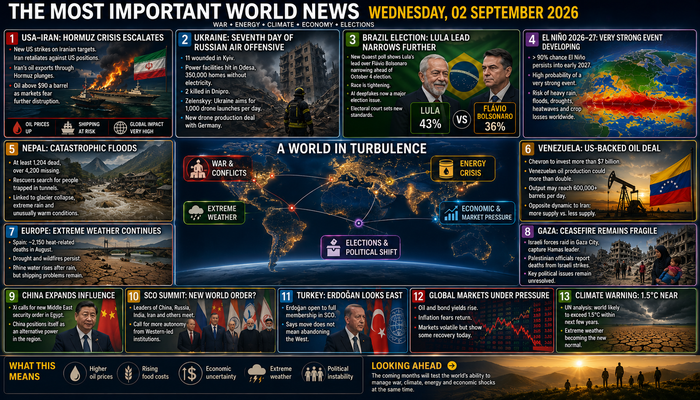
EXTENDED EDITION AI CHAT WORLD NEWS
War • Energy • Brazil • El Niño • Extreme Weather • China • Gaza • Global Economy
Today the world is being dominated by three interconnected developments: the renewed US–Iran confrontation around the Strait of Hormuz, Russia's escalating air war against Ukraine, and the increasingly important economic and climate consequences of these crises.
And for Brazil, today brings a significant new election poll: Lula's lead over Flávio Bolsonaro has narrowed further.
🔴 1. USA–IRAN — HORMUZ CRISIS IS THE WORLD'S BIGGEST IMMEDIATE DANGER
The US–Iran war has entered another dangerous phase.
US forces have carried out new strikes on Iran, including attacks on military and maritime capabilities around the Strait of Hormuz. Iran has responded with attacks on US positions in the region.
The central issue is still the Strait of Hormuz.
Iran's ability to restrict shipping through the strait has already caused a major disruption to global oil supplies. Reuters reports that Iran has gone roughly seven weeks without meaningful crude exports through the normal route.
🛢️ Oil is the key economic consequence
Brent crude has moved above $90 a barrel, and oil rose again today as traders assessed the risk of further disruption.
That creates a potentially dangerous chain:
War → Hormuz disruption → oil ↑ → transport ↑ → food ↑ → inflation ↑
This is why a regional war has become a global economic problem.
⭐ My assessment:
🔴 CRITICAL — the most important story today.
🇺🇦 2. UKRAINE — RUSSIA'S AIR OFFENSIVE ENTERS A SEVENTH DAY
Russia's massive air campaign against Kyiv has now continued for seven consecutive days.
Today's attacks wounded 11 people, damaged residential buildings and a university, and disrupted transport. Russian strikes also hit electricity facilities in Odesa, leaving about 350,000 homes without power. Two people were killed in Dnipro.
This is becoming particularly serious because Ukraine is approaching another winter.
President Zelenskyy has warned that Russia may be preparing a major campaign against Ukraine's energy infrastructure.
At the same time, Ukraine is dramatically increasing its own drone attacks against Russia. Zelenskyy says Ukraine wants to reach 1,000 drone launches per day.
Germany and Ukraine
Ukraine is also finalising a new drone agreement with Germany, potentially strengthening Ukraine's ability to produce and deploy unmanned systems.
⭐ Assessment:
🔴 CRITICAL
The danger is increasingly not only the battlefield but also European energy security and possible spillover toward NATO territory.
🇧🇷 3. BRAZIL — LULA'S LEAD OVER FLÁVIO BOLSONARO NARROWS
This is today's biggest Brazilian political development.
A new Quaest poll, released today, shows Lula's advantage over Flávio Bolsonaro narrowing ahead of the October 4 presidential election.
This confirms a trend already visible in other recent polling.
The election is becoming considerably more competitive than it appeared earlier in the year.
The crucial question
Can Flávio Bolsonaro turn his strong conservative base into enough support to defeat Lula in a second round?
At present, Lula remains ahead, but the margin is becoming increasingly important.
The first round is October 4, meaning Brazil has only about one month of campaigning remaining.
Why this matters internationally
Brazil is simultaneously:
🇺🇸 negotiating with the United States
🇨🇳 maintaining close economic relations with China
🌎 strengthening its BRICS role
🌳 controlling enormous Amazon resources
🌾 supplying global food markets
🛢️ expanding energy production
A change of government could therefore have consequences far beyond Brazil.
🤖 4. BRAZIL — AI DEEPFAKES ARE NOW AN ELECTION ISSUE
Another important development today is Brazil's attempt to deal with AI-generated political propaganda.
Brazil's electoral court has established new standards for identifying AI-generated deepfakes in political advertising.
This is potentially a landmark development.
A convincing fake video of a presidential candidate saying something outrageous can now be produced relatively cheaply.
The problem is therefore no longer merely:
"Is this news true?"
It is becoming:
"Did this person actually say or do this at all?"
Brazil's 2026 election could become an important test case for how democracies deal with political AI.
🌡️ 5. EL NIÑO — THE GREAT GLOBAL WEATHER STORY
The 2026–27 El Niño is becoming increasingly important.
Brazilian authorities confirmed the phenomenon earlier this year, and INMET's monitoring indicates a greater than 90% probability that El Niño will persist into at least early 2027, with a high probability of a very strong event.
International forecasters are also warning that this could become an exceptionally strong El Niño.
What this could mean globally
🌧️ Heavy rain
🌊 Flooding
🔥 Drought
🌡️ Extreme heat
🌾 Crop disruption
💧 Water shortages
🐟 Fisheries changes
🌲 Wildfires
And these effects occur simultaneously in different parts of the world.
🇧🇷🌧️ 6. BRAZIL — EL NIÑO DESERVES SPECIAL ATTENTION
Brazil's geography makes the country particularly sensitive to El Niño.
The broad tendency is:
SOUTH
🌧️ Wetter conditions and greater flood potential.
CENTRAL BRAZIL
🌡️ Heat and more irregular rainfall.
NORTH/NORTHEAST
🔥 Greater drought pressure in some areas.
But these are seasonal tendencies, not specific weather forecasts.
A particular city can have very different conditions from the national pattern.
🌊 7. UBATUBA — WHAT EL NIÑO MEANS FOR YOUR REGION
For Ubatuba, I would be careful about saying:
"El Niño means more rain."
It is more complicated.
Ubatuba sits between the Atlantic Ocean and the Serra do Mar, creating a special rainfall environment.
The potentially dangerous combination is:
**El Niño background conditions
- warm Atlantic water
- moist ocean air
- cold fronts
- Serra do Mar uplift**
That can produce very intense local rainfall.
So for Ubatuba, the most useful warning signs are not simply the El Niño forecasts but:
⚠️ 24-hour rainfall
⚠️ 72-hour accumulated rainfall
⚠️ approaching cold fronts
⚠️ thunderstorms
⚠️ Civil Defense alerts
⚠️ saturated soil
The official Brazilian El Niño panel itself stresses continuous monitoring of meteorological and hydrological conditions and Civil Defense recommendations.
🌊 8. NEPAL — CATASTROPHIC FLOOD DISASTER
The Himalayan disaster continues to worsen.
Reuters reports that at least 1,204 people have died in Nepal, with more than 4,200 missing, after catastrophic flooding and a possible glacier-related collapse.
Rescuers are still trying to reach people trapped in tunnels.
About 90 people in two tunnels are among those still offering some hope of survival.
This is one of the year's worst natural disasters.
And it has enormous significance in the wider climate discussion.
Scientists have linked the disaster to a combination of glacial conditions, extreme rainfall and unusually warm weather.
🇪🇺 9. EUROPE — EXTREME WEATHER IS NOT OVER
Europe's extraordinary summer continues to produce consequences.
Spain estimates that approximately 2,150 people may have died from heat-related causes during August.
At the same time, Europe's rivers and water systems have been affected by prolonged drought.
The Rhine has risen after recent rain, but shipping problems have not completely disappeared.
This illustrates another increasingly common pattern:
extreme drought → sudden heavy rain → flooding/runoff
rather than a simple transition from dry to wet conditions.
🇨🇳 10. CHINA — XI PROMOTES A NEW MIDDLE EAST SECURITY ORDER
Chinese President Xi Jinping has called for a new Middle East security framework during his visit to Egypt.
China is presenting itself as an alternative diplomatic power at a moment when the United States is deeply involved militarily in the region.
This is strategically important.
China is attempting to strengthen its position across:
Middle East + Africa + Asia + Global South
while Washington remains heavily engaged in Iran.
The result is an increasingly visible competition between different visions of the international order.
🇨🇳🇷🇺🇮🇳 11. THE SHANGHAI COOPERATION ORGANISATION — A CHANGING WORLD ORDER
The recent SCO summit brought together major leaders including:
🇨🇳 Xi Jinping
🇷🇺 Vladimir Putin
🇮🇳 Narendra Modi
🇮🇷 Masoud Pezeshkian
The organisation includes China, Russia, India, Iran and several Central Asian states.
The importance goes beyond the SCO itself.
The gathering demonstrates that the world is increasingly divided into overlapping geopolitical networks, rather than being dominated by one single Western alliance.
This does not mean that China, Russia and India agree on everything.
They certainly do not.
But they share some interests in creating greater autonomy from US-led institutions.
🇹🇷 12. TURKEY — ERDOĞAN LOOKS EASTWARD
A particularly interesting development today:
Turkish President Recep Tayyip Erdoğan says Turkey would consider full membership in the China- and Russia-led Shanghai Cooperation Organisation.
He insists this would not mean abandoning the West.
Turkey is already a NATO member.
Therefore, the possibility illustrates the increasingly complicated geopolitical position of countries that maintain relationships with both Western and non-Western powers.
Turkey could become an important bridge between:
NATO ↔ Russia ↔ China ↔ Middle East
🇻🇪 13. VENEZUELA — HUGE US OIL DEAL CHANGES THE ENERGY MAP
Another major story with enormous long-term implications is unfolding in Venezuela.
The United States is backing an arrangement that would give American companies a major role in Venezuelan oil production.
US Energy Secretary Chris Wright said today that Venezuelan production could more than double in the coming years.
Chevron alone plans to invest more than $7 billion through Venezuelan joint ventures and aims to double its production there to approximately 600,000 barrels per day.
Why this matters now
At exactly the same time that Iran is restricting oil exports, the US is trying to bring more Venezuelan oil onto the world market.
So there are two opposing forces:
Iran → reducing supply
Venezuela → potentially increasing supply
This could eventually become very important for global oil prices.
🇵🇸 14. GAZA — CEASEFIRE REMAINS FRAGILE
The Gaza ceasefire remains unstable.
Israeli forces have continued operations, including a raid in Gaza City in which Israeli special forces captured a Hamas leader. Palestinian medical officials have also reported deaths from Israeli attacks.
The central political problems remain unresolved:
Who governs Gaza?
Will Hamas disarm?
When and how does Israel withdraw?
Who finances reconstruction?
Until these questions are answered, the ceasefire remains vulnerable.
💰 15. GLOBAL MARKETS — SEPTEMBER BEGINS WITH OIL AND BOND PRESSURE
Global financial markets are increasingly reacting to the Iran crisis.
Oil has jumped, while government bond yields have risen because investors are worried about renewed inflation.
Today, however, global stocks showed some recovery as investors assessed the latest developments.
The market is therefore extremely sensitive to every new development in Hormuz.
🌍 16. THE CLIMATE STORY IS GETTING BIGGER
A particularly important warning came today from the UN environment community.
New analysis suggests that global temperatures are likely to exceed the 1.5°C threshold within the next few years, highlighting the increasing climate risks.
Meanwhile, the World Meteorological Organization continues to report record heat, drought, wildfire and flooding conditions around the world.
Put together:
El Niño + warming oceans + extreme heat + drought + intense rainfall
means that weather deserves to be treated increasingly as a global security and economic issue, not merely an environmental issue.
⭐ TOP 15 — WEDNESDAY, 2 SEPTEMBER 2026
| Rank | Story | Importance |
|---|---|---|
| 🥇 | 🇺🇸🇮🇷 US–Iran war / Strait of Hormuz | 🔴 CRITICAL |
| 🥈 | 🇷🇺🇺🇦 Seventh day of Russian air attacks | 🔴 CRITICAL |
| 🥉 | 🌡️ Very strong El Niño developing | 🔴 CRITICAL |
| 4 | 🇧🇷 Lula–Flávio Bolsonaro election race | 🔴 Very high |
| 5 | 🌊 Nepal catastrophic flood disaster | 🔴 Very high |
| 6 | 🇻🇪 US–Venezuela oil agreement | 🔴 Very high |
| 7 | 🇨🇳🇷🇺🇮🇳 SCO / changing global power structure | 🟠 High |
| 8 | 🇪🇺🔥 European heat/drought/extreme weather | 🟠 High |
| 9 | 🇨🇳🇹🇼 China–Taiwan tensions | 🟠 High |
| 10 | 🇵🇸 Gaza ceasefire instability | 🟠 High |
| 11 | 🇹🇷 Turkey's move toward SCO | 🟠 High |
| 12 | 💰 Oil / inflation / bond markets | 🟠 High |
| 13 | 🇧🇷🤖 AI deepfakes and Brazil election | 🟠 High |
| 14 | 🌾 Global food-security risk | 🟠 High |
| 15 | 🌍 Global warming / 1.5°C threshold | 🟠 High |
🔎 THE FIVE STORIES I WOULD WATCH MOST CLOSELY
🥇 IRAN + HORMUZ
This remains the biggest immediate danger. A prolonged closure or severe restriction of Hormuz could produce a major global energy shock.
🥈 UKRAINE
Seven consecutive days of attacks suggest that Russia is entering another major air-war phase, with Ukraine's energy system particularly vulnerable before winter.
🥉 EL NIÑO
This is the story I would watch for the next six months, particularly because of its potential impact on food, water, flooding and agriculture. Brazil's official monitoring continues to point toward a strong event lasting into 2027.
🇧🇷 BRAZIL
The election is becoming genuinely competitive. Today's Quaest poll showing Lula's lead narrowing is important.
🌊 EXTREME WEATHER
The Nepal disaster, Europe's heat and drought, and the developing El Niño are beginning to form a single global pattern: extreme weather is becoming a major economic and humanitarian story in its own right.
🇧🇷🌊 A FINAL WORD ON UBATUBA
For Ubatuba, I would keep El Niño on the radar but not become alarmed simply because El Niño is strong.
The real danger will come from particular combinations of weather systems.
Watch for:
🌧️ persistent rain + 🌊 high Atlantic moisture + ❄️ strong cold front + ⛰️ Serra do Mar
When those occur together, 24–72-hour accumulated rainfall and Civil Defense warnings become much more important than the seasonal El Niño forecast.