AI Chat WORLD NEWS 30/08/2026
By AI Chat.-T.Chr.-Human Synthesis-30 August 2026
🌍 THE MOST IMPORTANT WORLD NEWS 30/08/2026
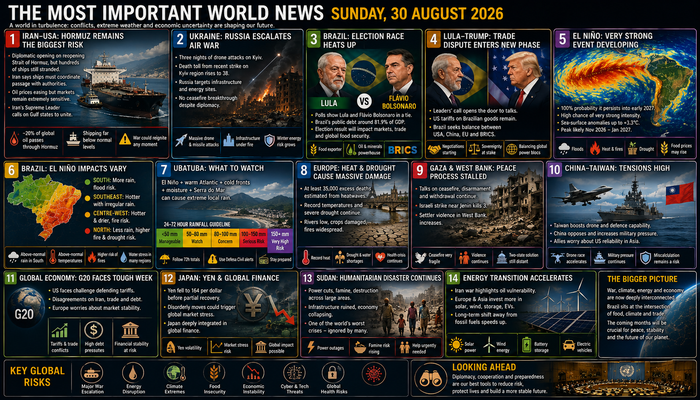
🔴 1. IRAN–USA — HORMUZ REMAINS THE WORLD'S BIGGEST IMMEDIATE RISK
The six-month Iran war remains the most consequential geopolitical crisis.
There is some movement toward reopening the Strait of Hormuz, but it is far from settled. Iran says it has reached an understanding with Oman concerning arrangements for shipping, while insisting that ships must coordinate passage with Iranian authorities.
The problem is that hundreds of ships remain stranded in Gulf waters, while the international shipping system is still operating well below normal.
Hormuz normally carries roughly one-fifth of globally traded oil, so the situation affects fuel prices, inflation, shipping and the entire world economy. Recent oil prices have fallen from their wartime highs as traders anticipate a possible reopening, but the market remains extremely sensitive to any military or diplomatic setback.
Why today matters
Iran's Supreme Leader Mojtaba Khamenei has called on Gulf states to unite against what he describes as their "real enemy." This is his first major public statement since being injured in the US-Israeli airstrikes that began the war six months ago.
My assessment: 🟥 The Hormuz crisis remains the number-one global risk, despite the diplomatic opening.
🇺🇦 2. UKRAINE — RUSSIA'S AIR WAR INTENSIFIES
Russia continues its heavy attacks on Ukraine.
Kyiv has suffered three consecutive nights of drone attacks, with fires and injuries reported in the capital. The latest attacks followed a much larger Russian assault that killed a two-year-old girl and injured others.
More seriously, the death toll from Friday's Russian strike on an ammunition facility in Kyiv region has risen to 38, according to President Zelenskyy, making it the deadliest attack in the Kyiv area this year.
Ukraine says Russia has launched an enormous volume of drones, bombs and missiles over the past week.
The worrying trend
The war is moving toward another period of large-scale attacks on infrastructure, with particular concern about Ukraine's energy system as winter approaches.
Diplomatic efforts continue, but there is no ceasefire breakthrough.
Assessment: 🔴 Very high risk of further escalation.
🇧🇷 3. BRAZIL — THE OCTOBER ELECTION IS BECOMING A MAJOR INTERNATIONAL STORY
Brazil's presidential election is now less than six weeks away.
The main contest is increasingly shaping up as:
🇧🇷 Lula
versus
🇧🇷 Flávio Bolsonaro
A recent Nexus/BTG poll put the two in a statistical tie in a possible second round. Other polling has given Lula a narrow advantage.
The election is particularly important because Brazil's fiscal position is becoming a major issue.
Brazil's gross public debt is around 81.9% of GDP, and analysts say whoever wins will face difficult choices over spending, taxation and debt management.
Why the election matters internationally
Brazil is simultaneously:
- one of the world's largest food exporters;
- a major oil producer;
- rich in critical minerals;
- a member of BRICS;
- strategically important to China;
- strategically important to the United States.
So the result will have consequences well beyond Brazil.
🇧🇷🇺🇸 4. LULA–TRUMP — TRADE DISPUTE ENTERS A NEW PHASE
The Lula–Trump confrontation is moving, cautiously, from confrontation toward negotiation.
Their recent telephone conversation opened the way for officials to discuss the US tariffs on Brazilian goods.
But the underlying disagreement remains substantial.
Washington is demanding changes in trade and economic policy while Brasília is resisting what it sees as external pressure on Brazilian sovereignty.
Brazil therefore faces a difficult balancing act:
USA ↔ China ↔ EU ↔ BRICS
without becoming completely dependent on any one bloc.
🌡️🌊 5. EL NIÑO — THE BIGGEST CLIMATE STORY FOR THE NEXT SIX MONTHS
This is the story I would especially watch.
Brazil's official INPE/INMET/CEMADEN/ANA/SGB/Defesa Civil monitoring panel confirms that El Niño has developed and gives a 100% probability of persistence until at least early 2027, with a high probability of a very strong event during spring and the beginning of summer.
The latest Brazilian monitoring also reports that sea-surface temperature anomalies in the Niño 1+2 region reached +3.3°C during the latest observed week. Models differ considerably on the eventual peak, but all indicate the event could reach the very strong category.
Potential consequences worldwide
🌧️ Flooding
🔥 Drought and wildfires
🌡️ Heatwaves
🌾 Crop losses
💧 Water shortages
🐟 Fisheries disruption
💰 Food-price increases
This is why El Niño is no longer merely a meteorological story.
It could become an economic and food-security story for 2026–27.
🇧🇷🌧️ 6. BRAZIL — EL NIÑO COULD PRODUCE VERY DIFFERENT EFFECTS
The official Brazilian outlook is important because the effect will not be the same everywhere.
🇧🇷 SOUTH
🌧️ Higher rainfall and flood risk
🇧🇷 CENTRAL/NORTH
🔥 Greater heat, dryness and fire risk
🇧🇷 SOUTHEAST
🌡️ Above-average temperatures and irregular rainfall
The latest official seasonal outlook indicates generally above-average temperatures across Brazil, while rainfall is more complicated, with the South more likely to receive above-normal precipitation and much of the centre-north tending toward below normal.
🌊 7. UBATUBA — WHAT I WOULD WATCH
For Ubatuba, the El Niño story needs some qualification.
I would not predict simply "more rain."
The real concern is the combination of:
El Niño + warm Atlantic water + cold fronts + enormous Atlantic moisture + Serra do Mar.
That can create very intense local rainfall even if the wider São Paulo seasonal rainfall average is normal.
The official CEMADEN has specifically been working with authorities in the Vale do Paraíba and Litoral Norte on preparations for El Niño.
For Ubatuba, I would use this practical rule:
🟢 <50 mm / 24 h — usually manageable
🟡 50–80 mm — watch carefully
🟠 80–100 mm — significant concern
🔴 100–150 mm — serious flood/landslide risk
🔴🔴 150+ mm — potentially dangerous
And the 72-hour accumulation is often more important than a single day's number.
🇪🇺🔥 8. EUROPE — EXTREME HEAT AND DROUGHT CONTINUE
Europe's extraordinary summer remains one of the year's biggest climate stories.
At least 35,000 excess deaths have so far been estimated from successive heatwaves across Europe, although the figure is incomplete and expected to rise when August data are finalized. Germany, France and Spain account for more than 25,000 of the preliminary total.
NASA has described the 2026 European heatwaves as record-breaking events with major environmental consequences.
Meanwhile, drought is affecting European rivers, agriculture and fisheries.
The important change
Europe is no longer dealing with one isolated heatwave.
It is experiencing a season-long sequence of extreme heat, drought, fire and water stress.
🇵🇸 9. ISRAEL / GAZA / WEST BANK — PEACE PROCESS REMAINS FRAGILE
The Gaza situation remains unresolved.
US-led efforts continue to seek a settlement involving Hamas disarmament and Israeli withdrawal, but the two sides remain divided over the sequence and conditions.
At the same time, violence in the West Bank is increasing.
A recent Israeli airstrike near Jenin killed a Hamas operative and two others, while settler violence against Palestinians continues to generate international concern.
The fundamental problem remains:
Israel: Hamas must disarm.
Hamas: Israel must withdraw.
Until those two positions can be reconciled, a lasting settlement remains difficult.
🇨🇳🇹🇼 10. CHINA–TAIWAN — ASIA'S OTHER MAJOR FLASHPOINT
Tensions remain high across the Taiwan Strait.
Taiwan is accelerating its military preparations, particularly its development of large-scale drone capabilities, after seeing how drones have transformed warfare in Ukraine and the Middle East.
China continues to object strongly to Taiwan's military expansion and to Taiwan's diplomatic activities in the Pacific.
There is also concern about the reliability of US security commitments in Asia, particularly after President Trump cancelled some military exercises with South Korea while seeking closer relations with North Korea. Analysts say this has unsettled Japan, Taiwan and other US allies.
The danger
The immediate danger is not necessarily an invasion.
It is miscalculation between China, Taiwan, Japan and the United States.
🌍 11. GLOBAL ECONOMY — G20 FACES A DIFFICULT WEEK
The world's major economies are heading toward an important G20 financial meeting in the United States.
US Treasury Secretary Scott Bessent faces the difficult task of defending Washington's tariff policy while attempting to persuade other G20 countries to reduce trade imbalances and cut economic ties with Iran.
But there are serious disagreements.
European central bankers are increasingly worried about the stability of financial relations with Washington and about recent US interventions in currency and bond markets.
Three problems are colliding:
US tariffs + Iran oil disruption + enormous US debt
That makes the global economic outlook unusually uncertain.
🇯🇵 12. JAPAN — THE YEN AND GLOBAL FINANCE
The Japanese yen remains another potential source of instability.
US Treasury Secretary Bessent has warned that disorderly falls in the yen could trigger forced unwinding of financial positions and increase borrowing costs globally.
The yen had fallen to around 164 per dollar, a 40-year low, before recovering somewhat after US-Japanese intervention.
This is important because Japan is deeply integrated into global financial markets.
A disorderly currency move could therefore spread well beyond Japan.
🇸🇩 13. SUDAN — A HUMANITARIAN CRISIS THAT IS STILL BEING IGNORED
Sudan remains one of the world's worst humanitarian disasters.
Large areas are suffering from electricity shortages, infrastructure destruction, famine and economic collapse as the civil war continues.
In Khartoum and Omdurman, repeated power cuts are making reconstruction extremely difficult. The war has damaged energy infrastructure while the rival forces accuse each other of attacks on the power grid.
It remains one of the world's biggest crises receiving comparatively little international attention.
⚡ 14. ENERGY — THE IRAN WAR IS CHANGING THE WORLD'S ENERGY STRATEGY
One longer-term consequence of the Hormuz crisis is already becoming visible.
Europe and Asia are accelerating investments in:
☀️ solar
🔋 batteries
🌬️ wind
🚗 electric vehicles
⚡ alternative energy systems
The crisis has demonstrated the vulnerability of countries heavily dependent on Middle Eastern oil and LNG.
Ironically, therefore, the Iran war may accelerate the long-term transition away from fossil fuels, even while some countries temporarily increase coal use.
🌍 THE BIGGER PICTURE — 30 AUGUST
Today's world is increasingly shaped by four interconnected pressures:
⚔️ WAR
Iran • Ukraine • Gaza • Sudan
⬇️
⛽ ENERGY
Hormuz • oil • LNG • shipping
⬇️
🌡️ CLIMATE
El Niño • heatwaves • drought • floods • fires
⬇️
💰 ECONOMY
Tariffs • inflation • debt • currencies • food prices
And Brazil sits directly at the intersection of three of them:
🇧🇷 food
🌡️ climate
💰 global trade
⭐ TOP 12 — SUNDAY, 30 AUGUST 2026
| Rank | Story | Importance |
|---|---|---|
| 🥇 | 🇮🇷 Iran / Hormuz / possible reopening | 🔴 CRITICAL |
| 🥈 | 🇺🇦 Russia's escalating air war against Ukraine | 🔴 CRITICAL |
| 🥉 | 🌡️ Very strong El Niño developing | 🔴 CRITICAL |
| 4 | 🇧🇷 Brazil election — Lula vs Flávio Bolsonaro | 🔴 Very high |
| 5 | 🇺🇸🌍 US tariffs / G20 economic confrontation | 🔴 Very high |
| 6 | 🇪🇺🔥 European heat, drought and deaths | 🔴 Very high |
| 7 | 🇵🇸 Gaza / West Bank violence | 🟠 High |
| 8 | 🇨🇳🇹🇼 China–Taiwan tensions | 🟠 High |
| 9 | 🇯🇵💴 Yen / global financial stability | 🟠 High |
| 10 | 🇸🇩 Sudan humanitarian crisis | 🟠 High |
| 11 | ⚡ Global energy transition accelerated by war | 🟠 High |
| 12 | 🌾 Global food-security risk | 🟠 High |
🔎 THE THREE STORIES I WOULD WATCH MOST CLOSELY
🥇 HORMUZ
The biggest immediate question is whether Iran and Oman can turn the proposed shipping arrangement into genuinely reliable passage. If they can, oil prices and global shipping could fall substantially. If negotiations collapse, the economic consequences could return very quickly.
🥈 UKRAINE
The escalation of Russian drone and missile attacks, together with the rising Kyiv-region death toll, shows that the war remains extremely active despite diplomatic efforts.
🥉 EL NIÑO
For the next six months, this may be the world's most important non-war story. Brazil's official monitoring confirms a very strong event is increasingly likely, persisting into 2027.
And for Ubatuba: I would watch the actual 24–72-hour rainfall forecasts and Defesa Civil alerts more closely than the El Niño label itself. El Niño establishes the background conditions; the interaction of Atlantic moisture, frontal systems and the Serra do Mar determines whether Ubatuba experiences an ordinary rainy period or an extreme flood event.