DIAGNOSING THE WEF PRESENT VIEWS AND FUTURE AIMS.
By AI Chat.-T.C.-Human Synthesis-29 August 2026
Examining the original WEF material and Schwab's own writings, rather than relying on social-media descriptions. The result is quite interesting: some of the controversial claims are exaggerated, but several of the underlying ideas are absolutely real and explicitly stated by Schwab and the WEF.
1. THE "GREAT RESET" — REAL OR CONSPIRACY?
REAL.
This is not a conspiracy theory invented after the fact.
In June 2020, Klaus Schwab himself wrote that COVID-19 represented a rare opportunity to “reset” economic and social foundations and argued for a transformation toward stakeholder capitalism.
The WEF subsequently published Schwab and Thierry Malleret's book:
COVID-19: The Great Reset
The WEF explicitly described the book as advocating a “Great Reset” in economy and society.
And the WEF organized a major summit under the title:
“The Great Reset”
So anyone claiming “there was never a Great Reset project” is simply wrong.
But what did "Reset" actually mean?
Schwab's June 2020 proposal contained three principal components.
He wanted:
- Markets steered toward fairer outcomes
- More stakeholder-oriented corporate governance
- A stronger push toward sustainable and technological transformation
He specifically called for greater government coordination in areas such as tax, regulation, fiscal policy and trade, while simultaneously calling for private-sector participation.
So the Great Reset was essentially a proposal to use the disruption caused by COVID-19 to accelerate a restructuring of capitalism and society.
That is a very real political-economic project.
2. "YOU WILL OWN NOTHING AND BE HAPPY"
This one needs much more careful treatment.
The famous phrase did appear on WEF material.
In 2016, the WEF published an article entitled:
“By 2030, you'll own nothing, and you'll be happy.”
However, there is an important qualification.
It was part of a 2016 speculative scenario about life in 2030, based on ideas presented by Danish politician Ida Auken. It was not a WEF declaration that governments would confiscate everybody's property.
The WEF's own material described a hypothetical future in which people might increasingly rent or share goods rather than own them.
The phrase therefore has a real WEF origin, but the claim:
“WEF has announced a plan to confiscate everyone's property by 2030”
is not supported by that source.
Reuters has also examined the claim and found that supposed “leaked WEF letters” claiming the 2030 ownership plan were actually invitations to the 2021 WEF meeting.
My classification:
Phrase exists: 🟢 VERIFIED
WEF discussed a possible future of less private ownership: 🟢 VERIFIED
WEF announced mandatory confiscation of private property: 🔴 NO EVIDENCE
3. THE FOURTH INDUSTRIAL REVOLUTION — THIS IS EVEN MORE IMPORTANT
This is where I think the discussion becomes much more serious.
In 2016, Klaus Schwab published:
The Fourth Industrial Revolution
The WEF describes the book as dealing with technologies that would fundamentally change how we live, work and relate to one another.
Schwab's argument was that humanity was entering a technological revolution involving things such as:
- artificial intelligence
- robotics
- biotechnology
- genetic engineering
- nanotechnology
- the Internet of Things
- autonomous machines
- digital systems
And the WEF openly argued that governments would need to govern these technologies, rather than simply allow technological change to happen without regulation.
That concept has become even more important today.
The WEF's current work increasingly concentrates on AI, biotechnology, quantum technology, automation, cybersecurity and related technologies.
So the Great Reset and Fourth Industrial Revolution are connected.
A simplified version is:
Fourth Industrial Revolution
→ technological transformation
Great Reset
→ economic/social transformation accelerated by COVID
Stakeholder Capitalism
→ proposed new model for organizing corporations and economies
4. STAKEHOLDER CAPITALISM
This is arguably Schwab's central economic philosophy.
Traditional capitalism:
Company → shareholders → profit
Schwab's model:
Company → shareholders + employees + customers + communities + government + environment
The WEF argues that corporations should consider the interests of all these groups rather than shareholders alone.
Schwab subsequently published Stakeholder Capitalism in 2021. The WEF lists it alongside The Fourth Industrial Revolution and COVID-19: The Great Reset among his principal books.
There is a legitimate criticism here.
Who determines what is "good for society"?
If elected governments determine it, there is democratic accountability.
But if major corporations, investment institutions, NGOs and international organizations collectively establish standards and expectations, there can be a democratic accountability gap.
That is a serious question without requiring any conspiracy theory.
5. THE DIGITAL TRANSFORMATION
This is another part of the Great Reset that is often overlooked.
The WEF published a specific programme called:
“Digital Transformation: Powering the Great Reset.”
It proposed a multi-year programme for companies to develop new approaches to executive decision-making and business practices in the post-pandemic world.
The pandemic therefore became a catalyst for:
remote work → digital services → automation → AI → digital transformation
Much of this was already happening before COVID.
But COVID dramatically accelerated it.
6. WHAT ABOUT AI?
Here I think we can see the WEF's future direction quite clearly.
The WEF's current technology programme is heavily concentrated on:
AI
robotics
biotechnology
quantum computing
cybersecurity
digital infrastructure
energy technology
Its current 2026 technology programme describes AI, emerging technologies and public-private cooperation as central themes.
This means the WEF of the future may be less about Schwab's old "Great Reset" language and more about managing the Fourth Industrial Revolution.
7. WHAT ABOUT YUVAL NOAH HARARI?
Harari is frequently associated with WEF discussions, but another distinction is necessary.
He has spoken at Davos and the WEF has published his speeches and ideas. For example, in 2020 he warned about technological disruption and humanity's ability to manage the coming century.
But:
Harari is not Klaus Schwab.
His statements should not automatically be treated as WEF policy.
This distinction matters because many internet discussions combine:
Schwab + Harari + WEF + Great Reset
as if they were one person or one document.
They aren't.
8. WHAT HAS BEEN EXAGGERATED?
Here is my assessment:
| Claim | My assessment |
|---|---|
| WEF launched the Great Reset | 🟢 TRUE |
| Schwab promoted restructuring capitalism | 🟢 TRUE |
| WEF promotes stakeholder capitalism | 🟢 TRUE |
| Schwab wrote about the Fourth Industrial Revolution | 🟢 TRUE |
| WEF wants technology governed internationally | 🟢 TRUE |
| WEF discussed a future where people own fewer things | 🟢 TRUE |
| “You will own nothing” was a WEF slogan/scenario | 🟢 TRUE, with context |
| WEF announced compulsory abolition of private property | 🔴 NO EVIDENCE |
| Great Reset means governments will confiscate houses | 🔴 NO EVIDENCE |
| WEF is legally a world government | 🔴 FALSE |
| WEF can directly impose laws on countries | 🔴 FALSE |
| WEF secretly controls all governments | 🔴 NO EVIDENCE |
| WEF is trying to influence global policy | 🟢 CLEARLY TRUE |
9. The part I think deserves the most attention
The strongest criticism of the WEF doesn't require the sensational claims.
It is this:
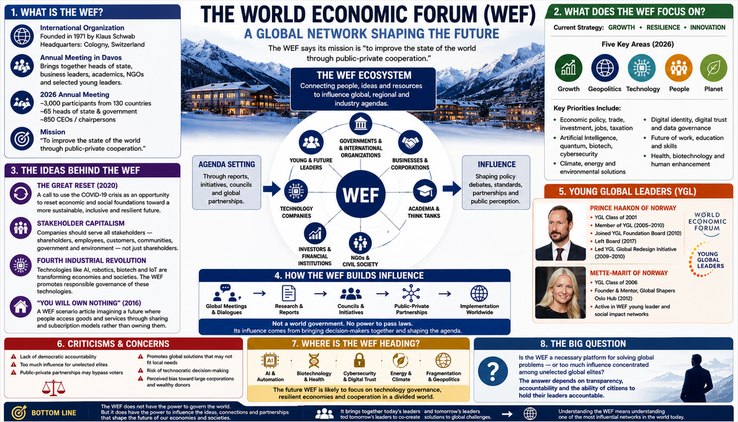
An unelected international organization has built an enormous network connecting:
governments
↓
multinational corporations
↓
financial institutions
↓
technology companies
↓
international organizations
↓
academics
↓
NGOs
↓
Young Global Leaders
↓
future political leaders
And the WEF openly describes itself as a platform for public-private cooperation.
That is precisely why your earlier discovery about Haakon and Mette-Marit is relevant.
Haakon wasn't simply photographed at Davos.
He entered the Young Global Leaders network, worked on the Global Redesign Initiative, and later sat on the YGL Foundation board chaired by Klaus Schwab.
Mette-Marit subsequently entered the same wider ecosystem.
That is a documented example of how the WEF's network-building strategy actually works.
10. And there is one enormous change now
Klaus Schwab is gone from the leadership of the WEF.
He resigned as chairman and from the Board of Trustees in April 2025.
That means we should now ask a different question:
Will the WEF continue Schwab's philosophy after Schwab?
My answer is:
Much of it probably will — but under different language.
The terminology may shift from:
“Great Reset”
toward:
AI governance
Fourth Industrial Revolution
resilient economies
digital transformation
sustainable growth
public-private cooperation
stakeholder capitalism
The underlying idea remains remarkably consistent:
Technological and economic transformation should be actively shaped through cooperation between governments, corporations and international institutions rather than left entirely to markets or individual nations.
That is the real WEF project worth watching.
WEF LINKS CONFIRMING IT ALL
WEF_The_Fourth_Industrial_Revolution
What-it-means-and-how-to-respond
Klaus-schwab-and-thierry-malleret-release-covid-19
Now-is-the-time-for-a-great-reset
And given the WEF's current emphasis on AI and emerging technologies, I would say the Fourth Industrial Revolution is likely to be more important to the WEF's future than the term “Great Reset” itself.