AI CHAT WORLD NEWS 28/08/2026

By AI Chat-Human Synthesis-28 August 2026
🌍 AI CHAT — MOST IMPORTANT WORLD NEWS-28/08/2026
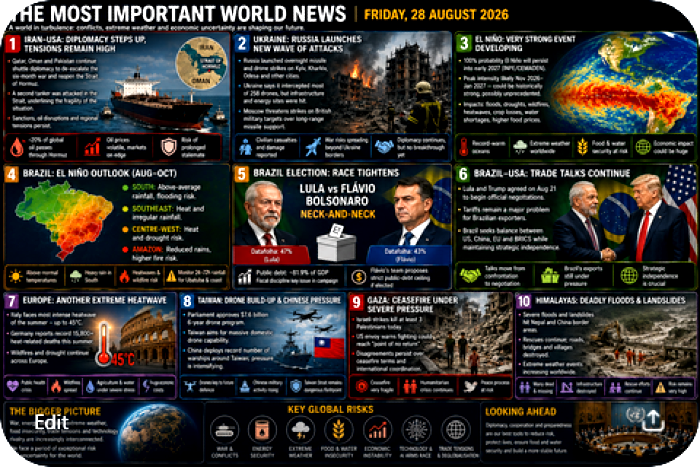
🔴 TOP 10 — What matters most today
| Rank | Story | Why it matters |
|---|---|---|
| 1 | 🇳🇵 Nepal–Tibet catastrophic floods | Major humanitarian disaster; hundreds dead and thousands missing |
| 2 | 🇮🇷 Iran war reaches six-month mark | Threatens energy supplies, shipping and wider regional stability |
| 3 | 🤖 AI companies warn of AI-powered cyberattacks | AI is becoming a new cybersecurity battlefield |
| 4 | 🇺🇸 Pentagon–Anthropic legal battle | Major test of government power over AI companies |
| 5 | 💰 Markets face a volatile September | Oil, inflation, interest rates and AI valuations collide |
| 6 | 🌍 Global drought crisis deepens | Agriculture, water, energy and food security increasingly affected |
| 7 | 🇪🇺 EU AI Act enters enforcement era | One of the world's biggest experiments in AI regulation |
| 8 | 🇰🇷🇯🇵🇺🇸 US–Japan–South Korea military drill | North Korea tensions remain high |
| 9 | 🇺🇦 Ukraine remains under sustained Russian attack | War continues despite wider geopolitical focus elsewhere |
| 10 | 🇳🇴 Norway faces royal succession controversy | King Harald V's death brings a major constitutional and political moment |
1. 🇳🇵 NEPAL–TIBET: CATASTROPHIC HIMALAYAN FLOODS
The most urgent humanitarian story today is the disaster along the Nepal–China/Tibet border.
A massive flash flood tore through Himalayan valleys after a glacier collapse and the formation and subsequent failure of a large body of water. The disaster has destroyed homes, roads and infrastructure and left rescue teams racing against the possibility of additional flooding.
Latest reported scale
- More than 570 deaths have been reported across Nepal and Tibet.
- Nearly 2,000 people are missing according to the latest AP figures.
- More than 3,700 people have been rescued in Nepal.
- Thousands of security personnel have been deployed.
- At least 93,000 people may need humanitarian assistance.
- Another dangerous lake is being monitored because additional flooding could occur.
The numbers are still changing rapidly, and different sources are reporting different totals as authorities reconcile information from remote areas.
Why this is especially dangerous
The disaster isn't simply a conventional rainstorm.
A glacier collapse can suddenly release enormous amounts of water and debris. That water can create temporary lakes behind natural barriers; if those barriers fail, another destructive flood can follow.
That is exactly why rescue operations have periodically been suspended.
🌡️ Climate connection
Scientists have increasingly warned that Himalayan warming is accelerating glacier melt and increasing risks associated with glacial lakes and unstable mountain terrain.
This means the disaster isn't only a Nepal story. It is part of a much larger question:
How will rapidly warming mountain regions cope with increasingly unstable glaciers and water systems?
2. 🇮🇷 IRAN WAR: SIX MONTHS OF CONFLICT
The Iran conflict has now reached the six-month mark, and its consequences extend far beyond the battlefield.
The war has increasingly become an attritional conflict, with no decisive political collapse and Gulf countries facing continuing uncertainty.
The biggest international concern: Strait of Hormuz
The Strait of Hormuz remains one of the most important strategic chokepoints in the world.
Iran has been discussing conditions for reopening shipping through the waterway, including demands involving sanctions, the U.S. blockade and compensation.
That matters because disruption to Hormuz can affect:
- crude oil prices
- LNG shipments
- Asian energy supplies
- global inflation
- shipping insurance
- manufacturing costs
- airline fuel costs
- central-bank interest-rate decisions
The economic paradox
Markets are currently getting some relief from falling oil prices.
Reuters reported Brent crude around $89.70 per barrel, with prices on track for a significant weekly decline amid possible diplomatic developments involving Iran and Oman.
But the underlying geopolitical risk hasn't disappeared.
In other words: markets are calmer than the geopolitics.
3. 🤖 AI BECOMES A CYBERSECURITY BATTLEFIELD
This is arguably the most important technology story today.
More than 100 technology organizations—including OpenAI, Anthropic, Microsoft, Google and Amazon—are calling for a major defensive effort against AI-driven cyberattacks.
What's changing?
AI can potentially help attackers:
- discover software vulnerabilities
- automate phishing
- generate malicious code
- impersonate people
- conduct reconnaissance
- analyze stolen information
- automate attacks at enormous scale
The important shift is that AI isn't simply another computer tool.
It can dramatically increase the speed, scale and automation of attacks.
The emerging AI security race
We're increasingly moving toward:
AI vs. AI
Defenders use AI to:
detect → investigate → isolate → respond
Attackers use AI to:
discover → automate → adapt → attack
This creates a new cybersecurity arms race.
Why governments care
If AI substantially lowers the cost of sophisticated cyberattacks, smaller groups could potentially acquire capabilities that previously required large teams of skilled specialists.
That makes AI security a national-security issue, not merely a technology-industry problem.
4. ⚖️ PENTAGON vs. ANTHROPIC: A LANDMARK AI LEGAL FIGHT
A U.S. federal judge has ruled against the Pentagon's treatment of Anthropic, finding that the government's actions against the AI company were unlawful.
The dispute centers on Anthropic's restrictions and concerns regarding certain military applications of its AI systems.
The ruling is potentially important because it raises a much bigger question:
Who controls advanced AI?
Is it:
A. The government?
or
B. The company that developed the model?
or
C. Some combination of government regulation and corporate control?
The case could become an important precedent for future disputes involving AI companies and national-security agencies.
It also comes at a time when the Pentagon increasingly wants access to frontier AI systems for military planning, intelligence and other applications.
5. 💰 GLOBAL MARKETS: SEPTEMBER COULD BE EXTREMELY VOLATILE
Financial markets are entering September with several major risks converging simultaneously.
Reuters identifies:
- Iran and energy prices
- inflation
- government debt
- central-bank decisions
- political uncertainty
- European fiscal problems
- AI valuations
- U.S. elections
as major risks.
🤖 The $1 trillion Anthropic question
One of the most extraordinary developments is the possibility of an Anthropic IPO at a valuation approaching $1 trillion.
Anthropic was valued at about $965 billion in May, according to Reuters' market analysis.
That creates a huge test for investor enthusiasm around AI.
If investors continue paying extraordinary valuations for AI companies, it reinforces the AI boom.
If sentiment suddenly changes, the consequences could spread across:
Anthropic → OpenAI → Nvidia → Microsoft → AI infrastructure → technology markets
That's why the IPO isn't just about one company.
6. 🌍 GLOBAL DROUGHT CRISIS
A major UN conference in Mongolia has highlighted an increasingly serious global problem: drought and land degradation.
Up to 40% of the world's land is considered degraded, according to AP's report on the talks.
Why drought is bigger than "lack of rain"
Persistent drought can affect:
🌾 food production
💧 drinking-water supplies
⚡ hydroelectric power
🚢 river transportation
🏭 industrial production
🐄 livestock
🌳 ecosystems
📈 food prices
The problem is particularly serious when drought combines with extreme heat.
Europe is already experiencing the consequences
Europe is suffering severe drought and extremely low river levels, affecting agriculture, shipping and even nuclear power facilities that depend on rivers for cooling.
International response
A new initiative announced at the Mongolia conference includes $1.2 billion across 45 rangeland projects, while the Asian Development Bank has pledged another $2 billion for restoration projects in Asia-Pacific.
But negotiations toward a legally binding global drought treaty were postponed again.
7. 🇪🇺 EUROPE: AI ACT ENTERS A NEW PHASE
Europe's AI regulation has moved from legislation toward actual enforcement.
The EU's AI Act is becoming a practical compliance framework, with major transparency requirements now taking effect.
Why this matters globally
Europe is attempting to establish rules for:
- AI transparency
- high-risk AI
- accountability
- safety
- prohibited applications
- AI-generated content
- provider responsibilities
The EU hopes its regulations can become a global benchmark in the same way that European privacy regulation influenced international technology practices.
The big question
Can Europe regulate AI aggressively without falling behind the U.S. and China technologically?
That's becoming one of the defining economic questions of the AI era.
8. 🇺🇸🇯🇵🇰🇷 EAST ASIA: NORTH KOREA TENSIONS
The United States, South Korea and Japan will conduct their Freedom Edge military exercise beginning September 7 near South Korea's Jeju Island.
The exercise is intended to improve cooperation in areas including:
- missile defense
- anti-submarine warfare
- joint military readiness
North Korea has condemned the exercises and recently launched approximately 10 short-range ballistic missiles.
Why it matters
The region now has three simultaneous strategic pressures:
North Korea's nuclear program
China–U.S. rivalry
Japan and South Korea's growing security cooperation
The Middle East may dominate today's headlines, but East Asia remains one of the world's most dangerous long-term strategic flashpoints.
9. 🇺🇦 UKRAINE: WAR CONTINUES
While global attention has shifted toward Iran and the Middle East, the war in Ukraine continues.
Today's international reporting includes another wave of Russian missile attacks and Ukrainian air defenses responding to the strikes.
The strategic importance goes beyond Ukraine itself.
The conflict continues to influence:
- European defense spending
- NATO strategy
- Russian relations with China
- European energy policy
- U.S. foreign policy
- sanctions
- global grain markets
The Ukraine war therefore remains a central component of the broader restructuring of global security.
10. 🇳🇴 NORWAY: KING HARALD V DIES
Norway is entering a major period of constitutional and political transition following the reported death of King Harald V, aged 89.
The succession passes to Crown Prince Haakon.
However, the transition is occurring amid controversy surrounding Crown Princess Mette-Marit and her historical correspondence with Jeffrey Epstein, according to today's reporting.
The situation therefore combines a major constitutional event with a politically sensitive controversy involving the future royal household.
🧑💻 SOCIAL MEDIA & AI
Meta faces an enormous child-safety settlement
Meta has agreed to an $18 billion settlement with 29 U.S. states over allegations concerning addictive platform design and harm to children.
The agreement reportedly includes measures such as:
- time restrictions
- controls around school hours
- age-appropriate settings
But critics argue that stronger age verification and changes to recommendation algorithms are still necessary.
Why this is important
The debate is moving from:
"Should social media companies do more?"
to:
"Should governments fundamentally regulate how recommendation algorithms interact with children?"
That question could eventually become as important as privacy regulation.
🌡️ CLIMATE: ANOTHER MAJOR WARNING
The climate story is no longer limited to future projections.
Today's headlines are increasingly about current infrastructure and economic disruption.
We're seeing:
Floods → destroyed infrastructure
Drought → agricultural losses
Extreme heat → water shortages
Low rivers → shipping problems
Heat → power-system stress
Glacier instability → catastrophic floods
The Nepal disaster and European drought are therefore two very different manifestations of the same larger challenge: climate and environmental instability increasingly intersecting with human infrastructure.
📊 GLOBAL ECONOMY — WHAT TO WATCH
The next several weeks could be particularly important.
🇺🇸 Federal Reserve
Investors are looking for clues about future U.S. interest rates.
🇯🇵 Bank of Japan
Japan's monetary-policy direction remains important for global bond and currency markets.
🇪🇺 European inflation
Eurozone inflation could remain elevated, complicating ECB policy.
🛢️ Oil
Iran and the Strait of Hormuz remain the biggest geopolitical wildcard for energy markets.
🤖 AI
Investors are asking whether AI profits can justify extremely high valuations.
💵 Government debt
High public debt is becoming a major concern across several advanced economies.
Reuters describes the combination as a potentially volatile September for global markets.
🧠 THE BIGGER PICTURE
If we step back from individual headlines, five major global forces are interacting:
1. ⚔️ Geopolitical fragmentation
Iran, Ukraine, North Korea and U.S.–China competition are producing a less stable international system.
2. 🤖 AI transformation
AI is simultaneously becoming an economic engine, military technology, cybersecurity threat and regulatory challenge.
3. 🌡️ Climate instability
Floods, droughts, heat and glacier changes are increasingly producing direct economic consequences.
4. 💰 Financial uncertainty
Inflation, government debt, energy prices and interest rates are interacting with enormous AI valuations.
5. 🏛️ Government vs. technology
The Anthropic case, EU AI Act and Meta child-safety settlement all point toward the same question:
How much power should governments have over the technology platforms shaping society?
🔥 THE 5 STORIES I WOULD WATCH MOST CLOSELY
🥇 1. Nepal–Tibet
The immediate humanitarian emergency. The death and missing-person totals could continue changing dramatically.
🥈 2. Iran / Strait of Hormuz
Potentially the biggest story for global energy prices and inflation.
🥉 3. AI cybersecurity
The possibility that AI dramatically increases the scale of cyberattacks is becoming a mainstream national-security concern.
4. Anthropic vs. Pentagon
A potentially landmark fight over the relationship between frontier AI companies and governments.
5. Climate extremes
The combination of Himalayan glacier instability, European drought and worsening land degradation demonstrates that climate risk is increasingly an immediate economic issue.
🌐 AI CHAT — ONE-SENTENCE SUMMARY
The world on 28 August 2026 is being shaped by a dangerous convergence of war, energy insecurity, climate disasters, rapidly advancing AI, regulatory battles and financial uncertainty—with Nepal's catastrophic floods, the six-month Iran conflict and the emerging AI-security race standing out as today's most consequential developments.
LA NIÑA AND WEATHER REPORT
Ubatuba, São Paulo, Brazil
August 28, 2026
1. Current Climate Situation
The first important point is that La Niña should not currently be treated as the main explanation for Ubatuba's weather.
Brazil's national meteorological service, INMET, has been monitoring the possibility of an El Niño pattern developing during the second half of 2026, rather than a straightforward continuation of La Niña. INMET notes that El Niño generally produces different rainfall responses across Brazil, with its effects varying substantially by region.
For Ubatuba, therefore, it is more useful to look at the actual atmospheric pattern affecting the São Paulo coast—including fronts, moisture from the Atlantic, upper-level disturbances and temperature changes—rather than assuming that every wet or dry period is caused by La Niña.
2. Ubatuba Weather Today
Ubatuba is experiencing a relatively warm afternoon today, with partly cloudy conditions and temperatures around the upper 20s °C.
The current forecast indicates:
- Friday, August 28: partly sunny/cloudy and warm
- Saturday, August 29: substantially hotter
- Sunday, August 30: increasing instability and a possibility of a localized storm
- Monday, August 31: partly cloudy
- Tuesday, September 1: rain showers become more likely
- September 2–4: cooler conditions with varying chances of rain
Independent forecasts also show a substantial temperature increase over the weekend, followed by a return of greater instability. One local forecast places Saturday's maximum around 36°C, while another forecast is somewhat lower at approximately 33–34°C. This illustrates the uncertainty that can exist several days ahead, particularly in coastal Ubatuba.
3. Friday–Monday Pattern
The immediate weather pattern is notable because Ubatuba is transitioning from a cooler period into very warm conditions.
INMET reports that instability is decreasing across much of the Southeast while temperatures are rising in large portions of Brazil.
For Ubatuba, this means:
Friday: warm, with clouds and periods of sunshine.
Saturday: potentially the hottest day of the short-term period. Temperatures could reach the low-to-mid 30s °C.
Sunday: conditions become more unstable, with a risk of showers or a localized thunderstorm.
Monday: temperatures remain relatively warm, although the pattern becomes less settled.
4. The Next Significant Change
The most important change appears likely around September 1–2.
Forecast guidance indicates increasing rainfall and a noticeable reduction in temperatures. The current forecast suggests temperatures falling into the low-to-mid 20s °C, with additional rain possible.
This is consistent with the broader pattern of alternating warm air and frontal/upper-air disturbances affecting southeastern Brazil.
5. Is La Niña Responsible?
At present, I would not attribute Ubatuba's immediate weather to La Niña.
There are three reasons:
- The Pacific climate signal is changing and should be evaluated using the latest ocean-atmosphere observations.
- Ubatuba's coastal weather is strongly influenced by the Atlantic Ocean, local topography and passing frontal systems.
- The immediate forecast is being driven more directly by short-term atmospheric disturbances and the movement of warm and cooler air masses.
INMET's 2026 outlook has specifically highlighted the possibility of El Niño developing during the second half of the year, making it inappropriate to describe the current situation simply as a La Niña season.
6. What This Means for Ubatuba
For residents and visitors, the practical outlook is:
🌡️ Temperature
Expect a marked warm-up this weekend, particularly Saturday, followed by cooler conditions during the first part of September.
☔ Rain
Rain is not expected to dominate Friday and Saturday, but the chance of showers increases around Sunday and becomes more significant from approximately September 1 onward.
⛈️ Storms
Sunday deserves some attention because current forecasts indicate the possibility of localized thunderstorms. Conditions can change quickly in Ubatuba because of the mountains and proximity to the Atlantic.
🌊 Ocean and beaches
Warm, partly sunny weather on Friday and Saturday may produce attractive beach conditions, but visitors should monitor local conditions because a change in wind, swell or thunderstorms can occur rapidly.
🔥 Heat
The broader state of São Paulo is experiencing a significant warming episode. The state has been under attention for unusually high temperatures and, particularly inland, very low humidity. Ubatuba's coastal environment is generally much more humid than the interior, so inland humidity warnings should not automatically be applied to the city.
7. Longer-Term Outlook
The most important climate question for Ubatuba during the coming months is not simply "Will La Niña return?"
The more useful questions are:
- Will the Pacific transition toward El Niño?
- How strong will that signal become?
- How will Atlantic sea-surface temperatures evolve?
- How frequently will cold fronts reach the São Paulo coast?
- Will rainfall become concentrated in fewer but heavier events?
- Will periods of unusually warm weather become more frequent?
These factors will determine Ubatuba's rainfall and temperature patterns more directly than a single ENSO label.
FINAL CONCLUSION
Ubatuba is entering a short period of unusually warm weather, with the strongest heat expected around Saturday, August 29. Conditions become more unstable around Sunday, followed by a greater likelihood of rain and cooler temperatures around September 1–2.
The current evidence does not support describing this as a La Niña-driven weather episode. INMET is instead monitoring the possibility of El Niño during the second half of 2026.
For Ubatuba specifically, the immediate forecast is more strongly controlled by coastal moisture, Atlantic influences, frontal systems and short-term atmospheric disturbances.
Practical forecast
Today: warm and partly cloudy
Saturday: very warm/hot
Sunday: increasing instability; storm risk
Monday: warm, partly cloudy
Tuesday onward: cooler with increasing rain potential
Because Ubatuba can change rapidly from sunshine to heavy rain, anyone planning beach, boating, hiking or fishing activities should check the short-term forecast and local alerts again immediately before going out.