AI CHAT WORLD NEWS 21/08/2026
By AI Chat-Human Synthesis-21 August 2026
🌍 WORLD NEWS
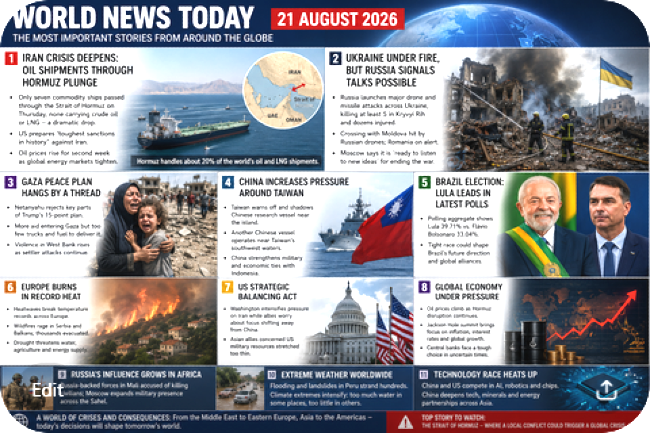
The most important developments around the world today
I have checked today's reporting rather than simply carrying yesterday's stories forward. The Iran–U.S. confrontation and the Strait of Hormuz are clearly the biggest international story today, with Ukraine, Gaza, China–Taiwan, Brazil and Europe's extreme weather following.
🔴 1. IRAN–U.S.: THE HORMUZ CRISIS IS GETTING MORE DANGEROUS
The Middle East remains the world's most immediate geopolitical danger.
President Donald Trump is shifting toward what he calls an "economic D-Day" against Iran, threatening unprecedented economic pressure rather than immediately expanding the military campaign. Iran, however, is warning that it would respond "devastatingly" to attempts to cut its economic lifelines.
The crucial issue remains the Strait of Hormuz.
Shipping through the strait has fallen dramatically. On Thursday, only seven commodity ships passed through — four entering and three leaving — and no large crude-oil carriers or LNG tankers were recorded. Before the conflict, Hormuz carried almost 20% of global crude oil and LNG shipments.
That is the part of this crisis that concerns the entire world.
🛢️ Oil is rising
Oil is heading toward its second consecutive weekly gain as the disruption continues.
This creates a chain reaction:
Iran → Hormuz → oil supply → shipping → petrol → inflation → interest rates → world economy
China is particularly exposed because it buys most of Iran's seaborne oil. Reuters reports that Iranian oil shipments to Chinese refiners have fallen sharply, with Chinese buyers increasingly looking toward alternatives including Brazilian and Iraqi crude.
⚠️ My assessment
This is considerably more important than simply another Middle Eastern military confrontation.
If Hormuz remains largely closed for a prolonged period, the energy crisis could become a worldwide economic crisis.
🇺🇦 2. UKRAINE: HEAVY RUSSIAN ATTACKS — BUT A DIPLOMATIC OPENING?
Russia continues its massive drone and missile campaign against Ukraine.
A Russian strike on Kryvyi Rih killed five people and wounded 52, including children, according to Ukrainian authorities.
Other attacks have hit residential areas and infrastructure, with Ukraine reporting substantial casualties in several regions.
Russian drones have also struck a border crossing with Moldova, while a Russian drone incident near Romania has again highlighted the danger of the war spilling into NATO territory.
But there is one interesting development
Russia's Deputy Foreign Minister Sergey Ryabkov says Moscow is prepared to listen to new ideas for ending the war, provided any proposal reflects what Russia calls the "realities on the ground."
That is not a peace agreement.
But it suggests that Moscow is keeping a diplomatic door open while continuing military pressure.
The contradiction
Russia is simultaneously:
- attacking Ukraine heavily;
- talking about possible negotiations;
- demanding recognition of its battlefield gains;
- trying to influence Washington's position.
This could become important if the Trump administration succeeds in getting the two sides back to serious negotiations.
🇮🇱🇵🇸 3. GAZA: PEACE EFFORTS ARE AGAIN IN SERIOUS TROUBLE
The Gaza situation remains extremely unstable.
The United States is pushing a proposed settlement, but Israeli Prime Minister Benjamin Netanyahu continues to reject important elements of Trump's 15-point plan.
Meanwhile, Egypt and Qatar are pressing the parties to maintain commitments to Trump's proposed roadmap.
Aid is arriving — but another problem has emerged
More humanitarian aid is reportedly reaching Gaza, but there are too few functioning trucks to distribute it efficiently. A large proportion of the enclave's previous truck fleet has been destroyed, while shortages of fuel and engine oil are hampering the remaining vehicles.
This is an important distinction:
Aid entering Gaza does not necessarily mean aid reaching people who need it.
West Bank tension is also worsening
Israeli settlers killed a Palestinian teenager during violence in the West Bank today, according to reports.
The increasing settler violence adds another obstacle to any broader Israeli-Palestinian settlement.
🇨🇳🇹🇼 4. CHINA–TAIWAN: PRESSURE INCREASES
The Taiwan Strait remains another major potential flashpoint.
Taiwan says it has warned off and shadowed a Chinese research vessel operating in sensitive waters west of the island. Taipei says the vessel's repeated appearances are part of a broader pattern of Chinese "grey-zone" pressure.
Separately, Taiwan reported another Chinese research vessel operating near the island's southwest.
China has also been increasing military and strategic cooperation with Indonesia, including defence, minerals, energy and technology.
Why this matters
China is not only concerned with Taiwan itself.
Beijing is building a broader strategic network across the Indo-Pacific while Washington is increasingly concentrating on the Middle East.
That creates an uncomfortable question for U.S. allies:
How much American military power can Washington devote to Iran without weakening deterrence against China?
🇧🇷 5. BRAZIL: LULA LEADS FLÁVIO BOLSONARO IN LATEST AGGREGATED POLLING
Brazil's presidential election is becoming increasingly important internationally.
The latest Inteligov/Exame polling aggregate puts:
Lula — 39.71%
Flávio Bolsonaro — 33.04%
That gives Lula a 6.67 percentage-point advantage in the first-round aggregate.
But this is still a long way from determining the result.
The election is particularly significant internationally because Brazil is:
- Latin America's largest economy;
- one of the world's largest agricultural exporters;
- a major oil producer;
- a BRICS member;
- a major voice for the Global South.
Lula versus Bolsonaro
The contest is also increasingly becoming a referendum on Brazil's international orientation.
A Lula victory would broadly mean continuation of his present foreign-policy direction.
A Flávio Bolsonaro victory could mean a significant shift toward the political right and potentially closer relations with Trump's United States.
That makes Brazil's election one of the most consequential political events still ahead in 2026.
🔥 6. EUROPE: AN EXTRAORDINARY SUMMER OF HEAT AND FIRE
Europe's extreme weather remains one of the world's major stories.
NASA reports that a series of heat waves during 2026 has broken temperature records across Europe, with Western Europe experiencing exceptionally high temperatures since May.
The European Commission's Joint Research Centre says large parts of Europe have been affected by drought since spring, with continued warmer and drier conditions increasing wildfire risk.
Fires remain serious
Serbia is struggling with a wildfire that has burned for weeks and forced evacuations. Authorities have issued warnings across much of the Balkans as another period of extreme heat approaches.
The scale of Europe's 2026 fires is extraordinary, with hundreds of thousands of people affected or evacuated in different regions.
This isn't merely an environmental story.
It is becoming a problem involving:
food production + water + tourism + insurance + electricity + public health + migration
🇺🇸 7. UNITED STATES: IRAN IS NOW DOMINATING WASHINGTON'S FOREIGN POLICY
Trump's administration is attempting to persuade allies — including China — to participate in increased economic pressure on Iran.
At the same time, Washington is facing a difficult strategic problem.
American military resources are being tied up by the Iran conflict, while China continues expanding its activities in Asia.
U.S. allies in Asia are reportedly concerned about Washington's ability to maintain deterrence against China while dealing with the Iranian war.
This could ultimately prove to be one of the most important strategic consequences of the Iran war.
💰 8. WORLD ECONOMY: THE IRAN WAR IS NOW A FINANCIAL STORY
The world's financial markets are increasingly reacting to the Middle East crisis.
The combination of:
- restricted oil exports;
- reduced Hormuz shipping;
- higher oil prices;
- inflation;
- uncertainty about interest rates
is putting pressure on markets.
Global financial leaders are meeting at the Jackson Hole economic symposium, where monetary policy and inflation will be major subjects.
The big question for central banks is becoming:
Can they lower interest rates while energy prices are pushing inflation upward?
That is particularly important for developing economies.
🌍 9. AFRICA: RUSSIAN INFLUENCE REMAINS A MAJOR ISSUE
Russia's influence in Africa continues to expand.
In Mali, a Russia-backed paramilitary force known as the Africa Corps has been accused of involvement in the killing of civilians, including children, according to reporting citing Human Rights Watch.
Russia's growing military relationships in Africa are part of a much larger geopolitical struggle between Moscow and Western countries.
The Sahel is increasingly becoming an area where:
Russia + local military governments
are replacing some of the traditional influence of:
France + United States + European powers.
🤖 10. TECHNOLOGY: AI REMAINS THE OTHER GREAT GLOBAL POWER RACE
Behind all the wars and political crises, the technological competition between the United States and China continues.
Artificial intelligence, semiconductor technology, robotics, drones and advanced manufacturing are increasingly treated as strategic assets rather than simply commercial products.
China's strengthening relationship with Indonesia in technology, minerals and energy, announced today, is another indication that Beijing is building long-term economic and strategic partnerships throughout Asia.
🌐 MY RANKING — WHAT MATTERS MOST TODAY?
| Rank | Story | Importance |
|---|---|---|
| 🔴 1 | 🇺🇸🇮🇷 Iran / Strait of Hormuz | ⭐⭐⭐⭐⭐ |
| 🔴 2 | 🇺🇦🇷🇺 Ukraine war & possible diplomacy | ⭐⭐⭐⭐⭐ |
| 🔴 3 | 🇮🇱🇵🇸 Gaza & Middle East peace plan | ⭐⭐⭐⭐½ |
| 🟠 4 | 🇨🇳🇹🇼 China–Taiwan pressure | ⭐⭐⭐⭐½ |
| 🟠 5 | 🇧🇷 Lula–Flávio Bolsonaro election | ⭐⭐⭐⭐ |
| 🟠 6 | 🇪🇺🔥 European heat & wildfires | ⭐⭐⭐⭐ |
| 🟡 7 | 💰 Oil & global inflation | ⭐⭐⭐⭐ |
| 🟡 8 | 🇺🇸 U.S. strategic pressure from Iran | ⭐⭐⭐½ |
| 🟡 9 | 🌍 Russian influence in Africa | ⭐⭐⭐ |
| 🟢 10 | 🤖 U.S.–China technology race | ⭐⭐⭐ |
⚠️ THE BIG STORY OF 21 AUGUST
If I had to choose one development to watch above all others, it would be the Strait of Hormuz.
The extraordinary thing today is that only seven commodity ships were recorded passing through the strait on Thursday, with no large crude-oil or LNG tankers.
That means the Iran conflict is no longer just a war in the Middle East.
It has become a potential global energy and economic crisis.
And there is a second danger developing in parallel: while the United States concentrates enormous attention and resources on Iran, Russia continues fighting Ukraine and China continues increasing strategic pressure around Taiwan.
That combination makes 21 August 2026 an unusually tense moment in world affairs.
🇧🇷 Brazil weather & ENSO — latest, 21 August 2026
⚠️ El Ninho
The latest NOAA/CPC ENSO bulletin, issued 13 August, says El Niño is strengthening, with more than a 90% probability of a very strong El Niño during the Northern Hemisphere autumn/winter 2026–27.
Brazil's INMET, together with INPE, ANA, CEMADEN and other national agencies, likewise says that El Niño is expected to intensify during the second half of 2026, potentially reaching very strong intensity during spring and early summer.
🌧️ What does El Niño mean for Brazil?
The developing pattern is broadly:
- South: greater tendency toward above-normal rainfall, with more frequent heavy-rain episodes and flooding risk.
- North/Northeast: greater tendency toward below-normal rainfall, increasing drought and wildfire concerns.
- Central Brazil: higher temperatures and periods of low humidity.
- Much of Brazil: increased probability of temperatures above the climatological average.
This is already showing up in the current forecasts.
🌡️ What is happening NOW — 21 August?
Brazil is experiencing a strong contrast between regions.
A cold air mass is moving through central-southern Brazil today and Saturday. INMET expects a sharp temperature fall, with temperatures near 0°C in some southern mountain areas and frost possible on Saturday. Parts of Mato Grosso do Sul and the Southeast will also become colder, with some minimums below 10°C.
At the same time, strong winds are expected along parts of the Southeast coast, including São Paulo and Rio de Janeiro states.
In the Amazon, particularly western Amazonas, Acre and surrounding areas, thunderstorms and rain remain possible.
🌧️ Rainfall pattern
INMET's latest weekly outlook shows the clearest contrast:
South: substantial rainfall, with parts of Rio Grande do Sul potentially receiving more than 150 mm during the forecast period.
Southeast: predominantly dry through about 23 August, with only light and isolated rain expected along parts of the São Paulo, Rio de Janeiro and Espírito Santo coast afterwards.
Central-West: predominantly dry and stable, with low humidity continuing.
North: rainfall concentrated particularly in western Amazonas, with locally significant thunderstorms.
Northeast: rainfall mainly confined to coastal areas, while much of the interior remains relatively dry.
🌎 What this means for the coming months
The really important story is not today's cold front. It is what happens as the strong El Niño develops.
Brazil's official climate panel expects, broadly, wetter conditions in the South and drier conditions across much of the North and Northeast, while much of the country has an increased probability of above-normal temperatures. The combination of heat + reduced rainfall in parts of the North, Northeast and Central-West increases the risk of wildfires and water stress.
So, ironically, the picture for Brazil is almost the opposite of the La Niña scenario I described earlier.
🇧🇷 And for Ubatuba / São Paulo?
For the São Paulo coast, the immediate outlook is relatively benign compared with southern Brazil: predominantly stable weather, followed by the possibility of light, isolated coastal rain after 23 August, together with stronger winds associated with the cold-air outbreak.