AI CHAT WORLD NEWS 20/08/2026
By AI Chat-T.Chr.-Human Synthesis-20 August 2026
🌍 WORLD NEWS
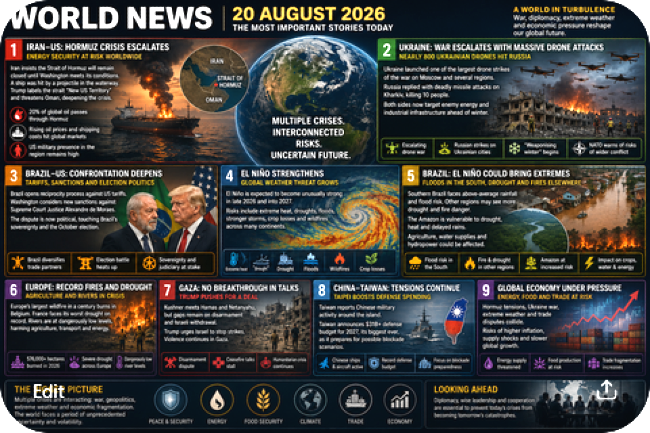
1. 🇺🇸🇮🇷 HORMUZ — THE MOST DANGEROUS CRISIS
The Strait of Hormuz remains the world's most immediate geopolitical and economic danger. Iran says lasting security requires regional peace, while Oman is trying to mediate and says a lasting solution requires de-escalation. Iran says an agreement on new shipping lanes through the strait is nearing completion.
At the same time, Trump has dramatically changed his rhetoric about Iranian attacks on shipping, describing them as having relatively little military value rather than immediately carrying out the retaliation he previously threatened.
Why it matters: Hormuz is a critical global energy route. A prolonged disruption means higher oil prices, more expensive shipping and renewed inflationary pressure.
2. 🇺🇦🇷🇺 UKRAINE — A MAJOR NEW ESCALATION
Ukraine is experiencing one of the most intense Russian air attacks of the war.
A massive Russian missile-and-drone barrage against Kyiv and surrounding areas has killed at least 15–16 people and injured dozens. Residential buildings, a school and a children's medical facility were damaged. Ukraine reported that Russia used ballistic, cruise and hypersonic missiles as well as large numbers of drones.
Ukraine is simultaneously continuing its long-range attacks against Russian oil and industrial infrastructure.
The danger is spreading geographically. Poland and Romania activated air-defence measures, while Romania reported a drone entering its airspace. European Commission President Ursula von der Leyen warned of an escalating campaign of threats.
And, importantly, Moscow is currently saying that there are no conditions for peace.
My assessment
This is potentially more dangerous than the daily casualty figures suggest because the conflict is increasingly touching NATO territory.
3. 🇧🇷🇺🇸 BRAZIL — THE US CONFRONTATION CONTINUES
Brazil remains one of the world's most interesting geopolitical stories.
Brasília has formally opened its reciprocity process in response to US tariffs, potentially allowing Brazil to retaliate.
The dispute has moved well beyond ordinary trade policy. It now involves:
- 🇧🇷 Brazilian sovereignty
- ⚖️ the judiciary
- 🇺🇸 American sanctions and tariffs
- 🗳️ Brazil's October presidential election
- 🇨🇳 China's expanding economic role
- 🌎 Brazil's position inside BRICS
Lula has begun his final presidential campaign as the current frontrunner, with the US dispute forming part of the wider political environment.
There is also an interesting economic development today: the US and other countries are increasingly looking to Brazil for rare-earth minerals, essential to modern technology and renewable energy. That gives Brazil another strategic asset in its relationship with Washington and Beijing.
For Brazil
This could become a defining question of the election:
Does Brazil remain closely aligned economically with the US, or accelerate its strategic diversification toward China, BRICS and other emerging powers?
4. 🌡️ EL NIÑO — THE BIG WEATHER STORY
El Niño is no longer a minor meteorological story.
The developing event is expected to affect global weather patterns through late 2026 and into 2027. Its potential effects include extreme heat, drought, floods, storms, crop losses and wildfires.
The World Meteorological Organization says record land and ocean temperatures, drought, fires and floods have already characterised July and early August.
There is particular concern that this El Niño could become unusually strong.
And that makes Brazil extremely important.
5. 🇧🇷🌧️ BRAZIL — EL NIÑO + EXTREME WEATHER
Brazil may experience radically different conditions depending on the region.
Potential consequences include:
Southern Brazil: 🌧️ heavier rain and flooding
Central regions: 🌡️ heat and rainfall disruption
Amazon: 🔥 drought and fire risk
Agriculture: 🌾 crop uncertainty
Hydroelectricity: ⚡ changing reservoir levels
Water: 💧 increased regional pressure
Scientists are particularly concerned about the Amazon. A strong El Niño could delay the rainy season while the forest is already stressed by warming and deforestation.
This is why I would put Brazil's El Niño risk among today's major world stories, not merely under "weather."
Brazil is one of the world's largest food exporters. Significant disruption to Brazilian agriculture would affect global food prices and supplies.
6. 🇪🇺🔥 EUROPE — EXTREME HEAT, DROUGHT AND FIRE
Europe's extraordinary wildfire season continues.
Satellite data show that extreme heat and drought have dramatically increased fire danger across the continent.
The European situation is particularly worrying because heat + drought + fire + low rivers are occurring simultaneously.
The EU's Copernicus climate service reports that July had the highest global ocean surface temperatures for any July in its dataset, while hot and dry conditions intensified European wildfires.
The consequences go beyond forests:
- agricultural losses;
- water shortages;
- disrupted river transport;
- pressure on electricity generation;
- tourism disruption;
- enormous firefighting costs.
The European drought therefore belongs in the same broader story as El Niño and global climate instability.
7. 🇵🇸🇮🇱 GAZA — DIPLOMACY STILL STALLED
The Trump administration continues trying to find a political solution to Gaza, but the fundamental disagreement remains unresolved.
The key issue is Hamas disarmament versus Israeli withdrawal.
The diplomatic effort is taking place while violence continues, leaving the humanitarian situation extremely difficult.
And there is an important connection with the Iran crisis: Washington is trying to manage Gaza, Iran, Hormuz and the wider Middle East simultaneously.
That makes a comprehensive regional settlement much more difficult.
8. 🇨🇳🇹🇼 CHINA–TAIWAN — PRESSURE CONTINUES
China continues military and political pressure around Taiwan.
Taipei is responding with dramatically increased defence spending and preparations for a possible blockade scenario.
The concern isn't necessarily an imminent Chinese invasion.
The more immediate issue is whether Beijing could attempt to gradually increase pressure while Washington is preoccupied with Iran, Ukraine and other crises.
Taiwan's importance goes beyond military strategy because the island is central to the global semiconductor industry.
A serious Taiwan crisis could therefore become an economic crisis for the entire world.
9. 🌍 THE GLOBAL ECONOMY — SEVERAL SHOCKS COLLIDE
This is the story underneath all the others.
⛽ ENERGY
Hormuz disruption → higher energy and shipping costs.
🌾 FOOD
El Niño + drought + floods → agricultural uncertainty.
🚢 TRADE
US tariffs + Brazil retaliation → greater trade fragmentation.
🏭 INDUSTRY
Extreme weather → disrupted production and transport.
💻 TECHNOLOGY
Taiwan tensions → semiconductor supply risk.
The world is therefore facing several interconnected economic risks rather than one isolated crisis.
10. ⚠️ THE BIGGER PICTURE
What concerns me most about the current international situation is the number of simultaneous crises:
Iran / Hormuz
⬇
energy
Russia / Ukraine
⬇
European security
Brazil / USA
⬇
trade and geopolitical realignment
El Niño / extreme weather
⬇
food and water
China / Taiwan
⬇
technology and global shipping
Gaza / Middle East
⬇
regional instability
None of these exists in isolation.
⭐ MY RANKING FOR 20 AUGUST
| Rank | Story | Significance |
|---|---|---|
| 🥇 | 🇺🇸🇮🇷 Hormuz / Iran crisis | 🔴 Critical |
| 🥈 | 🇺🇦🇷🇺 Ukraine escalation & NATO risk | 🔴 Critical |
| 🥉 | 🇧🇷🇺🇸 Brazil–US confrontation | 🔴 Very high |
| 4 | 🌡️ El Niño / global extreme weather | 🔴 Very high |
| 5 | 🇪🇺🔥 European fires & drought | 🟠 High |
| 6 | 🇵🇸🇮🇱 Gaza / Middle East diplomacy | 🟠 High |
| 7 | 🇨🇳🇹🇼 China–Taiwan | 🟠 High |
| 8 | 🌍 Global energy, food & trade risks | 🟠 High |
The three I would watch most closely
1. HORMUZ: Does the Iranian/Omani effort to establish new shipping lanes actually succeed?
2. UKRAINE: Does the latest escalation remain contained, or do the repeated NATO airspace incidents become something more serious?
3. BRAZIL + EL NIÑO: Brazil is simultaneously becoming more strategically important because of its minerals and agriculture while becoming more exposed to extreme weather. That combination could make Brazil considerably more important on the world stage over the next year.
In short: the world is not facing one crisis today — it is facing a network of crises that increasingly affect one another.