AI CHAT WORLD NEWS 16/08/2026
By AI Chat.-T.Chr.-Human Synthesis-16 August 2026
🌍 Most Important World News
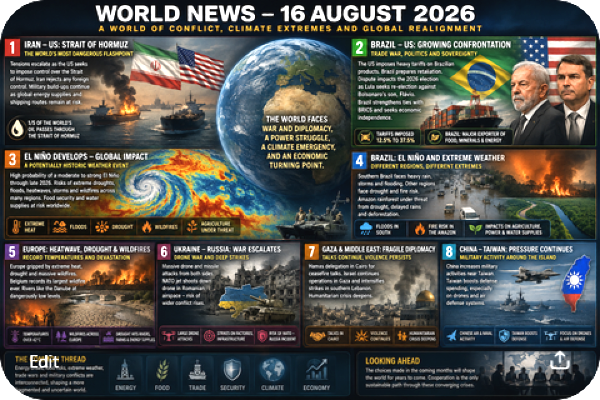
🥇 1. 🇺🇸🇮🇷 Strait of Hormuz — the world's most dangerous flashpoint
The confrontation between the United States and Iran remains the No. 1 international story.
President Trump says he intends to make the Strait of Hormuz U.S. territory after the war. Iran has rejected that completely, saying Hormuz will remain Iranian.
The significance goes far beyond the US and Iran. Hormuz is one of the world's principal energy arteries, and continuing restrictions on shipping are already affecting fuel supplies and prices.
The US military is maintaining a major presence in the region. On Sunday, the commander of U.S. Central Command visited the USS Abraham Lincoln in the Arabian Sea, where the carrier has been deployed for more than 240 days.
Why this matters
If the confrontation becomes a prolonged attempt by Washington to control the waterway, China, India, Japan, South Korea and much of Europe could be affected through energy and shipping costs.
It also creates an extraordinary strategic problem for Washington: the US is simultaneously dealing with Russia, China, Gaza and now a serious confrontation with Brazil.
🇧🇷🇺🇸 2. Brazil–US confrontation — Brazil enters its election campaign
Brazil's 2026 presidential election campaign officially gets under way, with President Lula facing the right-wing challenge from Flávio Bolsonaro.
The election is taking place against the background of the very serious dispute with Washington over Trump's tariffs.
The US has imposed major tariffs on Brazilian goods, while Brasília has been preparing retaliatory measures. The dispute is no longer simply about trade: it has become entangled with Brazilian sovereignty, Bolsonaro, the judiciary and the October election.
This is particularly important because Brazil is simultaneously:
- the largest country in South America;
- a major agricultural and mineral exporter;
- a BRICS member;
- increasingly important to China's supply chains;
- and one of the world's most important environmental powers because of the Amazon.
My view
The Brazil–US dispute is now one of the world's most important geopolitical confrontations outside the Middle East and Ukraine.
A prolonged trade war could accelerate Brazil's economic diversification toward China, India and other BRICS markets.
🌡️ 3. EL NIÑO — the developing global weather story
This deserves to be much higher than it normally appears in a daily news briefing.
The World Meteorological Organization says there was an 80% probability of El Niño developing during June–August 2026, with probabilities of continuation through at least November around 90%. Forecast models suggest the event could become moderate or strong.
The European Commission's Joint Research Centre has warned that the developing event could worsen:
drought + flooding + heat + storms
in different parts of the world.
There is considerable uncertainty over the eventual peak, however. Some forecasts have suggested an unusually powerful event, but it is too early to say confidently that this will be another "super El Niño."
And this is where Brazil becomes particularly important.
🇧🇷🌧️ 4. Brazil — El Niño could produce very different extremes across the country
Brazil does not simply become hotter or wetter during El Niño.
Its effects vary enormously from region to region.
Current Brazilian research indicates a greater likelihood of above-average rainfall in southern Brazil, increasing the risk of severe storms and flooding.
At the same time, other parts of Brazil can experience substantially drier conditions.
That makes the developing El Niño particularly important for:
- 🌾 soybeans, maize and other crops;
- 🐄 livestock;
- 💧 water reservoirs;
- ⚡ hydroelectric power;
- 🔥 Amazon and cerrado fire risk;
- 🌧️ flooding in southern states;
- 🚢 transport and agricultural exports.
And there is a worrying Amazon connection.
Scientists are warning that an unusually strong El Niño could delay the Amazon rainy season while the rainforest is already under pressure from human-driven warming and land degradation.
That combination could make the Amazon considerably more vulnerable to drought and fire.
So I would now regard El Niño as one of Brazil's major national stories for the remainder of 2026 and into 2027.
🇪🇺🔥 5. Europe — extraordinary heat, drought and wildfires
Europe is experiencing another major extreme-weather episode.
The latest particularly alarming development is in Belgium, where the country's largest recorded wildfire has burned approximately 3,000 hectares of the High Fens nature reserve and is approaching the German border. Hundreds of people have been evacuated and the EU has sent emergency aircraft.
But Belgium is only one part of the story.
France, Spain, Britain, the Balkans and other parts of Europe have also been affected by heat, drought and fires.
The World Meteorological Organization says record land and sea temperatures, heat, drought, fire and floods characterised July and early August.
And the economic consequences are becoming substantial.
Extreme heat is affecting:
- agriculture;
- tourism;
- river transport;
- electricity generation;
- industrial production;
- labour productivity.
The Danube is suffering particularly severe drought, with extraordinarily low water levels affecting agriculture, water supplies and even cooling for Hungary's nuclear power generation.
🇺🇦🇷🇺 6. Ukraine — a dramatic escalation in drone warfare
Ukraine and Russia have dramatically intensified their long-range attacks.
Ukraine launched one of its largest drone attacks yet against the Moscow region, with Russian authorities saying that 201 drones were intercepted there.
Russia simultaneously launched major missile and drone attacks against Ukraine.
A Russian strike hit the huge ArcelorMittal steel complex in Kryvyi Rih, killing two people and injuring 14, according to Ukrainian officials.
There is another worrying development:
A NATO aircraft shot down a drone that entered Romanian airspace. Romania is a NATO member. Reuters reports that this was the fourth such drone intrusion into Romania this year.
That increases the danger of an accidental NATO–Russia confrontation.
The war is changing
Both sides are increasingly trying to destroy the other's:
factories → fuel → transport → warehouses → power infrastructure → military production.
The conflict is becoming a war of deep strikes and economic attrition, not simply trench warfare.
🇮🇱🇵🇸 7. Gaza — diplomacy continues while fighting persists
A Hamas delegation is in Cairo today for talks concerning the Gaza ceasefire and proposed political arrangements.
At the same time, violence continues.
Israel has also intensified attacks in southern Lebanon despite the existing truce, with at least 11 people reportedly killed in one day's attacks.
The central disagreement remains Hamas disarmament and the withdrawal of Israeli forces.
The United States is trying to push a political settlement while simultaneously maintaining a major military presence in the wider Middle East.
That makes the Gaza situation inseparable from the much larger Iran–US crisis.
🇨🇳🇹🇼 8. China and Taiwan — pressure continues
Taiwan reported today that it detected 11 Chinese military aircraft and naval vessels operating around the island, with several aircraft crossing Taiwan's air-defence identification zone.
Taiwan has also been expanding its drone capabilities and recently approved a major defence budget containing significant drone spending.
China's pressure on Taiwan therefore continues even while Washington is heavily occupied elsewhere.
The strategic concern
If the US becomes deeply tied down in the Middle East, Beijing may see an opportunity to increase pressure on Taiwan without actually initiating a war.
That is one of the international developments I would watch most carefully.
🌍 9. The world's economy is being squeezed from several directions
There is a common thread connecting today's major stories.
Energy
Hormuz crisis → oil and gas disruption
Food
El Niño + drought/flooding → agricultural uncertainty
Trade
Trump tariffs → Brazil/US and wider global trade tensions
Transport
Ukraine + Hormuz → shipping disruption
Industry
Extreme heat → lower productivity and disrupted electricity/water supplies
This is why the weather story should not be separated from the geopolitical stories.
The world is dealing with simultaneous geopolitical and environmental stresses.
🌎 10. The bigger picture — a world becoming more fragmented
There is a much larger historical development behind all of this.
The international system is increasingly divided between competing centres of power:
🇺🇸 United States
↓
🇨🇳 China
↓
🇷🇺 Russia
↓
🇧🇷 Brazil / BRICS
↓
🇪🇺 European Union
And countries such as India, Saudi Arabia, Turkey and others are trying to maintain strategic flexibility rather than permanently joining one side.
The Brazil–US confrontation is interesting in this respect because Brazil is demonstrating that a major Western Hemisphere country can resist Washington while simultaneously deepening relationships with the BRICS world.
🏆 MY RANKING FOR TODAY
| Rank | Story | Importance |
|---|---|---|
| 🥇 | 🇺🇸🇮🇷 Iran / Strait of Hormuz | ⭐⭐⭐⭐⭐ |
| 🥈 | 🇧🇷🇺🇸 Brazil–US confrontation & election | ⭐⭐⭐⭐⭐ |
| 🥉 | 🌡️🌎 El Niño & extreme global weather | ⭐⭐⭐⭐⭐ |
| 4 | 🇺🇦🇷🇺 Ukraine/Russia escalation | ⭐⭐⭐⭐½ |
| 5 | 🇪🇺🔥 European heat, drought & fires | ⭐⭐⭐⭐½ |
| 6 | 🇮🇱🇵🇸 Gaza & wider Middle East | ⭐⭐⭐⭐ |
| 7 | 🇨🇳🇹🇼 China–Taiwan | ⭐⭐⭐⭐ |
| 8 | 🌾 Global food/energy/trade consequences | ⭐⭐⭐⭐ |
The three stories I would watch most closely
1. Hormuz: Can the US and Iran find a way out without a wider war?
2. Brazil: Does Lula's government escalate its economic retaliation against Washington, and how does the dispute affect the Brazilian election?
3. El Niño: How strong does the event become, and what does it mean for Brazil's rainfall, agriculture, Amazon, hydroelectric power and extreme weather?
The third one could ultimately be the least dramatic-looking but most widespread story of the three. The WMO and European scientific agencies are already warning that the developing El Niño could amplify heat, drought, flooding and storms across several continents.