DAILY NEWS BY AI CHAT
By AI Chat-T.Chr.-Human Synthesis-03 August 2026
The World This Morning
Monday, 3 August 2026
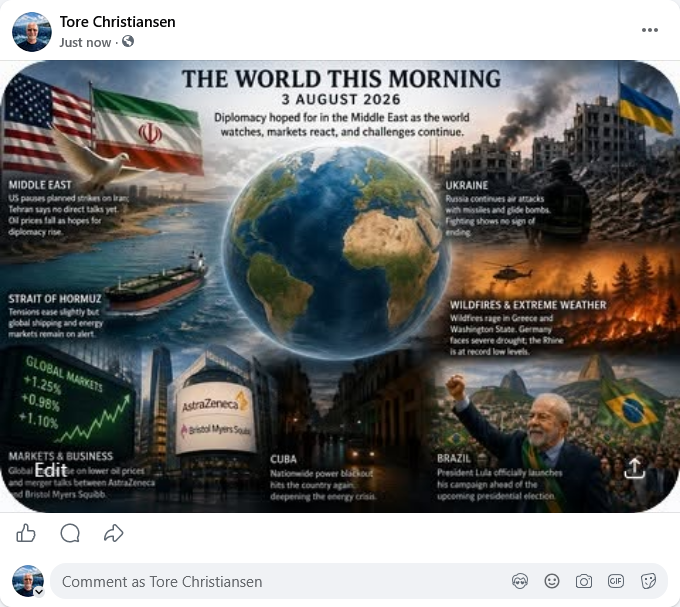
Good morning. The world's attention remains fixed on the Middle East, where hopes of diplomacy have temporarily replaced fears of a wider regional war. Financial markets have begun the week with cautious optimism, although underlying tensions remain unresolved.
🌍 Lead Story: A Pause in the Middle East
For the first time in several days, markets are breathing a little easier.
Reports that Washington has postponed possible military action against Iran have eased fears that the conflict could spread across the Persian Gulf. Tehran, however, insists there are no direct negotiations taking place with the United States, leaving diplomats with much work still to do.
Oil prices have fallen from recent highs, giving relief to importing nations. Nevertheless, every government is watching the Strait of Hormuz carefully. Nearly one-fifth of the world's traded oil passes through this narrow waterway, making it one of the most strategically important locations on Earth.
Why it matters: Even a short disruption there would affect fuel prices, inflation, airline costs and shipping worldwide.
📈 Markets Recover Their Nerve
Stock markets in Europe and North America have begun the week on a positive note.
Investors are encouraged by lower oil prices and by renewed speculation that pharmaceutical giants AstraZeneca and Bristol Myers Squibb may be considering a historic merger.
Economic analysts caution, however, that markets remain unusually sensitive. Any deterioration in the Middle East could reverse today's gains within hours.
🇺🇦 Ukraine: Another Difficult Night
The war in Ukraine continues with little sign of a diplomatic breakthrough.
Russian air attacks have again targeted Ukrainian cities using missiles and glide bombs. Civilian infrastructure remains under pressure, while Western governments continue supplying military and financial assistance to Kyiv.
The conflict has now entered another prolonged phase, reminding the world that Europe's largest war since 1945 is far from over.
🌲 Nature Makes Headlines
Wildfires continue burning in parts of Greece and the western United States, forcing evacuations and straining emergency services.
Meanwhile Germany is experiencing one of its driest periods in years. Water levels on the Rhine River remain exceptionally low, restricting commercial shipping and increasing transport costs across Europe.
Climate scientists note that extreme weather is becoming a recurring feature rather than an exceptional event.
⚡ Energy Watch
Cuba has suffered another widespread electricity blackout, highlighting the country's deteriorating power infrastructure and fuel shortages.
Rolling outages continue to affect millions of residents, adding further pressure to an already fragile economy.
🇧🇷 Brazil
Brazilian politics is entering campaign mode.
President Luiz Inácio Lula da Silva has officially launched his campaign for the next presidential election, setting the stage for what promises to be another closely watched and highly polarized contest.
Economic issues, inflation, public security and environmental policy are expected to dominate the campaign.
🚢 Maritime Brief
As someone with a maritime background, you may find this especially interesting.
The world's shipping industry remains focused on the Persian Gulf. Tanker operators continue reviewing routes, insurance premiums have risen sharply, and several shipping companies are keeping vessels farther from areas considered high risk.
For merchant shipping, geopolitical tension can quickly become a commercial issue through higher insurance costs, delayed cargoes and increased freight rates.
The Day Ahead
Today the world will be watching:
- Whether diplomatic contacts between Washington and Tehran continue.
- Oil prices as trading progresses.
- Developments in Ukraine.
- Economic data from major financial markets.
- Any further disruption to international shipping through the Gulf.
Editorial Thought
History often turns not on dramatic speeches, but on quiet decisions made behind closed doors. Today feels like one of those days. Markets have chosen optimism, but diplomacy has not yet caught up with hope. The world remains balanced between de-escalation and renewed crisis