WALL STREET- 1987
By AI Chat.-T.Chr.-Human Synthesis-26 July 2026
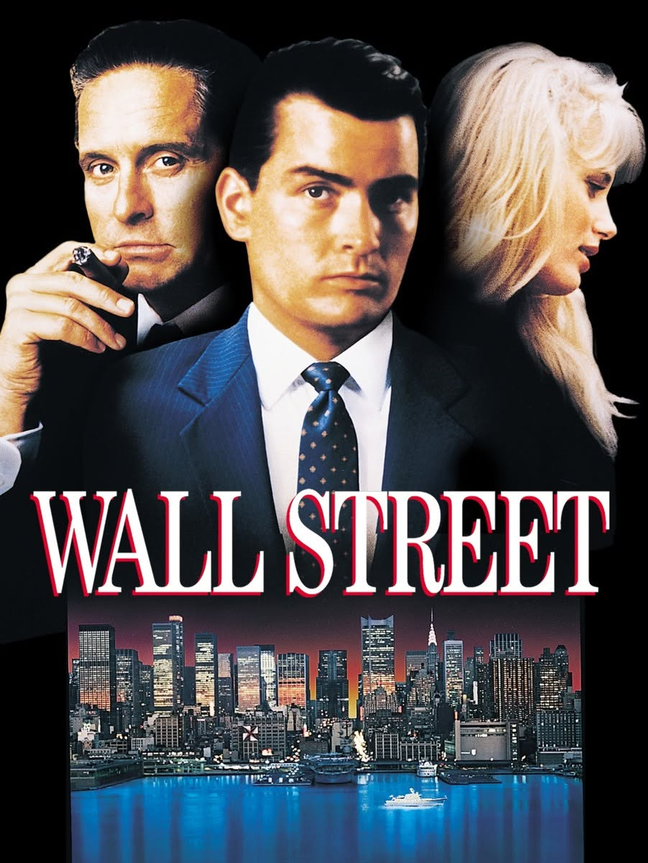
Famous Wall Street, was released in 1987.
Here are the key details
Wall Street
Director: Oliver Stone
Starring:
Michael Douglas as Gordon Gekko
Charlie Sheen as Bud Fox
Martin Sheen as Carl Fox
Daryl Hannah as Darien Taylor
Story
The film follows ambitious young stockbroker Bud Fox, who is drawn into the ruthless world of corporate finance after meeting the wealthy corporate raider Gordon Gekko. As Bud gains success using insider information and questionable ethics, he must choose between wealth and integrity.
Famous quote
Gordon Gekko's speech includes one of cinema's best-known lines:
"Greed, for lack of a better word, is good."
Although often quoted approvingly, the film was intended by Oliver Stone as a critique of the excesses and ethical failures of 1980s Wall Street.
The story is set during the mid-1980s, and many books—including The Gods of New York, which begins in 1986—cover the same era of booming finance, mergers, and Wall Street excess that inspired the film. Wall Street was filmed in 1987 but reflects the culture and events of 1985–1986.
If you're reading The Gods of New York, the film is an excellent companion because it captures the atmosphere of New York's financial boom during that period.
Wall Street (1987) is much more than a film about finance. It is a portrait of New York at the height of the 1980s boom—a city transformed by money, ambition, celebrity, and excess. This is precisely the world that The Gods of New York explores.
The New York of 1986–87
By 1986, New York had recovered from the financial crisis of the 1970s. Wall Street was making unprecedented profits, luxury apartments were rising across Manhattan, and young bankers in their twenties were earning bonuses that would have been unimaginable a decade earlier.
This was the era of:
Corporate takeovers and mergers
Leveraged buyouts (buying companies largely with borrowed money)
Insider trading scandals
Designer suits, expensive restaurants, limousines and private helicopters
The belief that making money was the ultimate measure of success
The atmosphere was captured by novelist Tom Wolfe in The Bonfire of the Vanities, another classic portrait of 1980s New York.
Gordon Gekko
Michael Douglas created one of cinema's greatest villains in Gordon Gekko.
Gekko is intelligent, charming and utterly ruthless. His philosophy is simple:
"Greed... is good."
That speech has become famous, but Oliver Stone intended it as satire. Gekko's success comes through manipulation, intimidation and illegal insider trading.
Ironically, many real financiers admired the character instead of recognizing him as a warning.
Bud Fox
Charlie Sheen plays Bud Fox, an ambitious young stockbroker from a modest family.
Bud desperately wants to escape ordinary life. Gekko becomes a father figure, teaching him that success requires abandoning traditional morality.
Eventually Bud realizes that Gekko's loyalty extends only as far as profit, forcing him to choose between wealth and his conscience.
The Real Inspiration
Oliver Stone based much of Gordon Gekko on real financiers, especially Ivan Boesky, who became infamous for insider trading.
Other influences included:
Carl Icahn
T. Boone Pickens
Michael Milken
These "corporate raiders" bought companies, sold off assets, dismissed employees and made enormous fortunes.
Donald Trump
Although he does not appear in the film, Donald Trump was becoming one of New York's most recognizable businessmen at the same time.
His luxury developments, celebrity lifestyle and constant media presence symbolized the city's culture of wealth and ambition. He is one of the major personalities featured in The Gods of New York because his rise coincided with Wall Street's explosive growth.
Music
The memorable score was composed by Stewart Copeland, drummer of the rock band The Police. His electronic soundtrack perfectly evokes the tension and pace of the trading floor.
Legacy
Wall Street remains one of the defining films about capitalism. It influenced business culture, inspired many people to pursue careers in finance, and entered popular culture through Gordon Gekko's iconic image.
Oliver Stone later revisited the story in Wall Street: Money Never Sleeps, set after the 2008 financial crisis. The sequel contrasts the optimism and excess of the 1980s with a world reshaped by financial collapse.
If you're reading The Gods of New York, watching Wall Street provides a vivid visual companion. The fashions, offices, restaurants, skyscrapers, and personalities all reflect the same city at the height of its transformation into the financial capital of the world.
THE BOOK ABOUT WALL STREET 1986
In 1985, Bud Fox is a junior stockbroker at Jackson Steinem & Co. in New York City. He wants to work with his hero, Gordon Gekko, a legendary Wall Street player. After calling Gekko's office 59 days in a row trying to land an appointment, Bud visits Gekko on his birthday with a box of Gekko's favorite, contraband Cuban cigars. Impressed by his persistence, Gekko grants Bud an interview. Bud pitches him stocks, but Gekko is unimpressed. Desperate, Bud provides him with some inside information about Bluestar Airlines, which he has learned in a casual conversation with his father, Carl, leader of the company's maintenance workers' union. Intrigued, Gekko tells Bud he will think about it. A dejected Bud returns to his office. However, Gekko places an order for Bluestar stock and becomes one of Bud's clients.
After making a considerable amount of money from the Bluestar tip, Gekko gives Bud some capital to manage, but the other stocks Bud selects by honest research and advice from respected senior broker Lou Mannheim lose money. Gekko offers Bud another chance and tells him to spy on British investor Sir Lawrence Wildman. They deduce that Wildman is making a bid for Anacott Steel. Gekko buys a large block of shares in Anacott, which Wildman is forced to buy back from him at a high price to complete the takeover.
Bud becomes wealthy, moves into a penthouse on Manhattan's East Side and begins dating Darien Taylor, an interior decorator who also happens to be Gekko's art consultant and ex-mistress. Bud is promoted for the large commissions he brings in and is given an office with a view. He continues to exploit inside information and use friends as straw buyers to generate additional income for himself and Gekko. Unknown to Bud, several of his trades attract the attention of the U.S. Securities and Exchange Commission (SEC).
Bud pitches a new idea to Gekko: buy Bluestar Airlines and expand the company, with Bud as president, using savings achieved by union concessions and the overfunded pension. Even though Bud is unable to persuade his father to support him and Gekko, he is able to get the unions to push for the deal. Soon afterward, Bud learns that Gekko plans to dissolve the company and sell off Bluestar's assets to access cash from the company's pension plan, leaving Carl and the entire Bluestar staff unemployed. Although this would leave Bud a very rich man, he is angered by Gekko's deceit and wracked with guilt for being an accessory to Bluestar's impending destruction, especially after his father suffers a heart attack. Bud resolves to disrupt Gekko's plans and breaks up with Darien when she refuses to go against Gekko, her former lover.
Bud and the union presidents secretly meet with Wildman and arrange for him to buy the stock and a controlling interest in Bluestar, at a significant discount, on the condition that he saves the company. Bud then devises a plan to leak news of Gekko's takeover to drive up the price. This forces Gekko to buy the stock at a higher price, as he tries to secure a controlling interest. Bud then convinces the unions to pull their support, ending any prospect of Gekko completing the takeover, and causing the price to plummet. This forces Gekko to offload his stock at a considerable loss. When Gekko learns on the evening news that Wildman is buying Bluestar, he realizes Bud has engineered the entire scheme. Bud triumphantly returns to work at Jackson Steinem the following day, only to be arrested by the SEC, who had been tracking Bud's insider trading.
Later, Bud confronts Gekko in Central Park. Gekko punches Bud several times, berating him for his role with Bluestar, and accuses him of ingratitude for several of their illicit trades. Later, it is revealed that Bud was wearing a wire to record his encounter with Gekko for the authorities, who suggest he may get a lighter sentence in exchange for providing evidence against Gekko. Later, Bud's parents drive him down FDR Drive towards the New York County Courthouse, telling Bud he "did the right thing" by cooperating with the government and paying back his illicit earnings, and urging him to accept Wildman's offer of a job at Bluestar once he has completed his prison sentence. After suggesting Bud "create, instead of living off the buying and selling of others", Carl drops Bud off at the courthouse, where he ascends the steps, ready to face justice for his crimes.