STAFF TURNOVER IS RAMPANT UNDER TRUMP 2.0-WITH INSIDIOUS RESULTS.
By Guardian-Arwa Mahdawi- 25 July 2026
A new report shows more Senate-confirmed staffers have left their jobs this time around than in his first term. Donald Trump loves a construction project. He’s building a ballroom, revamping a reflecting pool, and overseeing the construction of a skyline-altering arch in Washington DC. For his next real estate scheme, may I suggest a giant revolving door in the White House?
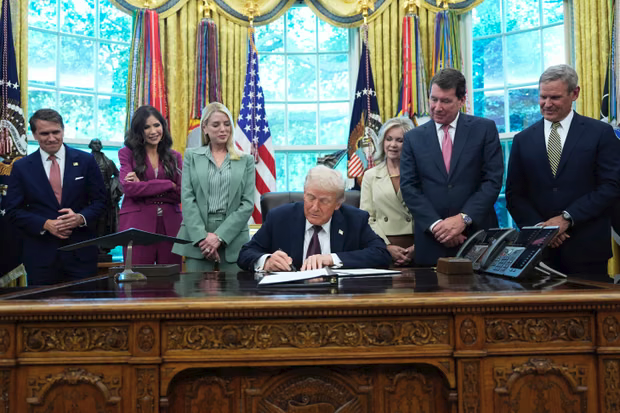
It would certainly get a lot of use: senior officials are leaving Trump’s second administration at record rates.
According to a new report called Quiet Chaos by the nonpartisan Partnership for Public Service, 27 Senate-confirmed officials have left their positions within cabinet departments to date. That’s nearly 150% higher than the 11 departures in the first 18 months of Trump’s first administration. Per the report, it is also “nearly two and a half times as many as Trump’s first administration (11) and over six times as many as the average between the George W Bush, Barack Obama and Joe Biden administrations (4.3)”.
High-profile departures, like that of homeland security secretary Kristi Noem’s, have had a lot of media coverage. But as the Partnership for Public Service note in their report, there has been “remarkably little public attention” when it comes to overall departures in Trump 2.0. Indeed, the narrative has largely been that while Trump’s first term was a chaotic mess marked by constant personnel changes, his second presidency has been far more stable.
And that narrative isn’t entirely wrong. In Trump’s first term the rapid turnover was a sign that the reality TV host and real estate nepo baby had no idea what he was doing. In Trump 2.0, however, the departures point to something far more insidious. Rather than signaling incompetence, they are fuelinga power grab by a president who seems to think of himself as a king.
“Turnover on this scale does not just thin the government’s leadership ranks – it concentrates power in the president,” Chris Piper from the Partnership for Public Service writes in a blog post. “Each seat left to an acting official is one the president can fill on his own terms without the Senate’s advice and consent: no vetting, no confirmation hearing, no vote.”
Trump himself has said he likes acting officials because the temporary nature of the position gives him more control. “And so, Acting gives you much greater flexibility,” the president said in his first term. “A lot easier to do things.” Last month Trump similarly told the Wall Street Journal that he thought the non-permanent status of Bill Pulte, his incoming acting director of national intelligence and a man sometimes referred to as “Little Trump”, was an asset. “You’re less shackled,” he said. “It sort of gives you more power, you know, for a somewhat limited period of time.”
Power, and the rapid accretion of it in the executive branch, is the overwhelming theme of Trump’s second term. The conservative supermajority in the supreme court, which Trump helped create, has been invaluable to him in this regard. In July 2024, the court ruled that former presidents are entitled to some degree of immunity from criminal prosecution, nullifying the chance of an election subversion case against him before the election.
Then, last month, the supreme court gave the president another gift: the power to fire leaders of independent agencies or commissions. The decision in Trump v Slaughter overturned Humphrey’s Executor, a 1935 ruling that the US constitution did not grant “illimitable power of removal” to the president.
Trump doesn’t quite have carte blanche to remove whomever he likes. On the same day as that decision, the supreme court ruled in Trump v Cook that the Federal Reserve was an exception to Trump’s power. Nevertheless, it is hard to overstate the significance of the Slaughter ruling, which upended almost a century of well-settled law curbing executive power.
“Today, the court discards that democratic regime in favor of one that distorts the structure of government to fit the majority’s theory of unitary, total executive control. The result is a president who emerges with far greater power than ever before,” justice Sonia Sotomayor wrote in her dissent. Trump, meanwhile, wrote on Truth Social that it was “the Greatest Increase in Presidential Power in the last 100 years”.
I highly doubt that Trump has spent significant portions of his life thinking about the constitutionality of the Humphrey’s Executor decision. But do you know who has? The people at the Heritage Foundation, who are behind Project 2025, which is widely seen as the playbook for Trump’s second term. Overturning Humphrey’s Executor is right there on page 560 of Project 2025.
Also in that playbook are steps to interfere with election administration and weaponize the Department of Justice against election officials who make decisions the Trump administration disagrees with. In other words: a strategy for influencing the upcoming election. Make no mistake: the masterminds behind Trump’s second term haven’t overseen “the Greatest Increase in Presidential Power in the last 100 years” just to easily cede that power to a Democratic president at the next election.

Arwa Mahdawi - Guardian