THE WAR SAILORS WWII

By Flipbook-Human Synthesis-20 July 2026
Alfred Garnes hailed from the coastal city of Bergen, Norway. Born and raised in the heart of this picturesque city, Alfred grew up with the sights and sounds of the sea permeating his everyday life. Surrounded by the majestic fjords and steep mountains that characterized the region, he developed a deep love for the ocean and a strong connection to his maritime heritage.
Growing up in a working-class family, Alfred witnessed first the struggles and hardships faced by his parents and community. From a young age, he felt the call of the sea, drawn to the allure of adventure and the promise of a better life. With a burning desire to explore the world beyond his hometown, he set his sights on a career at sea, embracing the opportunities it presented. Alfred's determination and strong work ethic led him to become a skilled and respected sailor. His commitment to his duties, paired with his unwavering loyalty to his crew mates, earned him a reputation for reliability and courage.
When World War II broke out, Alfred found himself thrust into a perilous situation, facing the horrors of war and the uncertainty of survival alongside his loyal friend, Wally.Despite the adversities they faced, Alfred's love for his family and his yearning to see them again served as a constant source of motivation. It was this deep-rooted connection to his home and loved ones that fueled his resilience and unwavering spirit in the face of danger. Throughout their journey, Alfred held on to the hope of reuniting with his wife, Cecilia, and their three children,longing for the day when he could return to the embrace of his family and the familiar shores of Bergen. Alfred Garnes had a big family he would give anything to protect.
Alfred Garnes cherished his family above all else, and their well being was always at the forefront of his mind. He had a loving wife named Cecilia, who stood by his side through thick and thin,supporting him in his pursuit of a seafaring career. Together, they had three beautiful children: Lars, their eldest son, Marie, their spirited daughter, and little Henrik, their precious baby boy. Alfred's love for his family was immeasurable, and he would give anything to protect them from harm. Each time he embarked on a voyage, his heart ached at the thought of leaving them behind.But he also understood the importance of his work, knowing that his dedication at sea provided for his family's livelihood and future.
As the war broke out and separated Alfred from his loved ones,his longing to see them again intensified. He could only imagine the hardships Cecilia faced in his absence, bearing the weight of raising their children alone in a world torn apart by conflict.Every letter exchanged between Alfred and Cecilia was filled with words of love, hope, and encouragement. He poured his heart onto the pages, sharing stories of his experiences at sea and assuring Cecilia that he would return to her and their children. In turn, Cecilia remained a pillar of strength for their family,shielding their children from the grim realities of war while holding on to the belief that Alfred would come back to them.
Even in the face of danger and uncertainty, Alfred's family served as a beacon of hope, giving him the strength to persevere.Thoughts of his children's laughter, his wife's warm embrace, and the joyous moments they shared together provided him with the resolve to survive and overcome the challenges that lay ahead.Throughout his harrowing journey, Alfred clung to the vision of reuniting with his family, promising himself that he would protect them with all his might. Their love and unwavering support were the driving force behind his resilience, propelling him forward a she navigated the treacherous waters of war, hoping against all odds to see his beloved family once more.
Back in Bergen, Cecilia had received news of the attack on her husband's ship. Fear gripped her heart as she imagined the worst.She refused to believe that Alfred was gone, holding onto the hope that he would return to her and their children. The war brought its own hardships to Cecilia's doorstep. Bombs fell on her city, and the destruction was devastating. When the British aircraft mistakenly targeted the school and civilian homes,the shock-waves of grief reverberated through the community.Cecilia, like many others, mourned the loss of loved ones and prayed for the safe return of those at sea. Cecilia's Struggle and 5-year war experience in Norway.
Cecilia Garnes was left behind in Bergen, Norway, faced her own set of challenges and struggles as she navigated the tumultuous landscape of war. As a wife and mother, she found herself thrust into a role of strength and resilience, shouldering the weight of their family's well-being in Alfred's absence.With Alfred at sea, Cecilia had to take on the responsibility of managing the household and providing for their children. The war brought with it a scarcity of resources, and Cecilia had to adapt to the hardships of rationing and making do with limited supplies.She became resourceful, finding ways to stretch their meagerprovisions to ensure that her children had enough to eat.
As Bergen became a target for bombing raids, Cecilia's fear for her family's safety grew exponentially. She watched in anguish as her city was transformed by the destruction of war. The bombing of the primary school at Laksevåg and civilian homes at Nøstet struck at the heart of the community, leaving a trail of devastation and loss.In the midst of such chaos, Cecilia's maternal instincts kicked into overdrive. She shielded her children from the horrors of war,doing her best to create a sense of normalcy amidst the chaos. She organized games, told stories, and sought solace in the simple joys of everyday life, determined to provide her children with a sense of security and stability.
The news of each attack and loss in the city tore at Cecilia's heart,and she mourned alongside her fellow citizens, grieving the lives lost and the destruction of their beloved Bergen. She clung to hope, seeking solace in the thought that Alfred would return to them, longing for the day when they could rebuild their lives together. Through it all, Cecilia relied on the support of her community,leaning on friends and neighbors who became like extended family during those trying times. They banded together, offering comfort, assistance, and a sense of solidarity as they weathered the storm of war. As the war drew to a close, Cecilia's resilience shone through.
She had become a pillar of strength for her children, providing them with love, guidance, and a sense of hope for the future. And when news of Alfred's survival reached her, her heart soared with a mixture of relief and joy, knowing that their family would soon be reunited. Cecilia's war experience in Norway was one of perseverance,love, and determination. She stood as a symbol of resilience amidst hardships, embodying the strength and spirit of countless women who faced the challenges of war head-on, all the while holding on to the hope of a brighter tomorrow.
The Outbreak of War
The vast expanse of the Atlantic Ocean. The year was 1939, and tensions in Europe had been steadily rising. Little did he know that his life was about to change forever.As news of the outbreak of World War II reached the ship, panic spread among the crew. The once peaceful voyage had turned into a dangerous journey through treacherous waters. German submarines lurked beneath the surface, ready to strike at any moment.Alfred's thoughts raced back to his wife, Cecilia, and their three young children back in Bergen. The worry etched on his face was mirrored by his childhood friend, Sigbjørn Kvalen, known to everyone as Wally.
They had grown up together in the small fishing village of Ålesund, and now fate had brought them together again in this perilous situation.As news of the outbreak of World War II reached the ship, panic spread among the crew. As news of the outbreak of World War II reached the ship, panic spread like wildfire among the crew. The once bustling and vibrant vessel transformed into a cauldron of fear and uncertainty.Whispers of war and the imminent dangers that awaited them circulated through the narrow corridors and cramped quarters. Crew members gathered in small groups, their voices hushed and anxious, as they exchanged rumors and shared their fears.
The reality of their situation sank in, and the weight of their vulnerability hung heavy in the air. Many of them were civilians,thrust unexpectedly into a war they never signed up for. They were unarmed and untrained for combat, their only protection was the thin veil of their merchant ship. Alfred Garnes and Sigbjørn Kvalen, caught in the middle of the unfolding chaos, felt their hearts race with a mix of apprehension and dread. They had heard tales of the brutality of war, of the merciless attacks by German submarines on innocent vessels. Now, those stories seemed closer to home than ever before. The captain's voice boomed over the intercom, attempting to maintain a semblance of order amidst the mounting chaos.
He reassured the crew that they would take all necessary precautions to avoid danger and navigate through the treacherous waters. But the reality of the situation couldn't be ignored, and the crew knew they were sailing into the heart of a conflict they couldn't fully comprehend. The once jovial atmosphere on the ship had turned somber and tense. The clatter of plates in the mess hall was replaced by hushed conversations and nervous glances. Each crew member grappled with their own fears and concerns, contemplating the uncertainty that lay ahead. As the ship continued its voyage, the crew remained on high alert,constantly scanning the horizon for any signs of danger. Every shadow in the water, every unusual ripple, sent shivers down their spines.
Their senses were heightened, and their nerves stretched thin as they anticipated the dreaded appearance of a German U-boat. Days turned into weeks, and the tension aboard the ship became palpable. Sleep became elusive, replaced by restless nights filled with anxious thoughts and vivid nightmares. The once familiar sounds of the ship creaking and the waves lapping against its hull now seemed ominous, serving as a constant reminder of the impending danger. Alfred and Sigbjørn, determined to protect themselves and their fellow crew-mates, worked tirelessly to fortify the ship's defenses.They assisted in setting up makeshift lookouts, sharpening their senses to detect any subtle signs of danger.
They huddled together, exchanging ideas and strategies to increase their chance sof survival should an attack occur. The monotony of life at sea was shattered by sporadic alarms and false alarms, as nerves frayed and imaginations played tricks one exhausted minds. Each time the ship changed course or a loud noise reverberated through the hull, hearts skipped a beat, and tensions reached a boiling point. As they sailed further into the Atlantic Ocean, the threat of a German submarine attack became an ever-present shadow,casting a pall over the entire crew. Every passing day without incident bred both relief and a sense of dread, knowing that they were merely one wrong move away from the crosshairs of .
The outbreak of war had transformed their peaceful journey into a perilous odyssey. The once familiar routines and camaraderie aboard the ship were replaced by the harsh reality of survival. Every crew member grappled with the knowledge that their lives hung in the balance and that their fate was intertwined with the whims of war. The German submarines, lurking beneath the waves, represented a formidable and unseen adversary. The crew could only imagine the devastation those vessels had wrought upon innocent ships and the lives that had been lost. The fear of becoming another statistic in the war's relentless toll weighed heavily on their minds.
Yet, amidst the fear and uncertainty, a sense of camaraderie emerged among the crew. They clung to one another, finding solace and strength in their shared plight. They supported each other emotionally, sharing stories of loved ones back home,reminding each other of the families they were fighting to protect. Alfred and Sigbjørn, with their shared history and deep bond of friendship, served as pillars of support for the crew. They provided reassurance and a sense of stability in the face of overwhelming danger. Their unwavering determination to survive and protect their loved ones inspired those around them, kindling a flicker of hope in the darkest of times.
As the ship continued its perilous journey, navigating through treacherous waters and constantly on the lookout for lurking submarines, the crew clung to the belief that they would defy the odds and make it through. They faced each day with resilience and unwavering resolve, their spirits buoyed by the hope of seeing their families again. The outbreak of World War II had thrust them into an-unimaginable situation, but they refused to surrender to fear. They would fight for survival, for the chance to embrace their loved ones once more. And with that shared determination, they pressed onward, sailing through the vast expanse of the ocean, their eyes fixed on the horizon, searching for a glimmer of hope amidst the chaos of war.
The merchant ship became a target for the German submarines,which seemed to appear out of nowhere. Torpedoes exploded around them, sending shock-waves through the ship. Chaos ensued as crew members scrambled to abandon the ship. Alfred and Wally clung to each other, desperately trying to stay afloat amidst the wreckage.Miraculously, they managed to find a makeshift raft, barely large enough to hold them both. They clung to it, their bodies battered by the unforgiving waves. Days turned into nights, and hunger gnawed at their stomachs. Each passing moment brought the constant fear of another attack.Driven by their will to survive, Alfred and Wally devised a plan.They would navigate the treacherous waters, avoiding enemy submarines and searching for other survivors.
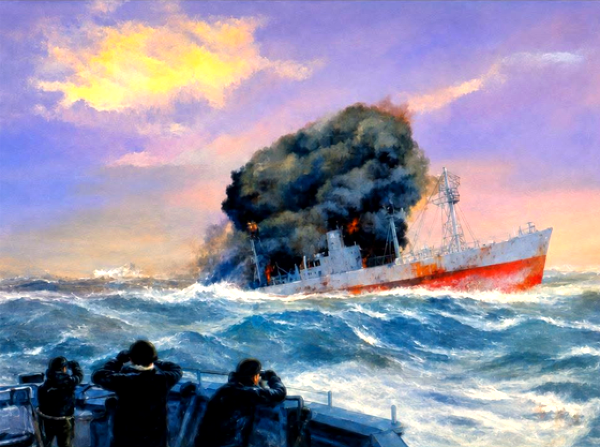
They rationed what little food they had and used their knowledge of the sea to chart a course toward safety. The submarine attack. The day was overcast, the sky heavy with dark clouds as the German submarine silently glided beneath the surface of the Atlantic Ocean. Unbeknownst to the crew of the merchant ship,danger lurked beneath the waves, ready to strike. Alfred Garnes and Sigbjørn Kvalen stood on the deck, their eyes scanning the horizon for any signs of trouble. The tension the ship was palpable, a sense of unease hanging in the air. Suddenly, without warning, the calm surface of the water erupted in a violent explosion.
A torpedo, launched from the submarine, ripped through the water, hurtling towards the merchant ship with deadly precision.The deafening blast echoed across the ocean, sending shock-waves through the vessel. The force of the explosion lifted the ship,causing it to shudder and groan under immense pressure.Pandemonium erupted as crew members scrambled for safety.The ship listed dangerously to one side, its metal hull groaning under the strain. Alfred and Wally clung to the railing, their knuckles turning white as they fought to maintain their footing.Smoke and fire engulfed the ship as the relentless attack continued.
The German submarine, its periscope disappearing beneath the surface, maneuvered for another strike. Panic spread among the crew, their voices mixing with the roar of the flames and the crashing waves. Alfred and Wally, their hearts pounding in their chests, knew they had to act swiftly if they wanted to survive. They fought their way through the chaos, dodging debris and flames, desperately searching for a means of escape. As they reached the lifeboats, another explosion shook the ship. A wall of water surged towards them, threatening to sweep them away. With a surge of adrenaline, they leaped into the lifeboat, narrowly avoiding being swept overboard.
The lifeboat crashed into the sea with a sickening thud, nearly overturning as Alfred and Wally scrambled aboard. Around them, terrified crewmen fought through oil-covered water, calling for help as burning wreckage drifted across the waves. The merchant ship, mortally wounded, groaned one last time before her stern lifted high into the air.
"She's going!" someone cried.
With a deafening roar, the ship disappeared beneath the Atlantic, dragging a whirlpool of debris into the depths. The suction pulled at the lifeboat, threatening to drag it under as well. Alfred seized an oar while Wally shouted for everyone to row with all the strength they had.
"Pull! Pull, men!" Wally yelled.
The little boat crept beyond the deadly vortex just as the sea closed over the wreck. An eerie silence followed. Only the crackle of burning oil, the cries of survivors, and the endless swell of the Atlantic broke the stillness.
There were twelve men in the lifeboat. Several were bleeding. One sailor had a broken arm, another had deep burns across his hands and face. Their supplies were pitiful—two tins of biscuits, a small keg of fresh water, a signal lamp, and a box containing a handful of distress flares.
Alfred looked over the endless horizon.
"No ship in sight," he muttered quietly.
As dusk settled over the ocean, the temperature dropped sharply. The exhausted survivors huddled together, soaked to the bone, their clothes stiff with salt and fuel oil. Every splash in the darkness made them wonder if another U-boat was nearby.
None of them dared light a flare.
The German submarine might still be watching.
Hours passed in fearful silence until the low drone of aircraft engines drifted across the clouds overhead. Every face turned skyward.
"British?" whispered one sailor.
"No..." another replied nervously. "Could be German."
The aircraft disappeared into the darkness without seeing them.
Morning brought little comfort. The sea was calm, but the blazing wreckage had vanished during the night, leaving no trace that a ship had ever existed. The men realized they were utterly alone in the vast Atlantic.
Hunger soon became their enemy. Alfred carefully divided the biscuits into tiny portions.
"One piece each," he said firmly. "No more. We don't know how long we'll be out here."
No one argued.
As the second day wore on, the sun beat mercilessly upon them. Lips cracked. Tongues swelled. Their precious water ration became only a few mouthfuls every twelve hours.
Late that afternoon, Wally suddenly pointed toward the western horizon.
"Smoke!"
Every man stood as best he could.
Far away, a thin column of black smoke rose against the sky.
Hope surged through the lifeboat.
Alfred quickly fired a red distress flare.
It arced brilliantly into the evening sky before fading into the distance.
The men watched...
...and waited.
Would the distant ship have seen it?
Or would the Atlantic once again swallow their last chance of survival?
Home to Bergen
The train wound its way through the valleys of southern Norway, climbing steadily toward the mountains before descending once more to the western coast. Alfred Garnes sat quietly by the window, scarcely noticing the magnificent scenery passing before his eyes. After nearly six years of war, countless voyages across submarine-infested seas, and the loss of so many good friends, he found it difficult to believe that he was finally going home.
In his jacket pocket lay a small bundle of letters from Cecilia. Their edges had become worn and soft from being read hundreds of times. Those precious letters had sustained him through the darkest nights in the North Atlantic, through convoy battles, Arctic storms, and the constant fear that each voyage might be his last.
As the train rounded the final curve, the familiar mountains surrounding Bergen came into view.
His heart began to pound.
"So this is home," Wally smiled, watching his friend's face.
"It never stopped being home," Alfred replied quietly.
The station platform was crowded with families eagerly searching every arriving carriage. Wives clutched flowers. Children held tiny Norwegian flags. Elderly parents stood silently, hoping that the son they had not seen for years would step onto the platform.
The train came to a halt.
For a moment Alfred could not move.
Then he stepped down.
Across the crowd he saw her.
Cecilia.
She looked older than when he had left. The years of occupation had etched worry upon her face, yet her eyes remained exactly as he remembered.
She stared at him in disbelief.
Neither spoke.
Then she ran.
Alfred dropped his duffel bag as she threw herself into his arms.
For several moments they simply held one another.
No words were needed.
Behind Cecilia stood three children.
Lars was almost a young man now.
Marie had become a graceful young girl.
Little Henrik...
Alfred stopped.
The tiny baby he had kissed goodbye before sailing away was now a schoolboy hiding shyly behind his mother's coat.
Henrik looked uncertain.
"Mamma...is that Father?"
Cecilia gently nodded.
The boy slowly stepped forward.
Alfred knelt before him.
"I've waited a long time to meet you again."
Henrik studied the stranger's weather-beaten face before suddenly throwing his arms around him.
"I knew you'd come home."
Alfred closed his eyes.
For the first time since the war began, he allowed himself to cry.
They walked slowly through the streets of Bergen.
Although peace had returned, the scars of occupation remained everywhere. Buildings still bore bomb damage. Empty lots marked places where homes had once stood. The people smiled more easily now, but every family carried memories of someone who had never returned.
Neighbours emerged from their houses.
"Welcome home, Alfred!"
"We heard your ship had been sunk!"
"We thought we'd lost you!"
One elderly fisherman removed his cap.
"You war sailors kept Norway alive."
Alfred smiled humbly.
"We simply did our duty."
That evening Cecilia prepared the finest meal their ration books would allow.
The family gathered around the table.
There was laughter.
There were stories.
There were awkward silences as children tried to know the father they could scarcely remember.
Long after the children had gone to bed, Alfred and Cecilia sat quietly beside the window overlooking the harbour.
Ships moved peacefully across the water.
No blackout.
No air-raid sirens.
No fear.
"It's finally over," Cecilia whispered.
Alfred reached for her hand.
"Yes."
"But we'll never forget."
Epilogue – The Forgotten Heroes
In the years that followed, life slowly returned to normal.
Alfred sailed for several more years before finally retiring to spend the rest of his life with Cecilia and their family in Bergen.
Wally also continued his career at sea, remaining Alfred's closest friend until old age.
Yet the memories of war never completely faded.
Sometimes, on quiet evenings, Alfred would stand overlooking the harbour and think of the men who had never returned.
He remembered the ships swallowed by the Atlantic.
The freezing Arctic convoys.
The screams in the darkness.
The lifeboats drifting beneath endless skies.
The friends whose graves would forever remain beneath the sea.
Many years passed before the Norwegian War Sailors received the recognition they deserved.
Throughout the Second World War, the Norwegian Merchant Navy became one of the largest Allied merchant fleets in the world. Sailing under constant threat from German U-boats, aircraft, and mines, these civilian seamen delivered the fuel, food, ammunition, tanks, and supplies that kept Britain alive and sustained the Allied war effort.
More than 3,700 Norwegian merchant seamen lost their lives during the war. Thousands more returned carrying wounds that could not be seen.
Their courage rarely appeared in history books.
They wore no medals in battle.
They carried no rifles.
Yet every voyage was a battle.
Every convoy was a gamble with death.
Every arrival in port was another small victory.
Alfred often told his grandchildren,
"People remember the soldiers who fought on land. But wars are also won by the ships that keep a nation alive."
His grandchildren listened with fascination as he unfolded faded photographs, worn charts, and weathered letters from Cecilia.
To them he was simply Bestefar.
To history he was one of the thousands of Norwegian war sailors whose bravery helped secure the freedom of Europe.
As the sun set over Bergen harbour, Alfred looked across the calm waters where fishing boats and merchant ships moved peacefully toward the North Sea.
The sea had given him a livelihood.
It had taken many friends.
It had tested his courage beyond measure.
But it had also brought him home.
He removed his cap for a moment and quietly whispered the names of those who had never returned.
Then he turned toward the lights of Bergen, where Cecilia waited by the window.
Together they walked home, grateful for every ordinary day that peace had given them.