GOYA BUILT NORWAY 1940

By AI Chat-T.Chr.-Human Synthesis-21 July 2026
The story of the Goya is one of the most tragic episodes of the Second World War. Originally, Goya was a Norwegian-built motor cargo ship, launched in 1940.
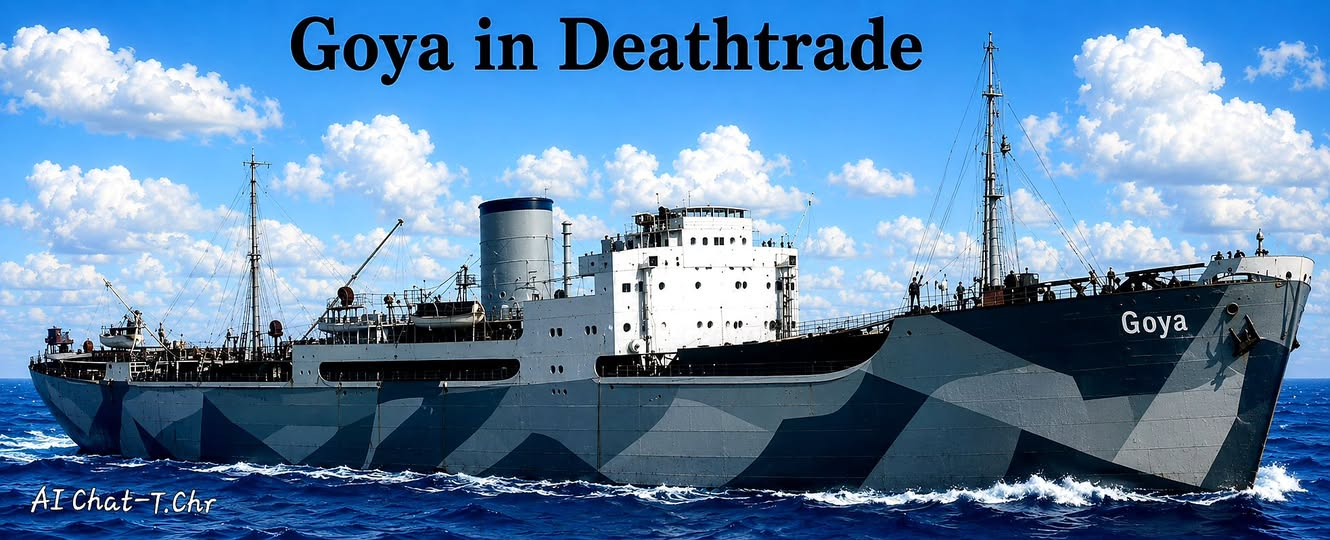
After Germany occupied Norway, she was seized by the Germans and used as a transport vessel. During the war she carried a variety of cargoes, including military supplies, making her part of the German wartime transport system.
The phrase "Deathtrade" is not an official historical title, but it can be used to describe her wartime role because she transported matériel that supported the German war effort.
After the war however, Goya's role changed dramatically. She was assigned to Operation Hannibal, the massive evacuation of civilians, wounded German soldiers and military personnel fleeing the advancing Soviet Army across the Baltic Sea.
On the night of 16 April 1945, while sailing in the Baltic Sea, Goya was struck by torpedoes fired by the Soviet submarine L-3. She sank within only a few minutes. An estimated 6,000 to over 7,000 German people were aboard, but only around 180–200 survived. It is regarded as one of the worst maritime disasters in history, with a loss of life greater than that of the Titanic.
1940–1944: A cargo ship serving the German war economy, transporting supplies during the conflict.
1945: Transformed into an evacuation ship carrying thousands of refugees and wounded people before being sunk in the Baltic Sea, resulting in a catastrophic loss of life.
That contrast—from a wartime cargo carrier to the scene of one of history's greatest maritime tragedies—makes Goya's story particularly compelling.