THE WORLD IS ON FIRE
By AI Chat-T.Chr.-Human Synthesis-09 July 2026
As of today, 08 July 2026, the United States and Iran are again in active armed conflict. Following the collapse of a ceasefire, the U.S. has resumed large-scale airstrikes against Iranian military targets, and Iran has responded with missile and drone attacks against the U. S. interests and regional allies. Fighting around the Strait of Hormuz has intensified, and both sides describe the ceasefire as effectively over. Reuters +1
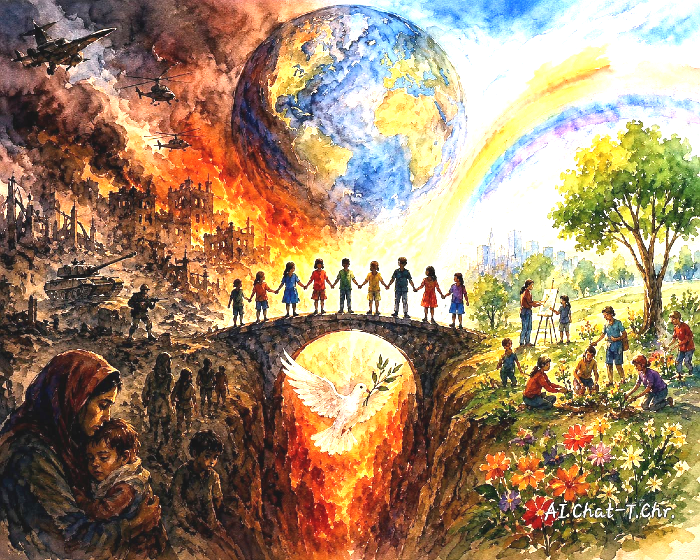
So, among the major wars and conflicts, it would now include:Russia–UkraineUnited States–IranIsrael–Iran and allied groupsSudan civil warMyanmar civil warYemen conflictFighting in Democratic Republic of the CongoMultiple insurgencies across the SahelUnfortunately, the number of serious armed conflicts worldwide remains at one of the highest levels seen since the end of the Second World War.Reuters +1
So, what can we do about it?
That is one of the biggest questions in history, and there is no single answer that scholars agree on. Most historians, political scientists, and psychologists see today's conflicts as the result of many forces interacting, rather than one cause that has "afflicted humanity."Some of the major factors include:
Competition for power and security.
Governments often believe they must become stronger because they fear rivals.
One country's attempt to increase its security can make another feel threatened, leading to an arms race or war.
Nationalism and identity. Ethnic, religious, or national identities can unite societies, but they can also deepen divisions when leaders frame conflicts as existential struggles.
Territory and resources. Land, water, energy, minerals, and strategic locations remain major causes of disputes.
Authoritarian leadership and political ambition. Some leaders use external conflicts to strengthen their domestic position or pursue long-held territorial or ideological goals.
Economic pressures. Inflation, inequality, sanctions, and competition over trade and technology can increase international tensions.
Rapid technological change. Cyber warfare, drones, artificial intelligence, and social media allow conflicts to spread faster and make misinformation easier to disseminate.
Weak international institutions. Organizations created after the Second World War have often struggled to prevent or stop conflicts when major powers disagree.
On a deeper level, many philosophers and religious traditions have argued that humans possess both a capacity for cooperation and a capacity for fear, aggression, and domination. Thinkers as different as Thomas Hobbes, Jean-Jacques Rousseau, and Sigmund Freud each offered different explanations for why societies repeatedly fall into conflict. At the same time, it's worth remembering that war can dominate the news while not representing the whole of humanity. Most people, in every country, are not fighting. They are raising families, working, helping neighbors, and hoping for peace.
Finally, history suggests that despair is a poor guide. Humanity has endured devastating wars, pandemics, and famines before. Recovery was not inevitable—it came through difficult choices made by leaders and ordinary people alike. Perhaps the advice could be summarized simply: Be slow to hate, quick to seek understanding, firm in defending human dignity, and persistent in working for peace. That does not solve geopolitical conflicts overnight, but it addresses something that every generation has had to confront: the temptation to answer fear with more fear, and violence with more violence.
While governments bear enormous responsibility for war and peace, the values held by millions of ordinary people also shape the societies in which those governments operate. These are difficult questions, and people have wrestled with them for thousands of years. Despite all the turmoil, one thing that gives me some perspective is this: history is not only a record of wars. It is also a record of people rebuilding after wars, reconciling with former enemies, creating art, making scientific discoveries, and caring for one another. The Norwegian writer Fridtjof Nansen once said: "The difficult is what takes a little time; the impossible is what takes a little longer."
Whether one is optimistic or pessimistic about the future, that thought reminds us that today's crises do not necessarily determine tomorrow's world.
End