THE STRANGER AT BLACKWATER HOUSE
By AI Chat-T.Chr.-Human Synthesis-24 June 2026
The storm arrived just after midnight. Rain hammered the windows of Blackwater House while the wind clawed at the old stone walls. Inside, the guests gathered around the drawing-room fire, speaking loudly to drown out the weather.
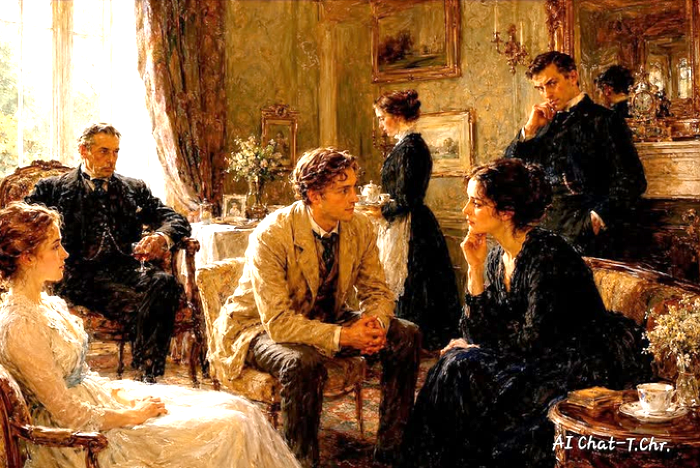
Lord Harrington was telling a hunting story. His daughter, Clara, pretended to listen. Victor Kane stared into his whisky glass. And beside the fireplace sat Helena Ashcroft, beautiful and restless, wearing a black dress that seemed to absorb the firelight.
Then the front door burst open. A servant hurried into the room. "There's a man outside, sir. His horse collapsed on the road." The guests exchanged annoyed glances. No one wanted interruptions
"Bring him in," said Lord Harrington. Moments later the stranger entered.He was soaked from head to toe. His coat was torn. Rainwater dripped onto the carpet. Yet despite his miserable appearance, his face carried a curious calmness.
"Forgive me," he said. "I would not have disturbed you, but the storm left me little choice." The servant offered him a towel. The stranger smiled warmly. "Thank you."
The simple sincerity of his voice caused several people to glance up. Most guests accepted kindness as a service. This man accepted it as a gift.
"My name is Daniel Grey," he said. No title. No rank. No attempt to impress. Victor Kane immediately disliked him. Helena Ashcroft immediately noticed him. And Clara Harrington immediately wondered why everyone had become so quiet.
Daniel was invited to stay the night.
At supper he spoke little, but listened carefully. When others talked, he paid attention in a way that made them feel strangely important. People began revealing more than they intended.
Lord Harrington complained about his failing health. Clara confessed her dream of seeing the world. Even the servants lingered nearby when Daniel spoke.
Only Victor Kane remained suspicious. "There is something odd about that fellow," he muttered later. "What?" Clara asked. "He has no ambition." She laughed. "That is hardly a crime." "No," Victor said. "It is unnatural."
The following morning, the storm had passed. A pale sun illuminated the grounds.
Daniel walked through the gardens and found Helena sitting beside the frozen fountain. She held a letter in her hands. Her eyes were red. "You should not be here," she said. "I can leave." "You are not curious why I am crying?" Daniel sat beside her. "People cry for many reasons."
Helena studied him. Most men rushed toward her sadness like hunters spotting prey. They wanted secrets, intimacy, advantage. Daniel simply waited.. For some reason, that frightened her. "My fiancé died three years ago," she said quietly.
"I am sorry." "Everyone says that." "Then perhaps I should say nothing." She looked at him. No one had ever answered that way. For the first time in years, Helena felt seen rather than examined.
Over the next week Daniel remained at Blackwater House while his injured horse recovered. The household slowly changed around him. Servants smiled more. Arguments ended sooner. Even Lord Harrington seemed less bitter.
Yet not everyone welcomed the change. Victor Kane watched Daniel carefully. Victor had spent years pursuing Helena. He wanted her wealth, her beauty, her social position. He also wanted her love. Though he never understood the difference.
One evening he found Helena laughing with Daniel in the library. Jealousy struck him like a knife. "What amusing philosophy are we discussing tonight?" Victor asked coldly. Helena rolled her eyes. "Nothing. We were speaking about childhood." Daniel smiled.
Victor hated that smile. There was no challenge in it. No rivalry. No fear. A man who refuses to compete is difficult to defeat.
Weeks passed. Then came the fire.
It began in the west wing shortly after midnight. A lantern overturned. Curtains ignited. Within minutes flames raced through the upper floor. Panic exploded through the house. Guests screamed. Servants ran through smoke-filled corridors.
Lord Harrington collapsed while attempting to escape. Clara became trapped behind a burning staircase. Chaos consumed everything. Daniel did not hesitate. He plunged into the smoke. The heat was unbearable. Flames crawled across the walls like living creatures.
Twice he nearly fell. Three times he lost his way. But he found Clara. The young woman was unconscious. He carried her through collapsing hallways and emerged into the night just as part of the roof crashed inward.
The crowd cheered. But Daniel did not stop. "Helena!" someone shouted. No one had seen Helena. Without a word, Daniel turned and ran back into the burning house. Victor stared after him. For one terrible moment he realized something.
Daniel loved Helena.
Not possessively. Not selfishly. Not because he wanted anything. He simply loved her. The realization filled Victor with shame. Because Victor himself had never loved anyone that way.
Inside, Blackwater House had become an inferno. Daniel found Helena trapped beneath a fallen beam. Together they struggled toward an upstairs window. Smoke filled their lungs. The floor groaned beneath them. "We are not getting out," Helena whispered.
Daniel smiled through the soot. "Let's try anyway." They reached the window. Outside, servants stretched blankets below. The drop was nearly thirty feet.
Too high. Too dangerous. Daniel helped Helena onto the ledge.
"You first." "No." "Please."
Flames erupted behind them. There was no more time. Helena jumped. The servants caught her. Daniel prepared to follow. Then part of the ceiling collapsed. The room vanished in fire.
A gasp rose from the crowd. Seconds passed. Then another. No one moved. No one spoke. At last a figure emerged through smoke on the roof itself.
Daniel. Burned. Bleeding. Alive.
He slid down a section of collapsing timber and dropped into the darkness below. Strong hands pulled him clear.
The house continued burning until dawn. By sunrise, Blackwater House was a blackened skeleton.
Weeks later Daniel recovered slowly from his injuries. The household visited him often. Even Victor. One evening Victor arrived alone. He stood awkwardly beside the bed.
"I owe you an apology." Daniel looked surprised. "For what?" "For hating you."
Daniel laughed softly. "That seems unnecessary." "No," Victor said. "I think it is necessary."
Silence followed.
Then Victor asked the question that had haunted him for months. "Why did you go back into that fire?" Daniel thought for a moment. "Because someone was still inside." Victor waited.
Surely there must be more. There wasn't. No speech. No heroism. No philosophy.
Just a simple answer. Because someone was still inside. Years later people still spoke of the fire at Blackwater House. Some remembered the destruction. Others remembered the rescue.
But those who knew Daniel best remembered something else. In a world where nearly everyone calculated advantage before acting, he had moved toward danger simply because another person needed help.
Many considered him foolish. Some called him naïve. A few called him extraordinary. But all of them, secretly, wondered the same thing:
Had they mistaken cynicism for wisdom all their lives? And was the stranger who could not pretend the only truly sane person among them?
PHILOSOPHICAL OVERVIEW
The story of Daniel Grey is not really about a fire, a country house, or even the people he saved.
It is about a form of goodness that modern society often struggles to understand.
Most people in Blackwater House measured life through exchange. Affection was traded for security. Friendship was balanced against advantage. Love was mixed with possession. Even kindness often carried an expectation of return.
Daniel operated according to a different principle.
He saw people not as opportunities, threats, rivals, or social roles, but simply as human beings deserving of compassion. Because of this, others found him both attractive and unsettling. His sincerity exposed the hidden calculations beneath their own behavior.
Victor could not understand him because Victor believed desire and love were the same thing.
Helena could not fully trust him because she had spent years believing herself unworthy of unconditional acceptance.
Even the household itself was disturbed by his presence, for he revealed how much of ordinary social life depends upon performance rather than truth.
The fire merely made visible what had always existed beneath the surface.
When danger arrived, every person acted according to their deepest nature. Some fled. Some hesitated. Some calculated risk. Daniel moved toward those in need without considering reward, reputation, or consequence.
His actions raise a difficult question.
Is such goodness wisdom, or is it a kind of beautiful foolishness?
The world often rewards caution, ambition, and self-protection. Yet societies also praise courage, compassion, and self-sacrifice. The contradiction lies at the heart of the human condition: we admire virtues that we may be unwilling to practice ourselves.
Daniel's greatest challenge is not surviving the fire. It is existing in a world that interprets innocence as naivety and kindness as weakness. His presence forces others to confront the possibility that cynicism may not be evidence of intelligence, but merely a defense against disappointment.
The story offers no simple answer.
It does not claim that goodness always triumphs, nor that compassion can solve every human conflict.
Instead, it suggests something quieter.
That genuine goodness remains one of the rarest and most disruptive forces in human life—not because it is powerless, but because it asks people to abandon the masks behind which they have learned to live.
And perhaps that is why people called such men fools throughout history.
Not because they understood less than everyone else.
But because they dared to live according to truths that everyone else had forgotten.