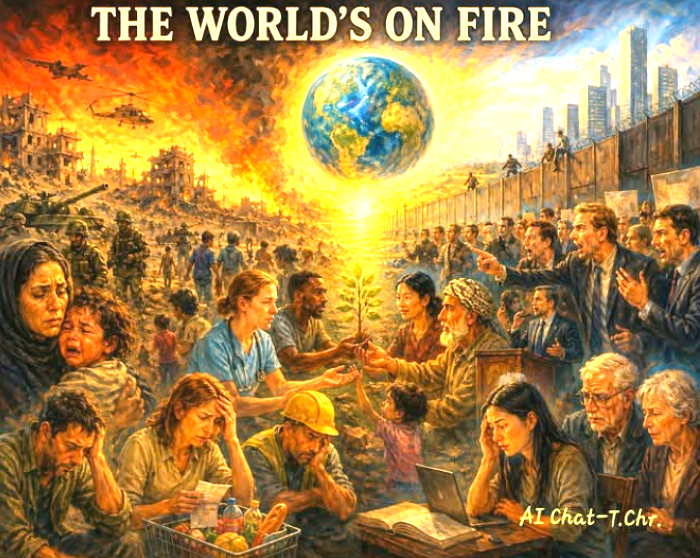
THE WORLD'S ON FIRE
By AI Chat-T.Chr.-Human Synthesis-11 June 2026
Turn on the news almost anywhere on Earth and the pattern is difficult to miss. Wars continue. Cities are bombed. Soldiers die. Civilians flee. Humanitarian agencies warn of rising hunger across parts of Africa, the Middle East, and other regions. Food insecurity affects hundreds of millions.
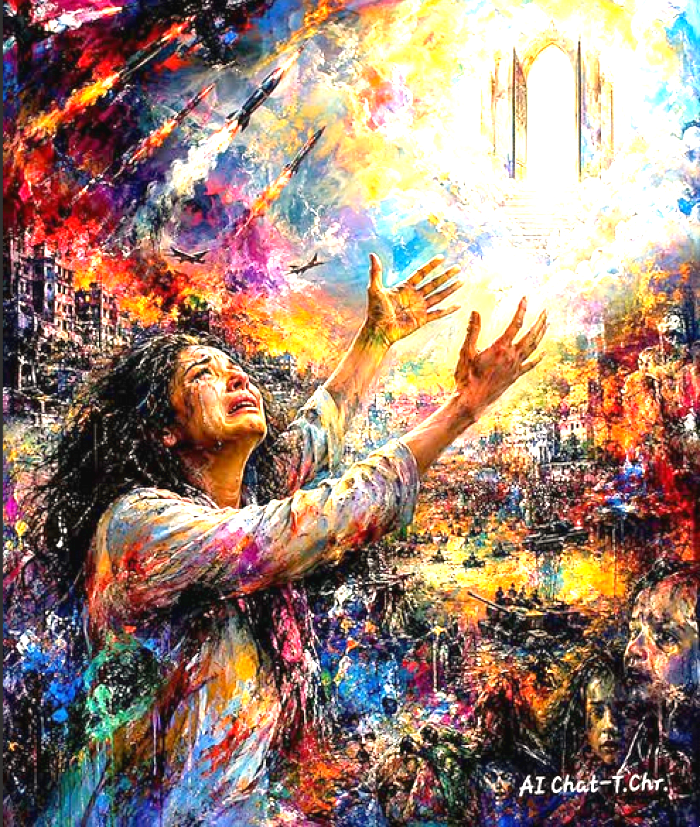
At the same time, much of the world faces a cost-of-living crisis. Housing is becoming unaffordable for many. Energy costs remain high. Food prices strain household budgets. Young people wonder whether they will ever own a home. Pensioners worry about making ends meet.
Political unrest follows economic pressure. Demonstrations erupt over fuel prices, wages, housing shortages, government policies, and declining living standards. Trust in institutions weakens. Political divisions deepen.
Immigration has become one of the most contentious issues of our time. Across many countries, citizens ask difficult questions. Why are so many people arriving? How many can a nation absorb? Who should bear the cost? What happens to national identity, culture, housing, and public services when migration occurs on a large scale?
Many people look at the situation and ask:
"Why can people not stay and develop their own land and fight their own battles internally instead of roaming to other lands that do not want them?"
Those who hold this view argue that every nation must ultimately be built by its own people. They believe that if citizens leave struggling countries in large numbers, those countries may never develop the institutions, industries, and stability needed to prosper. They point to pressure on housing, healthcare, education, and employment in receiving nations and argue that charity cannot replace national responsibility.
Others answer that many migrants are not leaving because they wish to abandon their homeland. They are leaving because war, political persecution, organized crime, famine, economic collapse, or environmental disasters have made ordinary life nearly impossible. A farmer cannot cultivate land under artillery fire. A shopkeeper cannot build a business amid civil war. A parent faced with hunger or violence often chooses survival over patriotism.
The result is a clash of realities.
The citizen in the receiving country asks:
"Why should we solve problems created elsewhere?"
The migrant asks:
"How do I stay when my family cannot survive?"
Neither question disappears simply because it is uncomfortable.
Meanwhile, global pressures continue to feed one another.
War disrupts trade.
Disrupted trade raises prices.
Higher prices fuel public anger.
Public anger fuels political polarization.
Polarization makes compromise more difficult.
And without compromise, solutions become harder to find.
The modern world is therefore not facing a single crisis. It is facing many crises at once.
Wars.
Migration.
Inflation.
Housing shortages.
Political division.
Food insecurity.
Economic uncertainty.
Each problem strengthens the others.
The headlines reflect a world under strain from multiple directions simultaneously. Governments struggle to maintain stability. Citizens worry about their future. Migrants search for safety and opportunity. Aid agencies warn of worsening humanitarian conditions. Economists warn of growing pressures on public finances and living standards.
The world is not simply on fire. It is a world wrestling with competing needs, competing fears, and competing visions of the future.
One side demands compassion.
Another demands borders.
One side speaks of human rights.
Another speaks of national sovereignty.
One side sees desperate people seeking refuge.
Another sees communities already struggling to cope.
The debate grows louder because the stakes are high for everyone involved.
And so the defining question of our age may not be whether these problems exist. They clearly do.
The question is whether nations can address war, migration, affordability, and social cohesion before today's pressures become tomorrow's crises.
For now, the fires burn in many places at once, and much of humanity is searching for a way through the smoke.