THE HOUSE AT TIDE'S EDGE

By AI Chat-T.Chr.-Human Synthesis-10 June 2026
The villagers called it The House at Tide's Edge. Long before the walls cracked and the paint peeled away, it had been the grandest home on the coast. Its balconies overlooked the sea, and on clear mornings the windows blazed with sunlight like polished gold.
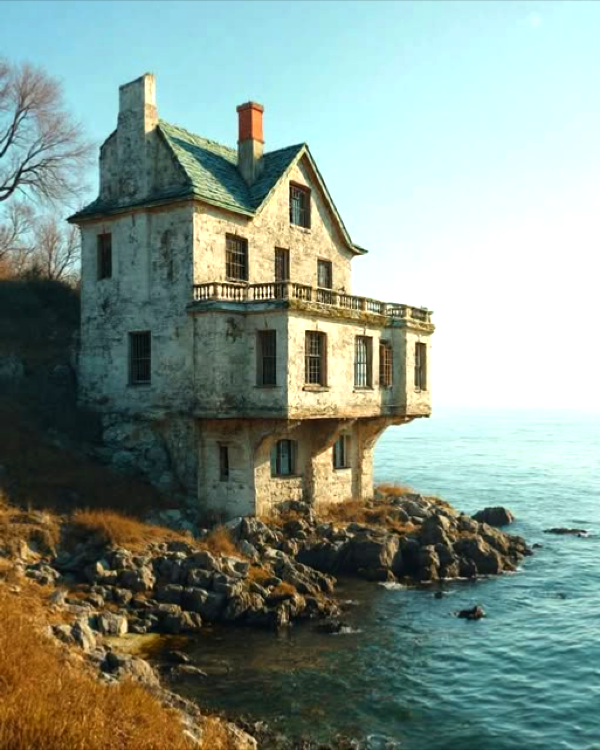
A sea captain named Elias built it for his wife Anna and their only daughter Sofie. For years the house was filled with laughter. Anna played piano in the evenings. Sofie chased gulls among the rocks below. Elias returned from distant voyages carrying strange shells and stories from lands beyond the horizon.
Then came the winter storm.
It arrived without warning, a black wall of cloud swallowing the sky. Fishing boats hurried toward shore, but Elias's vessel was still far out at sea. The storm raged for three days. Anna stood on the balcony every hour, staring into the darkness, convinced she would see the lantern of his ship. She never did. When the sea finally calmed, fragments of wreckage washed onto the rocks beneath the house. No bodies were found. No final words were delivered. Only silence.
Anna never recovered from the uncertainty. Had he drowned? Had he survived and been carried somewhere beyond the horizon? Not knowing became a wound deeper than grief itself. Each evening she lit a lamp in the highest window. One light. A beacon. A promise. "If he comes home," she told Sofie, "he must know where to find us."
Years passed. The village changed. Children became adults. Fishermen grew old. But every night the lamp still burned. Then illness came for Anna. On her final evening she asked Sofie to continue lighting the lamp. "Just one more year," she whispered. Sofie promised.
One year became ten. Ten became twenty. Suitors came and left. Friends moved away. The world beyond the cliffs modernized and hurried forward. But Sofie remained. Every sunset she climbed the narrow stairs and lit the lamp. The villagers began to think the house itself was waiting.
One autumn evening, when Sofie was already old, a storm rose from the sea much like the one that had taken her father. She climbed to the upper room with trembling hands. The lamp flickered. The wind screamed through the cracks in the walls. For the first time in her life she wondered whether her father had ever survived that storm. Whether all those years had been spent waiting for a ghost. The lamp went out. Sofie re-lit it. Again the wind extinguished it. A third time she tried. As she shielded the flame with her hands, she looked across the black water.
Far out at sea she saw a single light.
Another lamp.
Moving slowly toward shore.
Her heart leapt.
After half a century, could it be?
The light drew closer.
Closer.
Then vanished beneath a wave.
Gone.
Forever.
No ship arrived. No voice called her name. Only darkness remained.
The next morning the villagers found the lamp still glowing in the window, but Sofie was gone. They searched the shoreline and the rocks below. Nothing. No trace. Only the sea rolling endlessly against the foundations of the old house.
The years after Sofie's disappearance became years of whispers. Fishermen avoided the cove after sunset. Children dared one another to approach the old gate and touch the weathered stone wall. None stayed long. The silence around the house seemed different from ordinary silence. It felt as though someone was listening.
The sea continued its patient work. Storm after storm struck the coast. Windows shattered. Balcony railings cracked. Salt and wind gnawed at the walls. Yet the house refused to fall. It remained balanced between land and water, as stubborn as the people who had once lived there.
Nearly forty years later a young schoolteacher named Martin arrived in the village. Unlike the others, he loved old stories. One bright afternoon he crossed the rocks and entered the abandoned house. Dust lay thick across the floors. Sea air drifted through broken panes. The piano Anna had once played still stood in a corner beneath a blanket of grey dust.
Martin climbed to the highest room and found a journal. Its leather cover was cracked with age. Inside were Sofie's writings. Page after page. Year after year.
At first the entries were hopeful.
Father may come tomorrow.
The sea was calm today. A good day for ships.
I dreamed I heard his voice below the cliff.
But as the years passed the handwriting changed. The lines grew weaker. The words shorter.
Another winter.
Still waiting.
Mother would have been seventy today.
I no longer remember Father's face.
Then Martin reached the final page.
I finally understand. The lamp was never for Father. It was for me. If I stopped lighting it, I would have to admit he was gone. Tomorrow I shall light it once more.
There were no further entries.
Martin closed the journal and sat quietly by the window. Outside, the sea stretched endlessly toward the horizon. For the first time he understood the tragedy of the house. It was not built from stone. It was built from waiting. Waiting had become its foundation. Waiting had filled its rooms. Waiting had consumed three generations of a family.
That night a violent storm arrived, the strongest in decades. Rain lashed the coast. Thunder shook the cliffs. The villagers feared the old house would finally collapse into the sea. At dawn they hurried to the shoreline. The storm clouds were breaking apart. Golden light spilled across the water. The house still stood—damaged, leaning, but standing.
Then someone pointed toward the highest window.
A faint glow burned there.
A single light.
Steady and warm.
The villagers stared in silence. No one had entered the house. No lamp should have remained. Yet the light shone for several minutes before slowly fading into the morning sun.
Years later the house finally surrendered to time. One winter night part of the cliff gave way. The sea carried the foundations into the dark water below. By morning only scattered stones remained. The villagers gathered on the shore in silence. Many felt they were attending a funeral—not for a building, but for a promise, for a family, for all the years that had been sacrificed to hope.
Today the waves roll over the place where the house once stood. Nothing remains above the surface. Yet old sailors still tell a story. They say that on foggy nights, when the sea is perfectly still, a lonely light appears far from shore. Not a lighthouse. Not a boat. Just a small golden flame floating upon the darkness. And those who see it feel an overwhelming sadness, as though the ocean itself remembers.
For some griefs do not end. They simply become part of the landscape—like a cliff, like the sea, like a lamp that burned for sixty years waiting for a man who never came home.