SOLITUDE-THE SLOW MACHINERY OF ADAPTION
By AI Chat-T.Chr.-Human Synthesis-09 June 2026
People adapt with astonishing speed. They always have. They adapt to new love as though it had always lived beside them. They adapt to war as though the sound of distant explosions were merely another weather pattern crossing the horizon. They adapt to poverty and prosperity, to comfort and hardship, to kindness and cruelty. What once seemed impossible becomes ordinary. What once inspired awe becomes furniture in the room of daily existence.
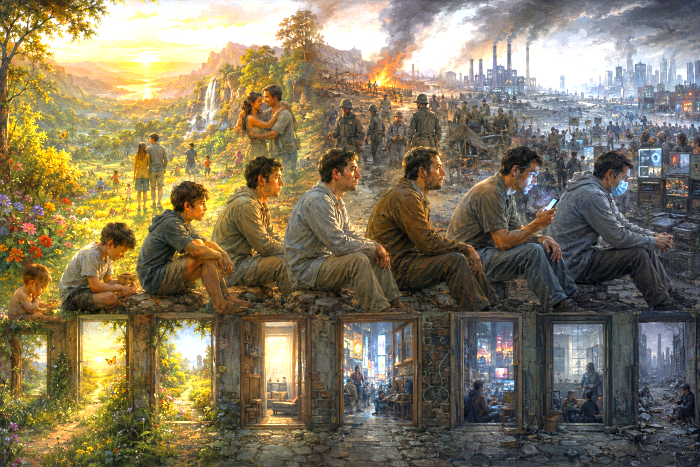
A person waits years for happiness, and when it finally arrives, it feels like a miracle. Yet before long that miracle is folded quietly into routine. The house that once felt like a palace becomes merely a place where dishes need washing. The embrace that once caused the heart to race becomes expected. The sunrise that once stopped a traveler in his tracks becomes another event beyond the window while thoughts drift toward errands and obligations. Human beings possess the remarkable ability to survive change, but hidden within that gift is a strange tragedy: they also lose the ability to see the wonder of what they have survived to obtain.
The same mechanism works in darkness. A people hear of distant suffering and shudder. New laws arrive. New restrictions appear. New fears settle over society like fine dust. There is discussion, concern, outrage, and debate. Voices rise for a while. Then the dust becomes part of the landscape. What was alarming yesterday becomes normal today. The mind adjusts. It always adjusts.
The world has witnessed this cycle endlessly. Conflicts emerge on one continent while another watches through glowing screens. Cities burn. Families flee. Nations divide. For a brief moment the suffering captures attention. Then newer events arrive, louder headlines replace older ones, and concern drifts elsewhere. Human beings continue with their meals, their errands, and their conversations. Life demands movement, and so movement continues. Only when the distant fire approaches their own fields do they truly feel its heat. Only when the knock comes to their own door does the abstract become real.
Adaptation protects the mind from collapse. Without it, every grief would be unbearable and every joy would overwhelm us. Yet adaptation is also the reason entire societies can drift slowly into conditions they would once have fiercely resisted. A gradual change rarely announces itself as danger. It arrives in small increments, each one easier to accept than the last. The extraordinary becomes ordinary. The unacceptable becomes tolerated. The intolerable becomes expected.
Philosophers have long admired adaptation as one of nature's greatest achievements. It is the trait that allows life to endure droughts, winters, disasters, and upheavals. Intelligence itself is often measured by flexibility—the capacity to adjust when circumstances change. The species that survives is not always the strongest, but the one most capable of adaptation.
Yet there remains a question seldom asked.
What if adaptation is not merely a strength?
What if it is also a blindness?
For every adjustment gained, something is lost. The ability to endure suffering may come at the cost of noticing it. The ability to normalize blessings may come at the cost of gratitude. The ability to continue may come at the cost of understanding what is being left behind.
In the wild, a lion adapts to shifting seasons, migrating prey, and rival predators. Yet no other creature truly knows the workings of the lion's mind. His fears remain his own. His calculations remain hidden. His solitude exists even while surrounded by life. He survives because he adapts, but his inner world remains a mystery.
Human beings are not so different.
Each person carries a private kingdom of thoughts invisible to everyone else. We assume we understand one another because we share language, customs, and stories. Yet beneath every conversation lies an unknowable depth. Every individual walks through life accompanied by silent fears, secret hopes, forgotten wounds, and unanswered questions. Entire civilizations are built upon the illusion of complete understanding, while every mind remains fundamentally alone.
Perhaps this is why adaptation comes so naturally to us. We are solitary creatures pretending, for brief moments, that we are not. We adjust because existence demands it. We normalize wonder because wonder cannot be sustained indefinitely. We normalize suffering because suffering cannot be carried every waking hour. We continue because stopping would mean confronting the vast uncertainty beneath our feet.
And so humanity moves forward through centuries. New loves replace old ones. New wars replace old wars. New fears arrive dressed in unfamiliar clothing. New technologies promise salvation. New leaders promise certainty. New generations inherit the habits and assumptions of those who came before. The machinery of adaptation turns slowly and endlessly, smoothing every sharp edge it encounters.
Yet wisdom may not lie in adaptation alone.
Wisdom may lie in occasionally resisting it.
In remembering that a sunset is not ordinary simply because it occurs every evening. In recognizing injustice before it reaches our own doorstep. In remaining grateful for what has become familiar. In refusing to become numb to the suffering of distant strangers. In questioning the changes that arrive quietly and settle unnoticed into daily life.
For although adaptation allows us to survive, awareness allows us to remain human.
And perhaps the deepest solitude of all is not that no one fully understands the workings of another mind. Perhaps it is that each of us must decide, alone, which parts of the world we will continue to see after everyone else has grown accustomed to them.
The lion survives because he adapts.
The human soul survives because it remembers.
Source - Ryan Thomson