THE WAR AGAINST OURSELVES
By AI Chat-T.Chr.-Human Synthesis-08 June 2026
War is no longer a distant chapter in history books. It is the language of our present age. It echoes across the shattered cities of Ukraine, through the ruins of Gaza, across the devastated communities of Sudan, and through the violence that continues to scar Myanmar and other forgotten corners of the world.
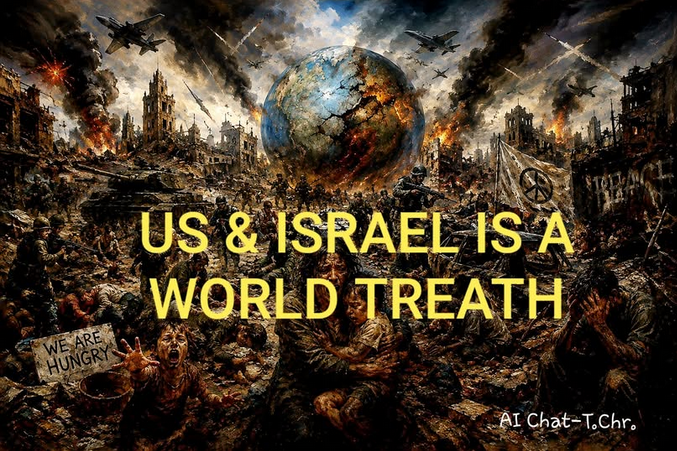
Every day, somewhere on Earth, human beings flee from fire, search for food, bury their dead, and wonder whether tomorrow will arrive. They know hunger. They know fear. They know the sound of explosions more intimately than the sound of laughter. They know what it means to live with death as a permanent neighbour.
Yet the greatest tragedy of war is not only the destruction of buildings, roads, hospitals, and homes. The greatest tragedy is the destruction of faith—not merely religious faith, but faith in one another, faith in truth, faith in reason, and faith in the possibility that humanity can learn from its own mistakes. Every war begins long before the first missile is launched. It begins when people stop listening. It begins when pride becomes more important than wisdom, when ideology becomes more important than reality, and when power becomes more important than human life.
We live in an age of extraordinary knowledge and astonishing ignorance. Never before have human beings possessed such access to information, and yet never before have so many struggled to distinguish truth from falsehood. We can communicate instantly across continents, yet often fail to understand our neighbours. We can observe distant galaxies, split the atom, and manipulate the building blocks of life itself, yet we repeatedly demonstrate an inability to solve the oldest of problems: greed, hatred, fear, and the hunger for dominance.
The modern world speaks endlessly of progress, yet progress without wisdom is merely acceleration. A vehicle moving rapidly in the wrong direction is not advancing. It is simply approaching disaster more quickly. Nations invest fortunes in weapons while millions lack food, shelter, and security. Leaders speak of peace while preparing for war. Entire populations are encouraged to fear one another, while the real enemies—poverty, ignorance, corruption, and environmental destruction—continue their work unchallenged.
Somewhere along the way, common sense became unfashionable. Moderation was mistaken for weakness. Patience was mistaken for indecision. Reflection was mistaken for inaction. Public debate increasingly became a contest of outrage rather than a search for understanding. The ability to shout louder often replaced the ability to think more deeply.
The consequences are visible everywhere. Trust erodes. Communities fragment. People retreat into tribes, identities, and ideologies. The space between disagreement and hatred grows smaller. The space between fear and violence grows shorter. Humanity becomes increasingly connected by technology while becoming increasingly disconnected in spirit.
Yet despite all this, history offers a lesson that pessimism often ignores, civilization have stood at similar crossroads before.
Empires have risen convinced of their permanence and vanished into dust. Generations have believed they were witnessing the end of everything, only to discover that history had not ended at all. The darkest chapters of human existence have repeatedly been followed by renewal. Not because humanity suddenly became wise, but because suffering eventually forces difficult questions. How many graves are enough? How much destruction is sufficient? How many generations must inherit fear before people decide that another path is necessary?
The answer has never come from weapons. It has never come from conquest. It has never come from victory alone. The answer emerges when enough people recognize a simple truth: every human being shares the same vulnerability. Hunger feels the same regardless of language. Grief speaks every dialect. Fear requires no translation. The tears of a mother are understood in every nation on Earth.
This recognition does not erase differences. It does not eliminate conflict. It does not create a perfect world. But it creates the possibility of something greater than conflict. It creates the possibility of peace.
Peace is not the absence of disagreement. Peace is the decision that disagreement will not justify destruction. It is the recognition that compromise is not surrender and that coexistence is not defeat. It is the understanding that no nation, ideology, religion, or political movement can flourish for long upon the suffering of others.
The future remains uncertain. The battlefields of today remind us of that every hour. But uncertainty is not the same as hopelessness. Humanity has survived wars, plagues, famines, collapses, and catastrophes that once seemed insurmountable. What carried previous generations through darkness was not certainty about tomorrow. It was the refusal to abandon tomorrow altogether.
The question before humanity is not whether darkness exists. It plainly does. The question is whether wisdom can once again become stronger than pride, whether reason can become stronger than fanaticism, whether compassion can become stronger than hatred, and whether the desire to build can finally outweigh the desire to destroy.
If the answer is yes, then the future remains open and the ruins of today need not become the foundations of tomorrow and the wars of today that scar our age may one day be remembered not as the beginning of humanity's decline, but as the moment humanity finally understood that survival depends not upon defeating one another, but upon learning, at last, how to live together in peace.
For where hope survives, humanity survives with it.