THE MAN BENEATE THE OVERCOAT
By FB - AI Chat-T.Chr.-Human Synthesis-05 June 2026
In Petersburg, where winter seemed less a season than a sentence, there lived a man so ordinary that even memory struggled to hold . His name was Alexey. Each morning he rose before dawn, pulled on his worn boots, and walked through snow that swallowed footprints before they were made.
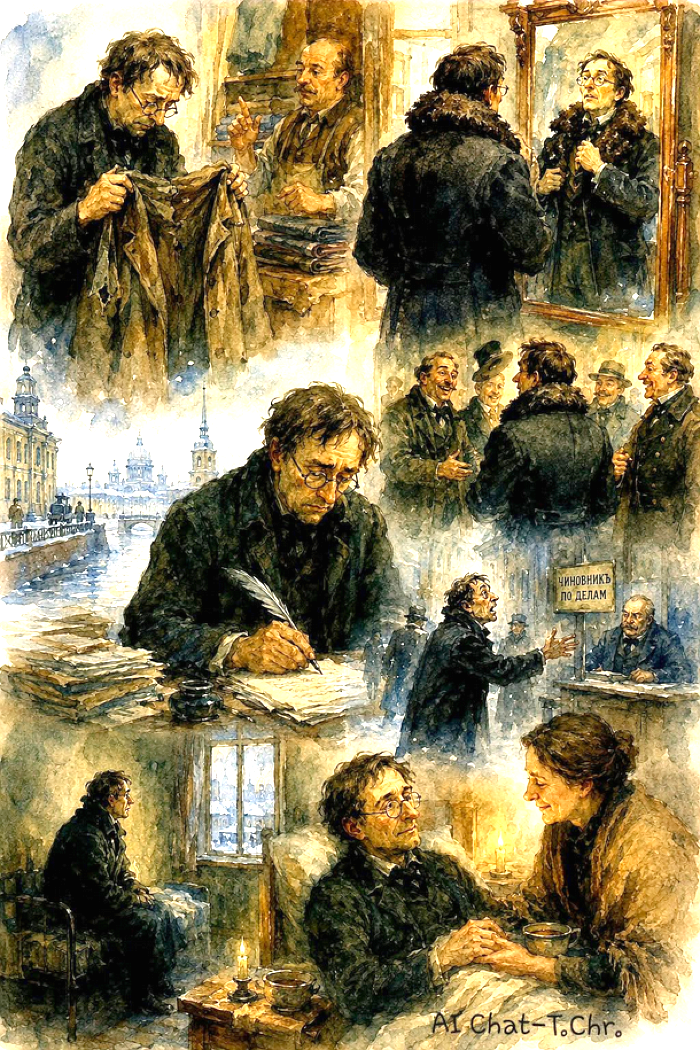
By evening he returned to the same small room, ate the same modest meal, and prepared himself to repeat the same day again. He copied documents. Not created them. Not signed them. Not decided their meaning. He simply copied them, line after line, word after word. Others spoke of careers, promotions, influence, and ambition. Alexey spoke little at all. His coworkers barely noticed him. When they did, it was often to laugh. His superiors knew his title but not his thoughts.
The city knew his labor but not his existence. And so years passed. Not dramatically. Not tragically. Simply quietly. Yet beneath every quiet life there often exists a silent hunger. Alexey's was not for wealth, nor power, nor glory. It was something far smaller and infinitely larger. He wished to matter. Not to the world. Just to someone. He wished, perhaps without fully understanding it himself, to be seen.
His old overcoat eventually surrendered to the years. Threadbare, patched, and exhausted, it could no longer protect him from the winter. The tailor shook his head. It cannot be repaired. Those words altered something inside him. For the first time in many years, he began to dream. Every coin became precious. Every unnecessary expense disappeared. He denied himself small comforts and counted each saved ruble like a man gathering fragments of hope. The overcoat became more than clothing. It became possibility. A future. A promise.
And when at last it was finished, it seemed almost miraculous. The cloth was thick. The collar elegant. The stitching precise. When Alexey wore it for the first time, the cold no longer reached his bones. More surprising still, people suddenly noticed him. Coworkers greeted him. Conversations opened around him. Smiles appeared. An invitation arrived. The invisible man had become visible. For several brief days he experienced what many people spend their entire lives chasing: recognition. Yet something troubled him. The attention felt strangely misplaced. People admired the coat. Few seemed interested in the man wearing it. They praised the fabric. They envied the craftsmanship. They spoke of appearances. Nobody asked what dreams had carried him through months of sacrifice.
Nobody wondered about the loneliness hidden beneath the new collar. It was as though the overcoat had entered the room while Alexey remained unseen.
Then came the night everything changed. The coat was stolen. Gone in moments. The object that had transformed his world vanished into darkness. As he searched desperately for help, he discovered how little compassion existed within the machinery of rank and authority. Doors closed. Officials dismissed him. Procedures mattered more than suffering. The city that had briefly acknowledged him returned to its old indifference. But this time the wound cut deeper. Because once a person has been seen, invisibility becomes harder to endure.
The loss broke something inside him. Yet the deepest tragedy was not the theft of the coat. It was the realization that so much of human affection can be conditional. People often claim to value souls, yet notice titles, appearances, success, status, and possessions. How often do we truly see one another without these disguises? How often do we love the person instead of the symbols they carry? As illness overtook him, Alexey spent long nights staring at the ceiling of his small room. The city outside continued its endless movement. Horses crossed bridges. Bureaucrats stamped papers. Snow covered streets and rooftops alike. Life continued exactly as before.
But in his darkest days, something unexpected occurred. A widow lived across the courtyard. For years they had passed one another in silence. Neither remarkable. Neither important. Neither noticed. One evening she knocked gently on his door. Not because of the overcoat. Not because of his position. Not because anyone told her to. She had simply noticed that his light had not been lit for several nights. She brought soup. She tidied the room. She sat beside him. Sometimes they spoke. Sometimes they did not. The conversations were ordinary. Childhood memories. Lost parents. Regrets. The weather. Nothing that history would preserve. Yet for Alexey they became the most important conversations of his life.
For the first time, someone listened not because he possessed something, but because he existed. No promotion had given him that. No overcoat had given him that. No institution could provide it. It was a gift available only from one human soul to another. One evening he asked her quietly why she was there. The woman thought for a moment and smiled.
"Because everyone deserves someone who notices when they are gone."
Alexey closed his eyes. Not from sadness. From relief. For years he had believed he wanted recognition. Then he believed he wanted dignity. Then he believed he wanted the overcoat. But beneath all those desires was a simpler longing: to be loved without needing to become anything else.
To be enough before achievement. Enough before status. Enough before success. Enough before admiration. Simply enough. As winter slowly surrendered to spring, the widow continued to visit. His health improved little by little. His poverty did not disappear. His room remained small. Yet the loneliness that had accompanied him throughout his life began to loosen its grip.
Together they spoke of abandoned dreams, old mistakes, and the strange way time steals years while leaving memories untouched. Neither tried to rescue the other. Neither tried to become extraordinary. They simply became present. And perhaps presence is the rarest form of love. Many people offer advice. Many offer judgment. Many offer solutions. Few offer themselves. One afternoon, while sunlight entered through the small window, Alexey realized something he had never understood before. The overcoat had not changed his life because it gave him status. It had changed his life because it revealed the depth of his hunger. The coat was never the destination. It was merely the signpost pointing toward something deeper.
A human being can survive cold. A human being can survive poverty. A human being can survive disappointment. But to move through an entire life unseen is a different kind of suffering. For what is the self if it is never reflected in another's eyes? Who are we if nobody truly knows us? The widow never answered those questions directly. Instead she sat beside him. And somehow that was answer enough. For love rarely arrives as revelation. More often it arrives as attention. A chair pulled closer. A hand resting quietly upon a table. A knock at the door. A sincere question. A silence shared without discomfort.
The years that followed were gentle. They never became rich. They never became important. They never became the kind of people whose names appeared in newspapers or whose portraits hung in grand halls. Yet they became something far rarer. They became companions. The widow shared her evening meals with him. Sometimes there was only black bread and soup. Sometimes potatoes. Occasionally a small piece of fish when fortune allowed.
To others there was nothing remarkable about these meals. Yet Alexey discovered that food tastes different when someone waits for you. Years before he had eaten merely to survive. Now he ate while listening to stories. She spoke of childhood summers beside a river. He spoke of endless winters among ink and paper. They laughed at memories neither had shared with another soul.
During spring they walked beside the canals. During summer they sat beneath trees watching children play. During autumn they listened to leaves scratch softly across cobblestones. And each winter they watched the snow return to the city that had once seemed so cold. The city itself had not changed. Alexey had. Loneliness had narrowed his vision for so long that he had forgotten how much beauty remained in ordinary things.
One evening they sat beside the river while the setting sun painted the water gold.
"Do you ever wish your life had been different?" she asked.
For many years his answer would have been yes. He would have wished for promotion. Respect. Recognition. Importance.
Instead he smiled.
"If I had become someone else," he said, "I might never have met you."
She laughed softly.
"And if I had become someone else, I might never have noticed you."
Those words remained with him. All his life he had measured himself against extraordinary people. Now he understood something they had never taught him. A meaningful life is not measured by how many people know your name. It is measured by how many know your heart. Years continued their quiet passage. She left flowers on his table. He repaired small things around her home. She read while he copied documents. He listened while she knitted beside the window. The smallest moments became the foundation of their happiness. And in those years Alexey discovered the great secret hidden from ambitious men: joy rarely arrives through achievement. It arrives through participation. Not in conquering life, but in sharing it.
As their hair turned white and their steps became slower, they often sat together watching the first snowfall of winter. The sight always reminded Alexey of the lost overcoat. Yet he no longer felt bitterness. Without losing it, he might never have discovered what he truly needed.
The coat had promised warmth. Love had delivered it.
The coat had brought attention. Love had brought understanding.
The coat had made him visible. Love had made him known.
One winter evening, many years later, they sat beside the fire while snow drifted beyond the window. Neither spoke for a long time. Finally she reached for his hand. The hand was old now, marked by years of work and time. He squeezed hers gently.
No grand declarations were needed. No dramatic speeches. The deepest love often becomes so complete that words can no longer improve it. And in that quiet moment Alexey understood that he had finally become the man he once dreamed of being. Not respected by society. Not admired by strangers. Not remembered by history. But loved by one human soul. In the end, that proved to be more than
For the greatest poverty is not the absence of money. It is the absence of connection. And the greatest wealth is not what fills a house. It is what fills a heart. The world never truly noticed Alexey. The city forgot him. The institutions forgot him. History forgot him.
But one person saw him.
One person knew him.
One person loved him.
And because of that, his ordinary life became extraordinary. For in the end, what warms a human soul is not the coat that shields it from winter, but the heart that recognizes it was never invisible at all.