MY MOTHER WAS FORCED TO GIVE ME UP FOR ADOPTION. BUT WHEN WE FINALLY MET DECADES LATER, IT WAS FAR FROM A FAIRYTALE ENDING.
By Guardian - David BattySat 6 Jun 2026 06.00 BST
Thirty years after my parents were pressured into placing me with an adoption agency, I finally reconnected with them. But it was nothing like the neat stories you see on TV.
One morning in late September 2023, I discovered by chance that my birth mother had been killed almost a year earlier. The revelation came while I was searching my work email for a stray message. In the bin folder, amid a slurry of irrelevant press releases, lay an unopened email, flagging a long-forgotten Google alert I had set up for her name, Susan Barras. We had been estranged for almost 15 years, so this in itself provoked trepidation. I had cut contact with her when our relationship had finally become too fraught and emotionally exhausting for me to continue. Opening the email, I realised with shock that the alert had been triggered by a probate notice about her estate.
Susan was only 69 when she died, and my first thought was that the breast cancer she was being treated for when we were in touch had returned. My second was the realisation that both my birth parents were now dead – my birth father had died of liver failure in late 2018, aged 70. But then the unfamiliar name listed on the probate notice, Suzann Doyle, captured my attention. Underneath this was confirmation that my birth mother had changed her name. Her address at the time of her death posed further questions. It was not that of the large detached house in Guildford I had visited just once, a few months after we were reunited, where she had lived with her husband. This address was for a tiny one-bed retirement flat overlooking Guildford train station.
I rang the law firm listed on the probate notice. Initially, they seemed reluctant to talk, perhaps because as an adoptee I had no legal claim on my birth mother’s estate. But, eventually, a solicitor disclosed that in late November 2022, Susan had been hit by a car and died hours later in hospital. The solicitor added that her two adult stepchildren had been informed, but not her younger sister, who, like me, got in touch only after seeing the notice. This, along with the disclosure that Susan had left her entire estate (including her personal possessions) to charity, suggested that she might also have been estranged from the rest of her family.
In the following days, I tried to piece together what had happened in Susan’s life since we last met and the circumstances of her death. Through the solicitor, I managed to speak, for the first time, to Susan’s sister and her best friend. From them, I discovered that Susan had undergone bowel cancer surgery a few months before she was killed. She had changed her name and moved home after an acrimonious split from her husband, who had later died of cancer.
Susan had cut contact with her mother, her sister and her brother, seemingly around the time I had broken ties with her. She had also recently fallen out with her best friend, who told me that this had happened repeatedly since they were at school together. Unsurprisingly, given her apparent isolation, there had been no funeral. Her ashes were scattered on the Isle of Wight, but where exactly and by whom no one I spoke to knew.
Adoption has often been likened to a ghost world, in which the adoptee, the birth parents and the adoptive parents are haunted by spectres of the past. For the birth parents, the primary ghost is of the child lost to adoption. For the adopted person, it is their birth mother. They may also be haunted by the ghost of their birth father; the pre-adoption child they once were; the imagined life they might have lived had they not been adopted; the ghost of the child their adoptive parents longed for; and, possibly, the ghost of the child their adoptive parents may have lost or been unable to conceive. Even after the deaths of both my birth parents, their spectres linger, because literally and metaphorically they were not laid to rest. My birth father didn’t have a funeral, because he was an impoverished alcoholic. I was left wondering how to mourn parents who had been a ghostly absence in my life for so long, and whose loss I had already grieved for many years.
Adoption has long been regarded as a fairytale ending by the British public. Children are widely regarded as lucky to be “saved” from birth families believed to be unwilling, unable or incapable of caring for them. Paradoxically, adoption reunion is also pushed as a happily ever after story by reality TV programmes such as Davina McCall’s tear-jerking Long Lost Family. My journey felt like walking into the artist Cornelia Parker’s exploded shed, with all the scorched wreckage precariously suspended around me.
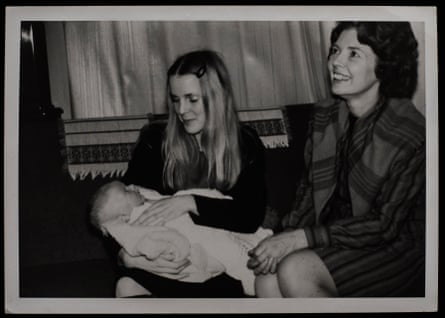
It began in May 1974 when my adoptive parents, Brian and Paula, took me from a Christian adoption agency in Muswell Hill, north London, back to their home in Brighouse, a town in West Yorkshire. Like many adoptive parents of that era, mine decided it was best to treat me “the same” as if I was their birth child. (I have an older sister and a younger brother who are my parents’ biological children.) Back then, psychologists and social workers considered adopted babies to be blank slates who could be moulded to fit their new families. A few weeks before he died last November, I discussed this article with my adoptive dad and asked him about the circumstances of my adoption.
He said he and my adoptive mum, who died in 2020, were given no advice on how to raise me, other than that they should tell me I was adopted between the ages of five and 10, at a time that seemed appropriate. When I was told, aged seven, my adoptive dad recalled that I hadn’t visibly reacted. He said he and my mum had explained that I was special because I had been “chosen”, following the expert advice of the time, which claimed this would offer comfort to children suddenly grappling with feelings of abandonment. (I recall nothing about this disclosure other than my adoptive sister, then 11, comforting me as I cried in the garden shed.)
I scanned the crowd for my birth mother. I saw a small thin woman with a severe bob. ‘Don’t let it be her’ I thought. Of course it was
As a child and young adult, I had no idea how to comprehend or articulate the loss of my birth family, and how this had affected my sense of self. As a teenager, I began to search through my parents’ bedroom cupboard for any adoption records they had, eventually discovering an incomplete version when I was 15. I was shocked to find out my birth father was Iranian; this had never been mentioned by my white British adoptive parents. It appeared, based on documents in the file, that the adoption agency had downplayed my mixed ethnicity because I “passed” as white. The agency’s first letter to my adoptive parents said: “You will notice that the baby’s father comes from a Persian family but the baby who is very fair shows no sign of any colour.” According to my adoptive dad, the agency said my ethnic background was irrelevant and there was no need to mention it to me.
While I always intended to trace my birth parents, I waited until I felt I had the independence, security and resilience to do so. In 2003, I approached the Post Adoption Centre (now PAC-UK) in north London for help finding my birth mother, who I knew from the records had lived in Twickenham, south-west London. I was obliged to attend counselling before our reunion, because prior to the Adoption Act of 1976 adoptions were “closed”, and some birth parents were led to believe that their children would never be able to discover their original names or family. My PAC-UK adviser thus acted as an intermediary and wrote a letter to Susan in the autumn of 2004 explaining who I was and why I was trying to contact her.
At the same time, I received a fuller version of my adoption file. What struck me reading through this again recently was how judgmental they were of my birth mother’s unmarried status; appearing to affirm Susan’s account that she was coerced into giving me up. In the UK, from the 1950s to the mid-70s about 185,000 unmarried women were pressured into relinquishing babies that they wanted to keep. A 2022 parliamentary human rights inquiry called this scandal “a violation of family life”. According to my records, my birth mother was in contact with the adoption agency soon after discovering she was pregnant; after she had me, I was placed with a foster mother.
What initial discussions took place about my future are not noted in the file. But the records show Susan took me back a month later. At this point, the adoption agency stepped in to dissuade her from keeping me, and her parents from trying to adopt me, warning that an “unnatural” family setup would probably result in me becoming a juvenile delinquent. The reverend who ran the baptist adoption agency branded my birth mother, then 20, a “rebellious daughter” and “a determined but probably disturbed girl”. “I would not be surprised to discover that over the years there had been conflict between her parents in the way that she should be disciplined,” he added.
Susan’s heartfelt first letter to me in November 2004 didn’t raise any red flags about our reunion. She wrote: “I would like you to know that not a single day has passed when I haven’t thought about you and wondered how you were and what you were doing.” But her second letter seemed to allude to elements of the adoption agency’s assessment of her emotional state 30 years ago. She wrote: “I attended Chiswick school where I learned the fine arts of how to ‘nut’, ‘give bother’ and ‘put in the boot’.”
After detailing her extended British and Irish family, sometimes with damning faint praise, she added: “I should warn you that most of my early life was terribly unhappy and that I never (and still do not) get on with my family and I rarely see them. As a consequence, I may find the retelling emotionally painful, but I owe it to you to give you any and all the information that you require.”
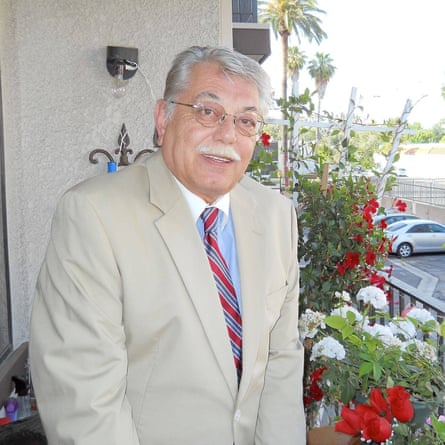
This letter also contained the first description I had of my birth father, an Iranian student whom she met on a business studies course at Luton polytechnic in 1973. “He was quite serious (and, sadly, rather too religious for my liking),” she wrote, though I later discovered this description bore no relation to reality. Susan said they had dated for six months until she found out she was pregnant and he decided to go to a university in Detroit, Michigan, adding: “I have no idea where he is now or what happened to him and, to be honest with you, I don’t care.”
Looking back now through our correspondence and my adoption file, these were among several glaring signs of the difficulties that later beset our relationship. But, at the time, I didn’t dwell on them, more interested to read about what we had in common: a love of art, architecture, design and literature. So, it wasn’t until Susan and I met in the spring of 2005 in Tate Modern’s Turbine Hall that I first had a sense of foreboding. I remember scanning the crowd with the baptist reverend’s description of her in mind: “She is a slim, attractive girl with long fair hair and rather pointed features.” My eyes settled on a small thin woman in black, with a somewhat severe dyed blond bob. There was something brittle in her manner that troubled me. To my surprise, my immediate thought was, “Don’t let it be her.” Of course, it was.
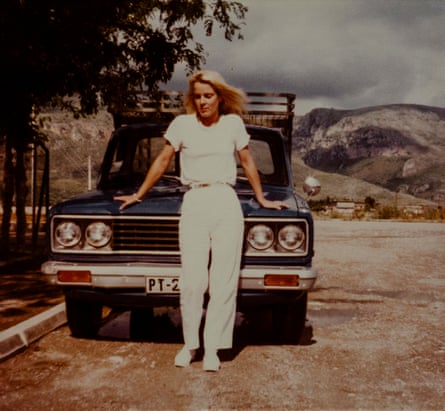
Susan was smart and funny, making droll remarks about the artspeak of the gallery’s picture captions. In the Tate members’ bar, she produced several envelopes stuffed with family snaps. The impact of seeing my own features in the photos of these relatives was unexpectedly overwhelming. In hindsight, it was revealing that she didn’t acknowledge that I closely resembled the two men of whom she had the most complicated and painful memories: her father and my birth father. Susan promised to give me a photo of my birth father but never did. Instead, at that first meeting, she produced a printout of a miniature Persian portrait of a Qajar prince, which she claimed looked like him. “Well, you get the idea,” she said, adding her mother was worried she was “going to have a black baby”.
I only met two members of Susan’s family during the time we were reunited. Her younger brother, a seemingly shy man, joined us in the members’ room of the Royal Academy in London. We barely exchanged a word to punctuate the awkward silence. Some months later, I met Susan’s husband, Terence, a lawyer and sometime property developer, at their home in Guildford. He seemed a kind and gentle man, although there was an air of melancholy about him. When Susan was out of earshot, he came over to me and whispered: “Everything’s going to be all right now you’re back.” This suggested that everything had not been all right before.
Over the next three years, Susan and I met every six to eight weeks, usually for lunch and an exhibition in London. Initially, our conversations struck a balance between discussing our current lives, mine as a journalist and then art student, and hers as a grammar school teacher, and our shared past. But, over time, Susan became increasingly fixated on the circumstances of my adoption and its emotional toll on her. Her expressions of hurt and anger, usually towards her parents, whom she felt had not supported her before, during and after my adoption, became prolonged and more intense.
She said my birth had been physically traumatic and she had broken her coccyx in labour. She was distraught to learn that I had not received the handwritten note she had hidden in my baby clothes before she handed me over to my adoption social worker. She said she had post-traumatic stress disorder and had been in therapy for 25 years. (Her best friend later insisted Susan had never been in therapy.)
On another occasion, Susan took issue with a letter she purportedly received from my adoptive mother after my adoption was finalised, which she described as condescendingly Christian. She said she had spent years trying to find me and, disconcertingly, had come very close, having determined that I lived in Halifax, the neighbouring town to the one in which I grew up. At another meeting, she claimed she’d been told I’d died when I was 16. The mood became increasingly suffocating.
At midnight on my birthday, she wrote, ‘Maybe you’ll respond to this and maybe you won’t but at least you’ll know I’m still thinking of you’
Several months after our reunion, my PAC-UK support worker admitted that she thought Susan had seemed “fragile” when they first spoke on the phone. I replied: “She doesn’t want me. She wants her baby back.” This epiphany, while painful, encapsulated the gap between me and Susan. She could not let go of the loss that had defined her life. She would never get to experience raising me. Here I was, an independent adult with another family’s history and memories. I think she wanted me to need her, to depend on her, as if I was a child. But I felt as if I was dealing with a vulnerable teenage girl who had been psychologically arrested at the point of my adoption. “You don’t remember me, but I remember you,” she would say repeatedly, leaving me to wonder whether I was supposed to feel guilty for this.
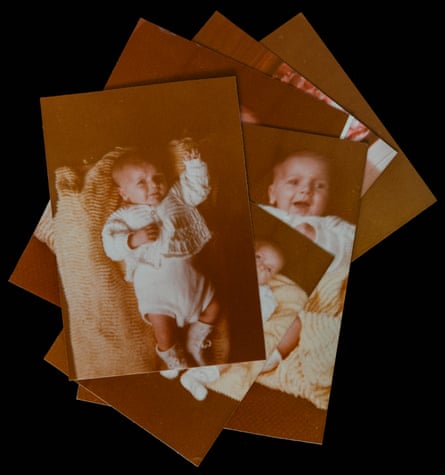
Years later, after I discovered my birth mother had died, I recounted this in a phone call with her best friend, who recalled visiting Susan in Athens, Greece, two years after my adoption. The friend was shocked to discover Susan’s apartment was undecorated except for one photograph on her bedside table – a studio portrait of me, aged seven months, sent from my adoptive parents via the agency. This was the image of me she had cherished over the decades we were separated.
The breaking point came over dinner at a Turkish restaurant in Mayfair, London, when I recounted a conversation with my adoptive parents and referred to Susan as my birth mother. She became apoplectic, and shouted: “I hate that term. I wasn’t a brood mare.” Pausing to draw breath, she added: “Your father wanted me to have an abortion. I hope you realise that.” While I had always suspected that at least one of my birth parents may have considered aborting me, it still stung to have that flung at me in public. I took her comments to mean: you owe me your life. A few days later, she sent an email bluntly stating that this was something she had needed to say. There was no acknowledgment that her remarks may have upset me.
My responses to her emails became more belated and intermittent. Eventually, I stopped responding to her requests to meet. She continued to message me for another two years, including at midnight on my birthday. In February 2008, she sent an email with the subject line “confused”. She wrote: “Maybe you’ll respond to this and maybe you won’t but at least you’ll know I’m still thinking of you.” Eventually, I emailed back saying I was cutting contact because I could no longer cope with her offloading on me her resentment towards her mother and late father and, to a lesser extent, her brother and sister. It felt as if she was trying to recruit me as an ally in an entrenched family conflict, rather than allowing me to meet my grandmother, aunt and uncle on my own terms, I added. I ended the email by asking her not to contact me again unless I contacted her first. I never heard from her again.
I searched for this email again after discovering Susan was dead. Looking back now, I’m able to sympathise more with her emotional pain. While she was wrong to treat our meetings as quasi-therapy sessions, we both lacked the support we needed to avoid retraumatising ourselves and each other. In my grief I deleted the message; I suspect because on some level it reminded me of the original trauma of our separation as mother and baby. Now, her death meant an irrevocable separation.
For many years, tracing my birth father, Monti, seemed an impossibility; there is very little support available here for adoptees seeking non-British birth parents. I had made a couple of attempts to trace him in my late 20s and early 30s, but only pursued it in earnest in my late 30s, after my reunion with my birth mother. A Google search on his name brought up a recently published blog – in Persian – by someone who matched the details in my adoption file. Translating the blog confirmed this was my birth father.
I was surprised to learn that after studying in the US he returned to Iran and became a broadcast journalist: unknowingly, I had followed in his footsteps. His career appeared to have petered out after he emigrated to the US in the 1990s, eventually settling in Los Angeles. He had legally changed his name, taking a more anglicised forename. Most importantly, the blog revealed he was divorced and had another son, Bryan, who was half my age. I decided to do nothing until this boy was 18, wary that I might be stepping into another fractured family.
© 2026 Guardian News & Media Limited or its affiliated companies. All rights reserved.(dcr)