THE ISLAND THAT WATCHES
By AI Chat-T.Chr.-Human Synthesis-01 June 2026
Eilean Dubh was the kind of place that disappeared when the fog came in. On certain mornings the island vanished entirely from the sea, becoming nothing more than a rumor whispered by fishermen and marked on old charts. It lay thirty miles north of the Scottish mainland, a lonely strip of black cliffs and windswept moorland surrounded by restless Atlantic water.
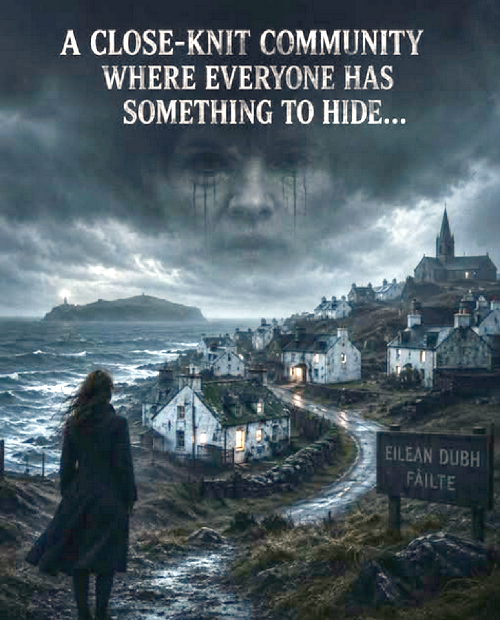
Fewer than two hundred people lived there. Families had remained for generations. Most houses belonged to the same names that appeared in parish records from two centuries earlier. The island possessed a church, a harbor, a small pub called The Lantern, and a graveyard that seemed far too large for such a tiny population. Visitors often remarked upon the friendliness of the villagers. Those who stayed longer usually noticed something else. Everyone knew everything about everyone else, yet nobody ever spoke about the past.
Detective Inspector Isla Kerr arrived in late November after human remains were discovered beneath the stone floor of an abandoned crofter's cottage near the northern cliffs. Winter storms had damaged the building, exposing a shallow grave hidden for decades. The skeleton belonged to a man who had died from a gunshot wound. There was no identification, no clothing that could establish a name, and almost no evidence beyond a silver pocket watch engraved with the image of a raven. The islanders claimed to know nothing about the dead man. They expressed concern, curiosity, and sympathy, but Isla sensed something beneath their words. The moment she stepped off the ferry she felt it. Eyes followed her wherever she went. Conversations softened when she entered rooms. People became careful around her, as though they had spent years preparing for questions they hoped would never be asked.
The investigation moved slowly. Records were incomplete. Documents had vanished. Several years of parish archives contained unexplained gaps. Photographs were missing from family albums. Newspaper clippings had been removed from library collections. Isla had investigated murders before, but she had never encountered a community that seemed so determined to erase parts of its own history. During her first week she interviewed dozens of residents. Each conversation produced the same strange pattern. The pocket watch would appear. A flicker of recognition would cross the person's face. Then the denial would come immediately afterward. Nobody had seen it before. Nobody recognized the engraving. Nobody knew who might have owned it. The lies were obvious. What puzzled Isla was the consistency. Entirely different people repeated the same denials with almost identical wording.
As the days passed, the island began to work on her nerves. It was not merely the weather, although the weather rarely helped. The wind never seemed to stop. At night it scraped against windows and crawled through chimneys with sounds that resembled distant voices. The sea pounded endlessly against the cliffs. The darkness arrived early and lingered long into the morning. There was a feeling on Eilean Dubh that could not easily be explained, a sensation that the island itself was listening. Isla found herself glancing over her shoulder when walking alone. She would look up from her notes convinced someone had just been standing behind her. More than once she awoke in the middle of the night with the certainty that she had heard footsteps outside her guesthouse window.
One evening she visited Morag Sinclair, the oldest resident on the island. Morag was ninety-two years old and lived alone in a weather-beaten cottage overlooking the western sea. Local people described her with a curious mixture of affection and unease. Some claimed she knew every secret on the island. Others claimed she knew things she should not know at all. When Isla showed her a photograph of the silver pocket watch, the old woman's expression changed instantly. Her hands began to tremble. For a long moment she stared through the window toward the ocean. Finally she spoke in a voice so quiet Isla almost failed to hear it.
"They should have buried him farther inland."
The words hung in the room.
"Who?" Isla asked.
Morag did not answer immediately. "The sea remembers," she whispered. "That's the trouble. People think they can hide things near the coast. But the sea always gives them back."
When Isla pressed her for details, the old woman refused to continue. The interview ended shortly afterward, leaving Isla with more questions than answers. That night she returned to the guesthouse feeling unsettled. Shortly after three o'clock in the morning she woke abruptly. At first she could not identify what had disturbed her. Then she heard it. Footsteps. Slow, deliberate footsteps moving across the gravel outside. They circled the building once, paused beneath her window, then continued. The sound persisted for several minutes. Isla eventually rose, grabbed a flashlight, and opened the door. The street beyond was empty. No movement. No figure disappearing into the darkness. Only cold wind and distant waves. Yet the gravel contained fresh impressions as though someone had indeed been walking there moments earlier.
The following morning she discovered another oddity. Every clock in the guesthouse had stopped during the night. The kitchen clock. The hallway clock. Even a wristwatch belonging to the owner. All displayed the same time: 3:17. The owner laughed it off as a coincidence caused by an electrical problem, but Isla noticed he looked uncomfortable. When she asked whether anything unusual had happened on the island thirty years earlier, he became silent for several seconds before changing the subject.
The breakthrough arrived in an unexpected form. While examining church records stored in a locked basement room, Isla discovered a hidden compartment behind a section of loose stone. Inside lay a leather-bound diary. The name on the first page was Alastair Reid. Research quickly revealed that Alastair had been a teacher from Inverness who arrived on Eilean Dubh three decades earlier and vanished after only six months. Official records stated he drowned during a storm. His body had never been recovered. The villagers rarely mentioned him. Reading the diary, Isla began to understand why.
Alastair's early entries described ordinary island life. He wrote about the landscape, the weather, and the people he had met. Gradually the tone changed. He became increasingly suspicious. He described overheard conversations that ended abruptly when he approached. He mentioned nighttime boats arriving in isolated coves. He recorded names, dates, and observations. It was clear he had uncovered evidence of a smuggling operation involving several respected members of the community. Yet the final entries moved beyond criminal suspicion into something stranger. Alastair wrote repeatedly about a feeling that the island was watching him. He described standing alone on the cliffs and sensing hundreds of unseen eyes. He wrote that the villagers seemed connected by some silent understanding, as though they shared knowledge they could not openly discuss. The final coherent entry chilled Isla more than anything else in the diary.
"The people do not keep the secrets. The island keeps them. The people are only the memory."
The next page contained a date.
A date occurring one day after Alastair's official disappearance.
The page after that carried another entry.
And another.
Several pages had apparently been written after the day he was believed to have died.
Isla initially assumed there must be some error. Yet later forensic analysis confirmed the ink and paper were consistent with the period. No evidence of forgery emerged. No rational explanation presented itself.
Before she could investigate further, another event shook the island. Morag Sinclair vanished. Her cottage door stood open. A meal remained untouched on the table. There were no signs of struggle and no evidence she had left voluntarily. The most disturbing detail awaited inside the sitting room. Every clock in the house had stopped at precisely 3:17.
Fear spread rapidly after her disappearance. For the first time the islanders appeared genuinely frightened. Old rivalries resurfaced. Long-buried accusations emerged. Decades of silence began to fracture. Under increasing pressure, several elderly residents finally admitted what had happened thirty years earlier. Alastair Reid had discovered the smuggling network and threatened to expose it. A confrontation near the northern cliffs turned violent. A gun was produced. Alastair was killed. His body was hidden beneath the abandoned cottage. The community agreed to conceal the crime. Parents lied to their children. Witnesses remained silent. Entire generations inherited the secret.
The confession explained the skeleton. It explained the pocket watch. It explained the missing records. Yet it failed to explain everything else.
Months later, after arrests had been made and the case officially closed, Isla left Eilean Dubh aboard the afternoon ferry. Villagers gathered along the cliffs overlooking the harbor as the boat departed. They stood motionless in the cold wind, watching the vessel move away from shore. Isla remained at the stern, observing the island recede into mist. The dark shape grew smaller and smaller until details became difficult to distinguish. Then, quite suddenly, one figure caught her attention. A man stood slightly apart from the others. He wore an old-fashioned dark coat. Even at that distance she could see the brief flash of silver in his hand. A pocket watch. For several seconds he appeared perfectly clear despite the fog gathering around the cliffs. Then he raised his head and looked directly toward the ferry.
Years later Isla would tell herself it had been an illusion. Distance, weather, exhaustion, and imagination had combined to create something that never existed. It was the only explanation she could accept. Yet she never forgot the face she saw on the cliff that afternoon. She had studied it many times in photographs recovered during the investigation.
The man watching the ferry had been Alastair Reid.
And the expression on his face had not been one of anger or accusation.
It had been patience.
As though he knew the island would still be there long after everyone else was gone, keeping its secrets in the wind, in the stone, and in the endless sound of the sea.
A Philosophical Overview of The Island That Watches
At its heart, The Island That Watches is not really a murder mystery. The murder merely uncovers a deeper question: What happens when a community values belonging more than truth?
The island becomes a metaphor for memory itself. The villagers believe they are protecting one another by keeping silent, yet the secret slowly imprisons them. Over time, the crime matters less than the burden of carrying it. Children inherit guilt they never earned. Neighbors inherit lies they never told. The past becomes a living presence, shaping lives long after the original event has faded.
The story also explores the illusion that anything can truly be buried. Human beings often imagine that time erases wrongdoing, grief, or shame. Yet memory works like the sea surrounding Eilean Dubh. It withdraws for a while, only to return what was cast into it. The skeleton beneath the cottage is therefore symbolic. It represents every hidden truth that waits patiently beneath the surface of our lives.
The island itself functions as a philosophical symbol. It is not merely a place but a conscience. The villagers attempt to forget, but the island remembers. The wind, the sea, the cliffs, and the silence become reminders that truth exists independently of human denial. Whether one interprets the eerie elements as supernatural or psychological is ultimately irrelevant. The deeper idea is that the past remains alive within us, whether acknowledged or not.
Perhaps the most unsettling aspect of the story is that there is no single villain. The murderers are guilty, but so too are the ordinary people who choose silence. The novel suggests that evil rarely survives through monsters alone. More often it survives through loyalty, fear, convenience, and the desire to protect what is familiar. Decent people become guardians of terrible things because confronting the truth threatens the world they know.
In the end, The Island That Watches asks a simple but disturbing question:
Do we possess our secrets, or do our secrets eventually possess us?
The island's answer is clear. The dead are not what haunt Eilean Dubh. What haunts it is memory. And memory, unlike people, never dies.