THE LAST TIDE
By AI Chat-T.Chr.-Human Synthesis-22 May 2026
Far beyond the crowded harbor of San Esteban lived an old fisherman named Rafael Morales. His skin had been darkened and cracked by decades beneath the sun, and his hands carried the scars of countless battles with rope, salt, and sea. For ninety days, Rafael had returned to shore without catching a single fish.
At first, the villagers had offered sympathy. Then came pity. Finally, silence.
The younger fishermen no longer greeted him with admiration. They glanced at his empty boat and turned away. Some called him cursed. Others whispered that age had finally defeated him. Children laughed quietly when they saw him dragging his nets through the sand.
But every morning before dawn, Rafael rose from his narrow cot, folded his worn blanket carefully, and walked to the shore with the same steady dignity he had carried his entire life.
Because somewhere inside him, untouched by failure, something still endured.
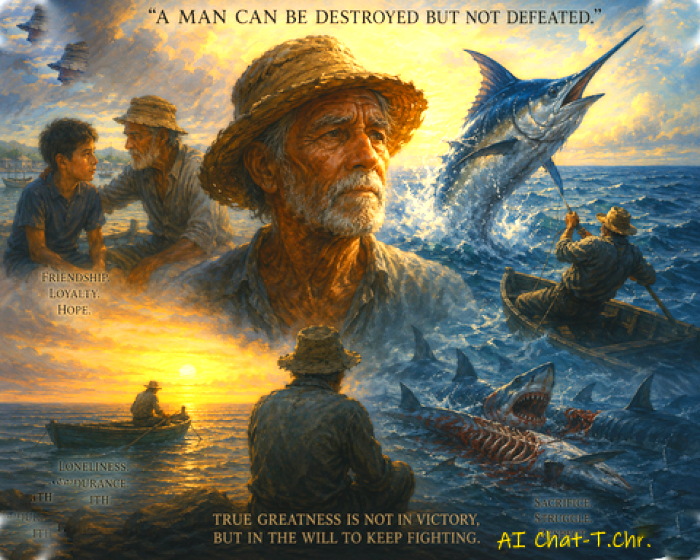
The only person who never doubted him was a boy named Mateo. Mateo was sixteen, thin and bright-eyed, with the restless energy of youth and a loyalty deeper than the sea itself. Years earlier, Rafael had taught him how to read the tides, how to follow birds to fish, and how to understand the moods of the ocean simply by watching the wind.
Now Mateo worked aboard a successful commercial boat owned by his uncle. The decision had not been his. His family believed Rafael’s luck would poison the boy’s future. Yet every evening Mateo returned to the old man’s shack beside the harbor. He brought him food when he could. Sometimes coffee. Sometimes only company.
“You should sleep longer,” Mateo said one evening while lighting a small lantern.
Rafael smiled faintly. “The sea does not wait for old men.”
Mateo looked at the patched sail folded against the wall. “One day they’ll remember who you are.”
Rafael shook his head gently. “It is not important to be remembered.”
“Then what is important?”
The old fisherman stared toward the dark horizon visible through the doorway.
“To remain yourself.”
The next morning, before the village had awakened, Rafael pushed his small wooden skiff into the water and sailed farther than he had gone in years. The sea stretched endlessly around him, blue and silver beneath the rising sun. Flying fish skimmed the surface like arrows of light. The wind carried the sharp scent of salt and rain from distant storms.
Hour after hour passed.
Then, just as the afternoon heat settled over the water, Rafael felt it.
A pull.
Deep.
Heavy.
Alive.
The line slid through his hands with terrifying strength. At first he thought the fish might snap the rope instantly. But instead, it moved steadily into the open sea, towing the small skiff behind it as though Rafael were nothing more than driftwood.
“A giant,” he whispered.
The fish never surfaced. For hours Rafael held the line across his back and shoulders while the marlin pulled him farther from land. By nightfall, his palms had split open. Blood mixed with seawater beneath his fingernails. Still he held on. Stars emerged overhead in silent brilliance.
“You are strong,” Rafael said aloud into the darkness. “Stronger than any creature I have known.”
The fish answered only through the endless tension of the line. By the second day, exhaustion settled deep into Rafael’s bones. His muscles cramped violently. Sleep came only in fragments. Yet something strange began to grow inside him—not hatred for the marlin, but admiration. He imagined the great creature below him: silver scales cutting through black water, enormous fins gliding like wings through the deep.
“You were born for greatness,” Rafael murmured.
And then, after a long silence:
“Perhaps so was I.”
The words surprised him.
For years he had carried humiliation quietly. Each empty return to shore had chipped away at him. The villagers saw only failure. Age. Weakness. But alone on the sea, connected to this magnificent creature by a single bleeding rope, Rafael remembered something the world had nearly taken from him.
His spirit. The marlin surfaced at dawn on the third day. Rafael gasped.
The fish was enormous—longer than the skiff itself, its silver-blue body glowing beneath the sunrise like something mythical. Water exploded around it as it leapt, vast and beautiful against the burning sky. For a moment Rafael forgot the pain in his hands. The marlin crashed back into the sea with thunderous force.
“I did not know such beauty still existed,” he whispered.
Hours later, when the fish finally weakened, Rafael gathered the last of his strength and drove the harpoon downward. The sea turned red beneath the sunlight. And suddenly, everything became silent. Rafael bowed his head.
“I am sorry,” he said softly.
He tied the marlin beside the skiff and began the long journey home. But blood in the water carries its own destiny. The first shark arrived before sunset. Rafael fought it off with his harpoon. The second came at night. Then another. And another.
Each attack tore flesh from the marlin.
Rafael battled them with desperate fury—using the harpoon, then an oar, then even a broken knife tied to wood. His body shook with exhaustion. His wounds deepened. Yet he refused surrender. Not because he believed he could save the fish. But because surrender itself felt impossible. By the time the harbor lights appeared in the distance, little remained of the marlin except its massive skeleton.
Rafael stared at it silently. Everything he had fought for was gone. Or so it seemed.
When he finally reached shore, the village slept. He dragged himself from the boat and collapsed inside his shack without removing his bloodstained clothes. The next morning, fishermen gathered around the enormous skeleton still tied beside the skiff. They stood speechless. No one laughed. No one pitied him. Mateo ran through the crowd and entered the shack, finding Rafael asleep on the bed, his scarred hands open beside him.
The boy’s eyes filled with tears.
“You were right,” Mateo whispered. “They remember now.”
But Rafael, half-awake, smiled faintly without opening his eyes.
“It was never about them.”
Outside, the wind moved softly across the sea.
And somewhere beyond the horizon, beneath endless water and sky, life continued in all its beauty and cruelty together. Rafael understood now what the ocean had been trying to teach him all along:
Victory is temporary.
Failure is temporary.
But the courage to continue—that is what defines a person.
And even when the world strips away everything you hoped to bring home, there remains one final thing no storm, no age, and no loss can destroy:
The part of the human soul that refuses to let go.
Sourced from - Ernest Hemingway