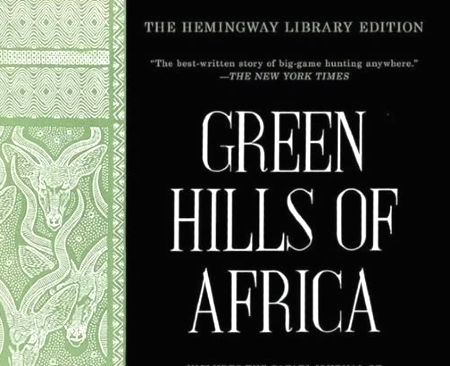
GREEN HILLS OF AFRICA
By Guardian-AI Chat-T.Chr-Human Synthesis-21 May 2026
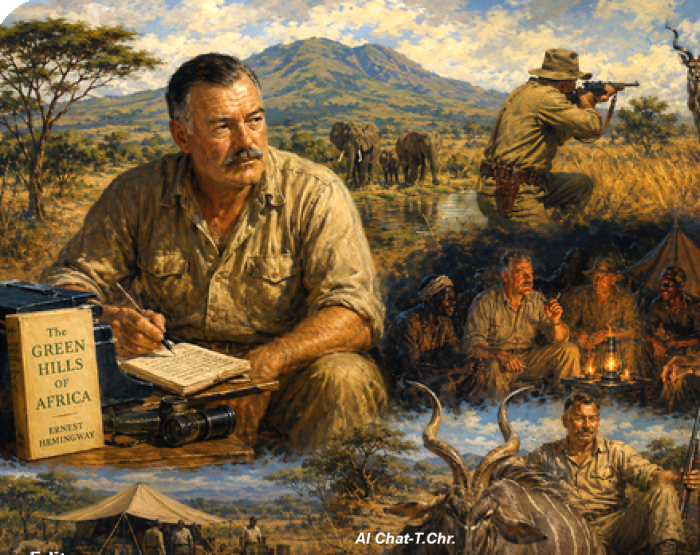
The train smoke, dust, and heat all seemed to dissolve into the African horizon as Ernest Hemingway entered the interior of East Africa. The land stretched endlessly — yellow grasslands broken by thorn trees, distant blue mountains, and green hills that shimmered after rain. Everything felt larger there: the silence, the sky, the animals, even his own thoughts.
He had come for hunting, but also for escape.
Back in Europe and America, Hemingway was already famous. People admired him, argued about him, copied him. Yet success had not made him calm. He carried a constant restlessness — the need to test himself again and again. Africa promised something harder and cleaner than literary society. Out there, skill mattered immediately. You either tracked the animal correctly or lost it. You either stayed steady under pressure or failed.
His safari camp moved slowly across the landscape with guides, gun bearers, cooks, tents, and supplies. Mornings began before dawn, when the air was cold and silver with mist. The hunters drank coffee in darkness while listening to distant animal cries. Then they would set out quietly into the bush.
The days became a rhythm of pursuit.
Sometimes they tracked antelope for hours through dry grass and thorn scrub. Sometimes they climbed rocky hills where the heat pressed down like weight. Hemingway watched tracks in mud, broken twigs, bent grass — tiny signs that revealed invisible movement. Hunting demanded patience more than violence. Most of the time was waiting, searching, failing.
And failure bothered him deeply.
If he missed a shot, he replayed it endlessly in his mind. If another hunter succeeded easily, jealousy flickered beneath his outward calm. He wanted mastery, not luck. The safari became less about collecting trophies and more about proving something to himself that he could never fully define.
Among all the animals, one came to dominate his imagination: the greater kudu.
The kudu was elusive and ghostlike, with long spiraling horns and an ability to disappear into thick cover almost magically. Hunters spoke about it with reverence. To Hemingway, the animal became a symbol of perfection — difficult, intelligent, nearly mythical.
For days he searched for one.
The hunts exhausted him. Dust coated his clothes and skin. Sweat soaked through his shirt. Sometimes he thought they were close, only to lose the tracks on hard ground. Sometimes he saw the animal only briefly before it vanished into brush. Every failed attempt sharpened his obsession.
Yet the story was never only about hunting.
At night in camp, under lantern light, conversations drifted toward literature. Hemingway argued passionately about writers. He spoke of truth in prose — how good writing should be simple on the surface but carry deep feeling underneath. He admired writers who stripped away decoration and reached something honest.
He talked about Mark Twain, Gustave Flaubert, and Leo Tolstoy as though discussing fellow hunters. To him, writing and hunting were connected. Both required discipline. Both exposed weakness immediately. Both punished vanity.
Still, vanity haunted him.
The deeper the safari went, the more the wilderness seemed to strip away social masks. Petty rivalries surfaced. Pride became visible. Hemingway compared himself constantly with professional hunters and companions. Even moments of beauty carried tension beneath them.
And Africa itself remained overwhelming.
There were evenings when the hills glowed green after rain and animals moved across the plains like shadows. There were nights filled with hyena cries and enormous stars. Hemingway often paused to describe the landscape with more tenderness than he showed toward people. The country felt ancient and indifferent — alive in a way modern cities were not.
Eventually, after long pursuit, Hemingway succeeded in taking the kudu he had hunted so obsessively.
The moment brought triumph, relief, and exhaustion. Yet satisfaction did not last long. Almost immediately another challenge appeared beyond it. That was one of the quiet truths running through the story: achievement never finally cures restlessness.
As the safari neared its end, the mood changed. The excitement of pursuit gave way to reflection. Hemingway understood that Africa would become memory — something impossible to fully keep. The green hills, the dawn hunts, the camps, the tension and beauty would fade into the past even as they shaped him permanently.
By the end, the story feels less like a tale about killing animals and more like the portrait of a man searching for certainty in a world where certainty never lasts.
Africa gave Hemingway moments of clarity:
- the directness of survival,
- the beauty of physical skill,
- the intensity of danger,
- and the feeling of being fully awake.
But it also revealed his insecurities, competitiveness, and inability to remain satisfied for long.
That mixture — wonder, ambition, pride, beauty, and melancholy — is what gives Green Hills of Africa its lasting power.
A Story Inspired by Ernest Hemingway’s African Journey