KING HAAKON HAAKONSSON STORM IN TRONDHEIMSLEIA, NORWAY-WINTER OF 1240

By Ai Chat-T.Chr.- Human Synthesis-14 May 2026
Sea smoke drifted low across the dark, bottomless strait. It was the winter of 1240, and the air cut into exposed skin like a thousand icy needles. Aboard the great royal warship, men stood shoulder to shoulder in heavy wool and iron mail already crusted with salty frost. Their numb fingers clung to the rail as the ship hammered through the steep black waves of the Trondheimsleia. This was no ordinary voyage across open water.
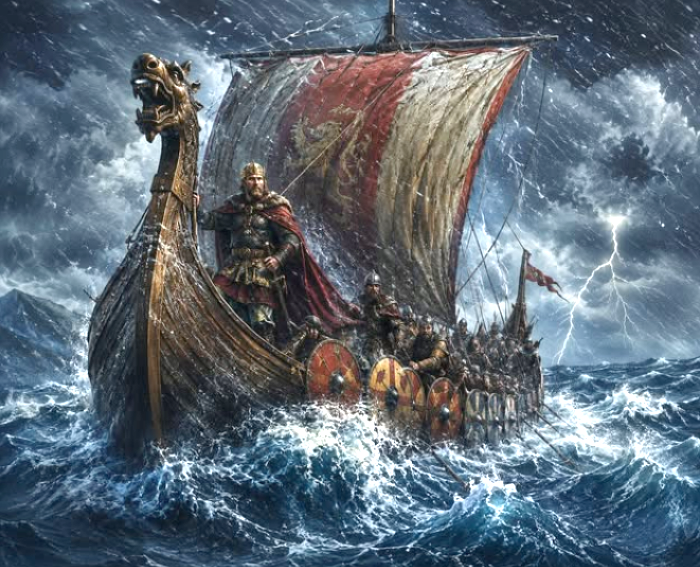
It was a floating fortress of timber and iron, one of nearly forty massive warships carving northward through the narrow and treacherous channel.
Under the command of King Haakon Haakonsson, the enormous fleet pushed onward through the storm-dark sea. The king stared toward the dense black pine forests of the mainland and then westward to the wind-scoured cliffs of Hitra. He knew exactly what this strait meant. Whoever controlled these waters controlled the gateway to the Trøndelag heartland itself.
But tonight, the deep channel felt less like a road to power and more like a death trap waiting to swallow his kingdom whole.
Without warning, the weather turned.
It happened with the terrifying speed for which this coast was infamous. A wall of snow exploded in from the open ocean to the west, erasing the boundary between sky and sea in minutes. Gray heavens and black water became one endless void. Visibility vanished completely. The soaked sails snapped violently in the gale, threatening to tear the thick masts apart.
For a fleet this large, trapped in such narrow waters, the conditions became impossible.
One mistake—one hidden reef beneath the waves—and forty royal ships could be smashed into splinters.
Haakon made his decision immediately.
“Seek harbor!”
The fleet turned toward the sheltered coves near Sandstad on Hitra, where the channel narrowed into one of the most dangerous stretches of the entire coast. Snow buried the painted shields stacked along the rails. Frozen ropes creaked like dying trees. Warriors stumbled ashore through knee-deep drifts while the king waited beneath a makeshift tent stretched across the deck.
Outside, spies and scouts arrived one by one from the darkness, some rowing through the blizzard in tiny boats, others appearing silently from the forests along the shore.
Their news made the cold feel sharper.
Skule had not remained in Nidaros.
He was moving south toward the uplands.
And if Haakon delayed now, the kingdom would tear itself apart.
For more than a hundred years, civil war had ripped Norway to pieces. Kings, pretenders, jarls, and warlords had drowned the land in blood. But now the struggle had reached its final boiling point, and the Trondheimsleia—the deep, twisting sea passage between islands and mainland—would decide who ruled Norway forever.
These waters had seen such things before.
Decades earlier, other fleets had slipped silently through the same straits under cover of moonless nights. The Birkebeiner warriors, led by the brilliant and ruthless King Sverre Sigurdsson, had used these islands, inlets, and hidden coves to vanish from enemies who outnumbered them many times over.
One could almost hear the ghosts of it still.
The crack of timber smashing against timber.
The screams of drowning men.
The roar of battle echoing across frozen water.
Long ago, Erling Skakke and King Magnus Erlingsson had stood watch from rocky cliffs along the strait, desperately searching the darkness for enemy sails. They understood the terrible truth of this place: whoever controlled this narrow corridor controlled access to all of central Norway.
Miss an enemy fleet here, and by morning your farms would burn, your storehouses would be plundered, and your crown would already belong to someone else.
The Trondheimsleia was never merely a shipping lane.
It was the pulsing artery of medieval Norway.
Every chieftain’s ship, every merchant vessel, every royal war fleet passed through these waters. Farmers and fishermen living along the harsh shores of Heim, Aure, and Orkland watched history sail directly past their doorsteps in the form of dragon-prowed longships and towering cargo vessels loaded with dried fish, hides, iron, and grain.
Farther south, the open sea near Hustadvika was feared by every sailor alive. Savage waves, hidden reefs, and merciless storms devoured ships without warning. Because of that, nearly everyone with valuable cargo—or political ambition—turned inland as early as possible, steering into the safer depths between Hitra, Smøla, and the mainland.
Here, ships could shelter for days.
Sometimes for weeks.
Natural harbors like Aunøya and Agdenes became floating camps packed with warriors waiting impatiently for favorable winds. Men stared constantly toward the forests and mountains, praying for weather that would let them either reach the brutal waters of the Trondheim Fjord or escape northward into the open sea.
Today the gray water lies silent and calm.
But that silence feels unnatural.
Because once, these shores trembled with tension every single day.
Every island carried a story.
Every name on the map hid forgotten tales of betrayal, survival, power struggles, and impossible logistics. Armies numbering in the thousands required staggering amounts of food, fresh water, ale, firewood, tar, and iron simply to survive while trapped by storms in the strait.
For the great farms and chieftain halls along the coast, the arrival of a royal fleet could mean ruin—or immense wealth.
Some were stripped bare by starving soldiers.
Others became rich supplying kings preparing for war.
At night, great fires burned along the rocky shorelines. Axes rang endlessly through the forests as men chopped wood against the freezing dark. Thousands of warriors huddled around the flames, speaking in low voices, knowing they might be sailing toward their final battle.
And when the snowstorm finally loosened its grip on Haakon’s fleet at Sandstad, there was no longer a moment to waste.
The fragile balance of the kingdom hung by a thread.
The ships were shoved back into the icy water with raw human force. Long oars struck the sea in perfect rhythm. Dragon heads rose at the bows once more, turning northeast through the mist.
Toward destiny.
Today, modern travelers cross these waters in warm ferries or speed silently beneath them through the Hitra Tunnel far below the seabed. The strait appears peaceful now—almost impossibly peaceful.
But the sea remembers.
It remembers the men who sailed out to unite a fractured kingdom.
The men who fought to tear it apart.
And the countless nameless souls who stood on the freezing shoreline, watching the fleets disappear into the storm-dark horizon, never knowing who would return alive.