JOAN CRAWFORD-THE WOMAN WHO INVENTED HERSELF

By AI Chat-T.Chr.-Human Synthesis-12 May 2026
A Child Running From Chaos. Before she became a face twenty feet high on theater screens, before strangers copied the shape of her eyebrows and reporters wrote breathlessly about her romances, before Hollywood transformed her into an emblem of glamour and force, there was a child standing in confusion at the edge of adulthood, learning one of the harshest lessons a human being can learn too early:
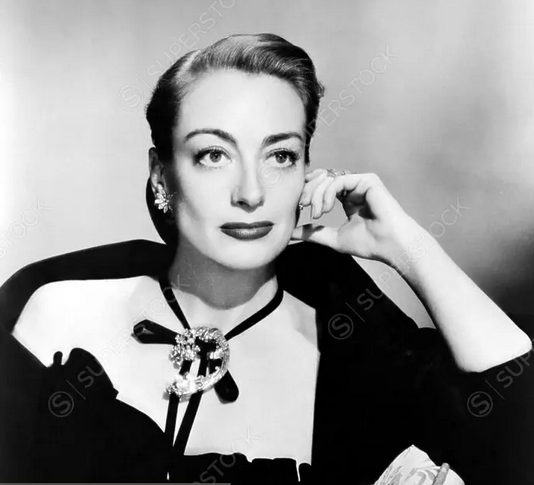
Love is unstable.
Joan Crawford entered the world in 1904 as Lucille Faye LeSueur, in an America still rough around the edges, still inventing itself. The country was industrializing rapidly, cities expanding like living organisms, fortunes appearing overnight while millions remained trapped in poverty. It was a society obsessed with self-creation. The old European idea that a person was born into a fixed identity had weakened in America. Here, people believed they could become someone else.
But for the poor, reinvention was rarely romantic.
It was survival.
Her childhood unfolded amid instability. Fathers disappeared. Stepfathers arrived. Money was uncertain. Home itself did not feel permanent. Stories from her early life contain fragments rather than certainty: strict authority figures, emotional turbulence, humiliation, possible abuse, loneliness. Even basic truths — such as who her biological father truly was — seemed hidden behind adult secrecy.
A child raised in that environment develops unusual instincts.
Some become passive, convinced the world is uncontrollable.
Others become hypervigilant. They study faces, moods, tones of voice. They learn how to adapt before danger arrives. They become experts at performance because performance keeps chaos manageable.
Lucille became the second kind.
There is a philosophical idea proposed by several modern thinkers that personality is not entirely discovered — it is constructed as armor. The self becomes an answer to suffering.
If that is true, then Joan Crawford was one of the greatest self-constructions of the twentieth century.
The Invention of Joan Crawford
As a girl, she dreamed not merely of escape, but of elevation. Escape removes pain. Elevation humiliates pain. That distinction matters. She did not only want safety. She wanted triumph so complete that the world itself would validate her existence.
She gravitated toward dance because dance offered transformation without explanation. In motion, one could become elegant even while hungry. A stage did not ask for family history. Audiences did not care where you slept if you smiled convincingly beneath the lights.
By the early 1920s she had entered the culture of traveling dance revues and choruses under the name Billie Cassin. America during the Jazz Age worshipped movement: jazz rhythms, automobiles, cinema, skyscrapers, stock markets, modern women with bobbed hair and cigarettes. Everything felt fast. The nation was intoxicated by reinvention.
And Hollywood was becoming its cathedral.
Silent films had created a new kind of immortality. For the first time in human history, beauty itself could be mechanically reproduced and distributed across continents. Ancient queens had once needed armies to become legendary. Now an actress needed only a camera.
Lucille sensed the opportunity instinctively.
Yet the path into Hollywood was brutal. Thousands of young women arrived carrying identical dreams. Most vanished into anonymity. Some returned home. Others drifted through precarious lives at society’s margins. The industry rewarded beauty while simultaneously consuming it.
When MGM noticed her, she was not yet extraordinary in the way the public would later understand. She was ambitious, photogenic, disciplined, energetic. But Hollywood already had beautiful women. What separated Joan Crawford was hunger.
Hunger is difficult to teach.
Studio executives soon decided even her surname was unsuitable. “LeSueur,” they believed, sounded too much like “sewer.” The studio launched a public contest to rename her. Imagine the psychological strangeness of that moment. Your identity becomes marketing material. Strangers participate in your rebirth.
And from that process emerged “Joan Crawford.”
The transformation symbolized something larger than publicity. Hollywood was teaching her that selfhood itself was negotiable. Identity could be engineered, polished, rewritten.
This became her central philosophy:
If the world will not give you dignity naturally, manufacture it.
Stardom and Survival
She entered films during the silent era, often playing flappers — modern young women full of energy, sexuality, rebellion, and aspiration. These characters mattered culturally because they reflected a society changing rapidly after World War I. Traditional expectations around femininity were loosening. Women had gained the right to vote. Urban life encouraged independence. Joan Crawford’s screen presence captured that restless momentum.
But beneath the glamorous roles was relentless labor.
Many people imagine classic movie stars simply “possessed charisma.” In reality, the studio system was industrial. Actors worked punishing schedules. Joan studied cinematography obsessively. She learned how light shaped the face. Which angles emphasized strength. How to move precisely enough for silent storytelling. How to appear emotionally spontaneous while calculating every gesture.
This obsession with control was not vanity alone.
It was existential.
Children raised in unstable environments often discover that perfection can reduce punishment. If you become flawless enough, perhaps abandonment stops. Perhaps humiliation stops. Perhaps unpredictability stops.
Joan Crawford spent much of her life trying to become unassailable.
Then came one of the greatest crises in entertainment history: sound.
The arrival of talkies destroyed countless careers. Some silent stars had voices audiences disliked. Others lacked adaptability. Entire acting styles became obsolete almost overnight.
Joan survived because she evolved.
Again.
That pattern defined her existence. Every time the world shifted, she rebuilt herself before irrelevance could consume her. It was almost Darwinian. Hollywood was not merely an art industry; it was an ecosystem of constant replacement. Younger faces always approached. Careers collapsed publicly. Fame could evaporate within months.
For actresses especially, aging was treated almost as betrayal.
Male stars often transitioned into authority figures, patriarchs, or romantic leads well into later life. Women faced a narrower path. Once youth faded, the industry frequently discarded them.
Joan fought this reality with near-military intensity.
She exercised discipline over her body, speech, wardrobe, publicity, and relationships. Friends and colleagues often described her as intensely prepared, intimidatingly professional, emotionally guarded. To admirers, she embodied resilience. To critics, she seemed calculating and cold.
But perhaps those traits were inseparable.
There is a tragic pattern among highly driven people: the qualities that create greatness often damage intimacy. The same emotional armor that protects ambition can suffocate tenderness.
The Price of Reinvention
By the 1930s, Joan Crawford had become one of MGM’s major stars. Yet Hollywood success is psychologically dangerous because it creates dependence on external adoration. Applause becomes emotional oxygen. The public image grows so powerful that the private self begins disappearing underneath it.
Who was Joan Crawford when nobody watched?
That question haunted many stars of the era.
The studio system encouraged artificiality at every level. Public romances were manipulated. Scandals hidden. Personalities curated. Actors learned to perform constantly, not merely onscreen.
Eventually the performance invades the soul.
Then came decline.
Every star experiences some version of it. Audience tastes changed. New faces emerged. Joan’s popularity weakened. Hollywood executives began treating her as outdated. Nothing terrifies a self-created person more than irrelevance, because irrelevance threatens annihilation. If identity was built through recognition, what remains once recognition fades?
This fear drove one of her greatest reinventions.
Leaving MGM, she accepted darker, more mature roles. And in 1945 she starred in Mildred Pierce — a performance that now feels almost autobiographical in spirit.
Mildred is a woman who builds herself through sheer determination. She survives humiliation, economic struggle, romantic disappointment. She sacrifices endlessly for family while simultaneously craving respect and admiration. Strength and desperation coexist within her.
The role resonated because Joan understood that emotional terrain intimately.
When she won the Academy Award, it was more than professional success. It represented vindication against erasure. Hollywood had attempted to move past her, and she forced the industry to look again.
Fame, Motherhood, and the Shadow
But personal life remained turbulent.
She married multiple times, searching perhaps for permanence, perhaps for validation, perhaps for control. None of the marriages fully resolved the loneliness beneath the public grandeur. Fame creates a peculiar isolation: people become attached to the symbol rather than the person.
Then there was motherhood.
She adopted children in part because she genuinely desired family, but perhaps also because family represented something psychologically unfinished inside her — an opportunity to build the stable world she never possessed.
Yet damaged people sometimes reproduce the emotional conditions they hoped to escape.
After her death in 1977, Christina Crawford released Mommie Dearest, depicting Joan as abusive, controlling, alcoholic, terrifying. The memoir permanently altered public perception.
Some rejected the book entirely, insisting Joan had been generous, disciplined, loving, misunderstood.
Others believed Christina completely.
Most likely, reality existed in painful complexity between extremes.
Psychologically, Joan Crawford appears less like a simple villain and more like someone who transformed suffering into control so thoroughly that control eventually overwhelmed warmth. The very mechanisms that protected her from helplessness may have made vulnerability intolerable.
People often imagine trauma creates visible fragility. Sometimes it creates formidable people instead — people so disciplined, so commanding, so unwilling to appear weak that they become emotionally unreachable.
The Final Contradiction
And yet audiences remain fascinated by Joan Crawford because she represents something universal beneath the glamour:
the terror of insignificance.
She built herself against oblivion.
Every film role, every photograph, every carefully managed appearance was part of a larger rebellion against disappearance. She came from uncertainty and imposed shape upon it. She came from instability and created myth.
But myths cannot fully heal human beings.
In old age, the grandeur around her slowly dimmed. Friends disappeared. Hollywood changed. New generations viewed her as relic rather than queen. This may be the cruelest law of fame: eventually even icons become historical.
Yet near the end of her life, she still expressed gratitude toward Hollywood. Not because it made her happy in every sense, but because it gave meaning to her struggle. The industry took a frightened girl from poverty and transformed her into someone the world could never entirely forget.
That transformation was both salvation and imprisonment.
And perhaps that is why Joan Crawford still feels haunting decades later.
Not because she was flawless.
Not because she was monstrous.
But because she embodied a deeply human contradiction:
the desire to become invulnerable in a world that wounds everyone eventually.
Epilogue
Joan Crawford lived nearly five decades inside the machinery of Hollywood. She survived the silent era, the arrival of sound, the collapse of studio dominance, changing fashions, changing audiences, changing moral codes.
Few stars endured as long.
Fewer still transformed themselves so completely.
She remains difficult to judge because she was difficult to simplify.
A survivor.
A perfectionist.
An actress of enormous discipline.
A woman shaped by instability.
A mother surrounded by controversy.
A symbol of old Hollywood ambition.
A human being who spent her life constructing strength while perhaps secretly fearing collapse.
In the end, Joan Crawford’s life was not merely a Hollywood story.
It was a story about identity itself.
About how human beings attempt to outrun pain.
About the masks people build to survive.
About ambition as both salvation and burden.
And about the frightening possibility that if we perform a role long enough, the role may eventually become us.
“I came from nothing… but Hollywood took me from nothing and gave me everything good that I’ve learnt and that I have.”
— Joan Crawford