US-IRAN TRUCE TEETERS ON MELTDOWN AS STALEMATE TAKES TOLL ON EACH SIDE.

By Guardian - Jason Burke -Tue 5 May 2026 20.11 BST
Conflict appears to have reached painful stalemate, but leaders in Tehran and Washington seem to think victory is near. The month-old ceasefire between Iran and the US appeared to be in new peril on Tuesday with a fresh barrage of Iranian missiles reported to have targeted the United Arab Emirates as US naval forces pressed ahead with efforts to reopen the strait of Hormuz.
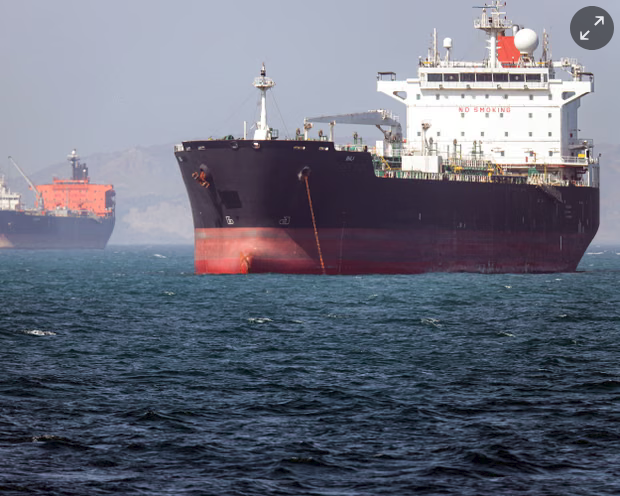
The Iranian strike on the UAE was the second in 48 hours, and came shortly after the US defence secretary, Pete Hegseth, insisted the shaky truce which has paused the war in the Middle East was intact, despite the new increase in violence.
On Monday, the US military said it had destroyed six Iranian small boats, as well as cruise missiles and drones, after Donald Trump sent warships to “guide” stranded tankers through the strait in a campaign he called “Project Freedom”.
‘Project Freedom’: a grand humanitarian gesture, or a fast track to more war?
Hegseth told a press conference on Tuesday the operation to encourage commercial ships to transit the strait was temporary and the truce was not over.
“We’re not looking for a fight … Right now the ceasefire certainly holds, but we’re going to be watching very, very closely,” he said.
There was no immediate reaction from Iran, though earlier on Tuesday its parliament speaker, Mohammad Bagher Ghalibaf, issued a defiant statement accusing the US of breaching the ceasefire.
“We know well that the continuation of the current situation is unbearable for the United States, while we have not even begun yet,” Ghalibaf, who is considered one of the most influential senior officials in Tehran, said in a social media post.
Marco Rubio, the US secretary of state, claimed that 10 civilian sailors had died due to the ongoing conflict in the strait of Hormuz, without providing additional details. Ships and their crews are being “held hostage”, he told a White House briefing. “They’re isolated, they’re starving, they’re vulnerable.”
The strait of Hormuz carries a fifth of the world’s oil and liquid gas supplies in normal times but has been virtually shut since the US and Israel began attacks on Iran on 28 February, triggering massive economic disruption around the world. More than 800 ships and roughly 20,000 crew members remain stranded west of the narrow waterway.
Iran has threatened to deploy mines, drones, missiles and fast-attack craft, making passage through the strait too risky for commercial shipping. The US has countered by blockading Iranian ports.
Addressing reporters, Rubio claimed Tehran was trying to make its shutdown of the waterway a “new normal”. “Under no circumstances can we ever allow them to normalize the fact that they get to blow up commercial ships and put mines in the water,” he said. “So the response to that is, we’re going to blockade your ships.”
The war, which began with an Israeli strike that killed Ayatollah Ali Khamenei, Iran’s then supreme leader, now appears to have reached a stalemate. Iran is suffering massive economic losses which may escalate dramatically if it begins to run out of storage capacity for its oil, but Trump is under pressure domestically and internationally as fuel prices spike in the US and across the rest of the world.
Leaders in Washington and Tehran appear to believe they are close to victory and are unwilling to make significant concessions to allow an on-off negotiation process mediated by Pakistan to make progress.
There are contesting claims from Iran and the US over events in the strait on Monday, when several merchant ships in the Gulf reported explosions or fires, and the important oil port at Fujairah in the UAE was hit by Iranian missiles.
In Washington, Hegseth told reportersthe US had successfully secured a path through the strait and that hundreds of commercial ships were lining up to pass through.
However, only two vessels, both of them US-flagged merchant ships, are confirmed to have crossed through the waterway so far.
Iran denied that any crossings had taken place and claimed that the US had targeted civilian and cargo vessels on Monday, killing five people.
Trump has minimised recent violence in the strait.
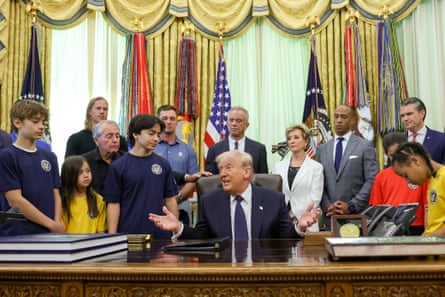
Speaking on Tuesday during an Oval Office event on physical fitness among American children, Trump claimed that Iran “wants to make a deal”. He said: “We’re in a little skirmish, military [sic]. I call it a skirmish, because Iran has no chance. They never did. They know it.
“What I don’t like about Iran is they’ll talk to me with such great respect and then they’ll go on television. They’ll say, we did not speak to the president.”
US and Iranian officials held one round of face-to-face peace talks in Islamabad last month, but efforts to arrange further meetings have been abortive.
Trump has repeatedly cited Iran’s nuclear programme as a justification for the war and has insisted Iran must surrender its enriched uranium stockpiles to prevent it producing a nuclear weapon – an ambition Tehran denies.
Iran presented a 14-point peace proposal to the US via Pakistan on Friday, with a reported focus on the lifting of the blockades and a new mechanism for managing the strait. Iranian press reports portrayed this as a comprehensive peace plan to be implemented within 30 days, rather than just a ceasefire.
Iranian state media said on Sunday that the US had conveyed its response to the proposal via Pakistan, and Iran was reviewing it. Neither side gave details.
A senior Pakistani official involved in the talks told Reuters that “backdoor diplomacy” was continuing. “We have put in a lot of efforts, actually both the sides have narrowed gaps on a majority of the issues,” the source said.
Abbas Araghchi, Iran’s foreign minister, said peace talks were progressing with Pakistan’s mediation, and warned the US and the UAE against being drawn into a “quagmire”.
Iran’s state television said military officials had confirmed they attacked the UAE on Monday in response to the “US military’s adventurism”, while Iranian authorities released a map of what they said was an expanded maritime area now under Iranian control, stretching beyond the strait of Hormuz to include sections of the UAE coastline.
The Iranian map included Fujairah and another Emirati port, Khor Fakkan, both on the Gulf of Oman which the UAE has relied on since the start of the conflict to bypass the blocked strait.
The stalemate has cast a shadow over Trump’s delayed trip to China, planned for 14 May. China is Iran’s biggest customer, buying 80% of its oil before the war, accounting for 13% of Chinese oil imports.
Rising petrol prices and a slowing global economy also pose a political threat to Trump as the US approaches congressional elections in November. A Democratic win in one or both chambers would weaken his presidency. Trump has so far shrugged off domestic concerns with some reports suggesting he is more interested in securing what he sees as his historic legacy than any immediate political concerns.