SHARE THE WARMTH
By FB- AI Chat-T.Chr.-Human Synthesis-01 May 2026
There was once a village set in a valley where winters came early and lingered long. Snow would fall in silence, covering rooftops, fields, and the narrow paths between homes. In that village lived a young man named Eirik, who prided himself on his independence. He worked hard, stored food carefully, and kept his firewood dry and plentiful. When winter came, his house was always warm.
One evening, as the cold deepened and the wind howled through the valley, Eirik sat by his fire and thought about how well he had prepared. He felt a quiet satisfaction—he had earned this warmth.
Outside, the storm thickened, and through the frost-covered window he saw faint shapes moving: neighbors trudging through the snow, carrying what little they had.
A knock came at his door.
It was an old woman from the edge of the village. Her hands trembled, and her voice was thin. “My fire has gone out,” she said. “May I warm myself for a while?”
Eirik hesitated. He had enough wood, but not endlessly. Letting her in meant sharing—not just warmth, but time, space, and resources. Still, something in her eyes unsettled him. He stepped aside.
She entered, sat by the fire, and said nothing. Slowly, her shivering eased. After a while, she thanked him and left, carrying with her a small ember wrapped carefully in cloth.
That night, Eirik could not sleep. The room felt different—not colder, but somehow less complete. He began to wonder: had the warmth diminished when he shared it? Or had something else grown?
The next day, he noticed something strange. The paths between houses, usually buried, were clearer. People were moving more—visiting, carrying bundles, helping one another. Smoke rose from chimneys that had been dark the day before.
Another knock came.
This time, it was a father with a child. Then a farmer with frostbitten hands. Then two siblings who had lost their roof to the storm. Each time, Eirik opened the door more quickly.
Days passed. His woodpile shrank, yet the village seemed to grow warmer. Fires were lit not just in hearths but in gestures—in shared bread, in repaired walls, in laughter that resisted the cold.
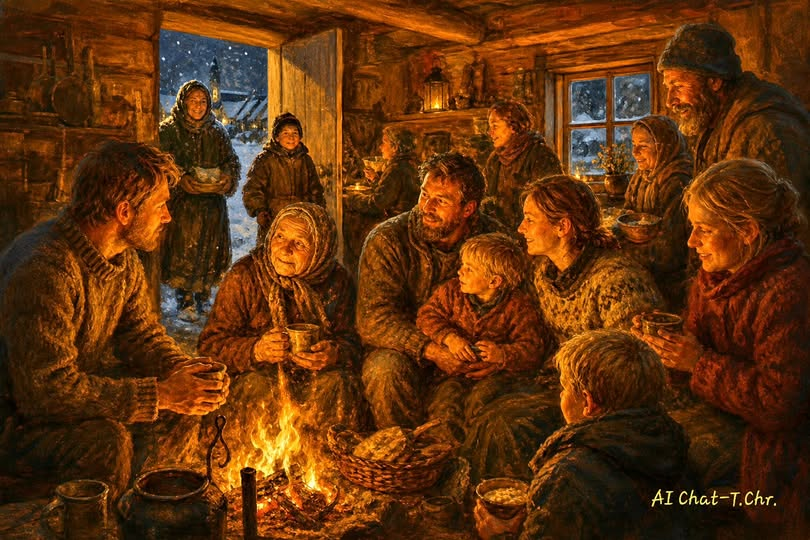
One evening, exhausted, Eirik sat among a group of villagers in his once-quiet home. The fire burned lower than he was used to, but the room was full. Voices overlapped, hands passed cups, shoulders leaned together.
He realized something subtle yet profound: he no longer felt like the owner of the warmth. He was part of it. The old woman returned and sat beside him. “Do you see now?” she asked gently.
Eirik nodded slowly. “I thought warmth was something I kept,” he said. “But it seems it only becomes real when it moves.” She smiled. “A fire alone burns out. Fires shared become a living thing.”
That winter became known as the harshest in memory. And yet, strangely, it was also remembered as the winter no one froze.
Years later, travelers would ask how the village survived. Some said it was careful planning. Others said luck. But those who had been there knew a quieter truth:
The cold had not been defeated by stronger walls or larger stores—but by a shift in language, almost invisible at first.
People had stopped saying “I” when it mattered most. And in doing so, they had discovered that survival was never an individual act, but a shared condition.
And somewhere, in the glow of many small fires, the idea of “we” continued to burn—fragile, demanding, and powerful enough to keep the cold at bay.