HEGSETHS WAR: THE MILITANT CHRISTIAN THEOLOGY ANIMATING THE US ATTACK ON IRAN
By Guardian -Julia Carrie WongFri 10 Apr 2026 13.00 BST
The bible-thumping US defense secretary is overseeing another strategic disaster in the Middle East. Is this a war or a crusade? Nine months and six days before a Tomahawk missile tore through the gaily decorated classrooms of the Shajareh Tayyebeh elementary school in Minab, Iran, ripping apart the bodies of schoolchildren, teachers, and parents, US defense secretary Pete Hegseth’s personal pastor delivered a sermon at the Pentagon.
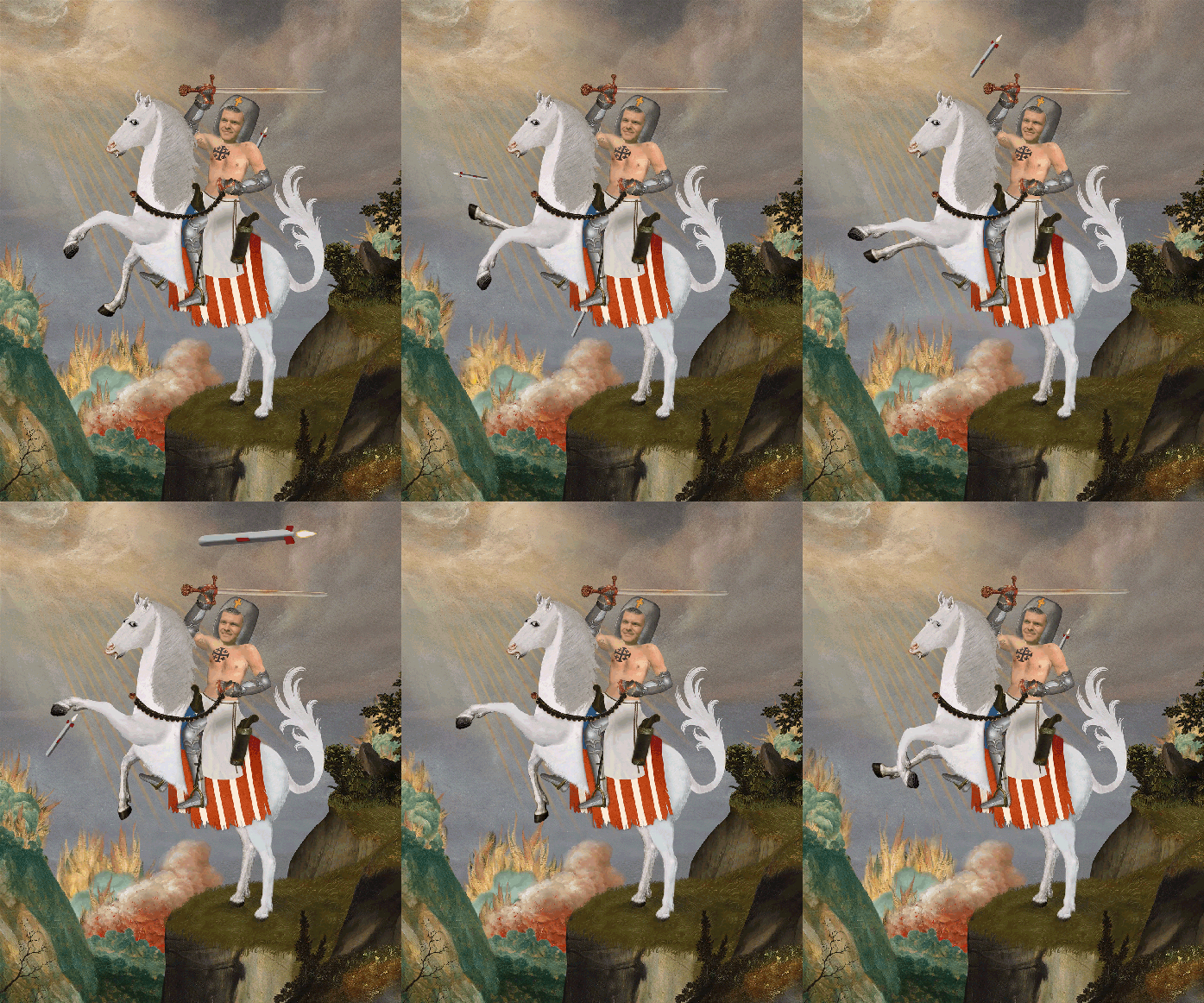
“There’s a temptation to think that you’re actually in control and responsible for final outcomes, especially for those who issue the commands and do the aiming and the shooting,” preached Brooks Potteiger, Hegseth’s closest spiritual adviser, at the first of what have become monthly Christian worship services at the Department of Defense. “But you are not ultimately in charge of the world.”
Citing a verse from Matthew 10, Potteiger told the gathered leaders of the US military: “If our Lord is sovereign even over the sparrow’s fallings, you can be assured that he is sovereign over everything else that falls in this world, including Tomahawk and Minuteman missiles …
“Jesus has the final say over all of it.”
The available evidence and a preliminary investigation by the US military all suggest that the US was responsible for the 28 February school bombing that killed more than 175 people, most of them children, but neither Donald Trump nor Hegseth has taken any responsibility, nor have they expressed any remorse.
Instead, Hegseth has persisted in framing the war in Iran, which reached a temporary ceasefire on Tuesday after six weeks of fighting, as divinely sanctioned, repeatedly invoking “God’s almighty providence” and expressing surety that God is on the side of the US military. Amid boasts about the US’s superior firepower and theatrical disdain for “stupid rules of engagement”, the defense secretary has promised to give “no quarter” to the “barbaric savages” of the Iranian regime and called on the American people to pray for victory “in the name of Jesus Christ”.
Hegseth’s distinct combination of piety and bloodlust was most prominently on display at the 25 March worship service at the Pentagon, the first since the war in Iran began, when he prayed for “overwhelming violence of action against those who deserve no mercy”. The prayer was so shocking that it appears to have provoked a direct rebuke from Pope Leo, who preached on Palm Sunday that God ignores the prayers of those whose “hands are full of blood” from making war.
Hegseth will hardly mind harsh words from the head of the Catholic church, however. The 45-year-old US army veteran and former Fox News host is a member of an obscure, deeply Calvinist wing of evangelical Christianity – John Calvin broke from the Catholic church during the 16th-century Protestant Reformation – that rejects the pope’s authority and is rooted in a belief in predestination.
“They believe that nothing happens that isn’t in God’s will,” said Julie Ingersoll, a professor of religious studies at the University of North Florida, who researches this branch of Reformed Christianity. “They believe that God directs everything that happens.”
Even a bomb falling on an elementary school full of children?
“If God would order a genocide in Deuteronomy 20,” Ingersoll said, citing a passage in which God instructs the Israelites to “destroy every living thing” in certain cities, “what makes you think he wouldn’t cause a girl’s school to be attacked?”
The Iran hawks in the US foreign policy establishment have never lacked for material and geopolitical justifications for wanting to go to war, but the sheer recklessness of the prosecution of this war raises questions about what other factors may be at play. The US has long managed to pursue its interests in the Middle East without bombing Tehran, and the entirely predictable consequences – deadly attacks on US bases and allies, the global economic fallout from the closure of the strait of Hormuz, and the consolidation of power by the Iranian regime – provide an object lesson in why restraint prevailed for 47 years.
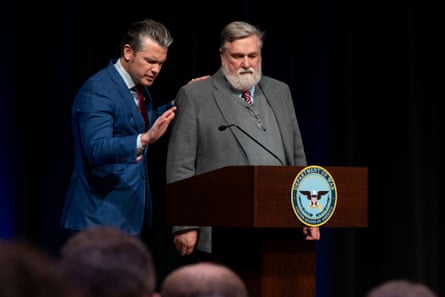
Why take such a risk now? Could the bellicose, belligerent and braying Hegseth – with his Crusader tattoos, his disdain for diplomacy, and his evident taste for violent domination – have convinced Trump to start a war to complete the unfinished business of the Crusades?
On Monday, at a news conference touting the rescue of a crew member from a downed F-15 fighter jet in southern Iran, Hegseth once again invoked his religious beliefs to justify events as they transpired. “Shot down on a Friday, Good Friday, hidden in a cave, a crevice, all of Saturday and rescued on Sunday,” he said. “Flown out of Iran as the sun was rising on Easter Sunday, a pilot reborn.”
It’s not exactly the son of God dying for humanity’s sins, but it at least provided a positive spin to some inconvenient facts: a fighter jet felled weeks after Hegseth claimed that the US had achieved “total air dominance”; a rescue mission that resulted in the loss of hundreds of millions of dollars of military aircraft; and all within the context of a war in which the US appears headed for a straightforward strategic defeat.
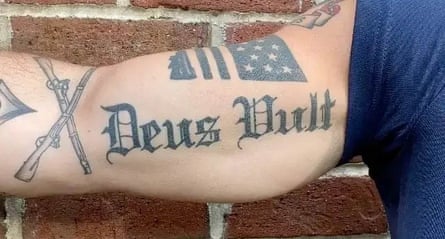
“Deus Vult,” reads the tattoo inked across Hegseth’s right bicep. It’s a Latin phrase meaning “God wills it” that is believed to have been chanted by the Christian warriors who responded to Pope Urban II’s call in 1095 to march to the Holy Land and reconquer it for Christendom. As the American and Iranian people remain trapped in this deeply unpopular war, it’s vital to understand what “God wills it” means to Hegseth, and what that might mean for the rest of us.
Hegseth has described his early life as having a “a Christian veneer but a secular core”. Born and raised in Minnesota, he pursued officer training while at Princeton and served multiple tours in Iraq, Afghanistan and Guantánamo Bay. (A longtime reservist, he left the service after being reported by fellow service members in 2021 for his Crusader tattoos, which have been associated with white supremacist and extremist groups.)
He was elevated to leadership roles at two different advocacy groups for veterans only to be forced out over what the New Yorker called “serious allegations of financial mismanagement, sexual impropriety, and personal misconduct”. Twice divorced due to infidelity, he is now raising seven children with his third wife, whom he married in 2019. He paid $50,000 to a woman who accused him of rape in 2017, though he denies the allegation.
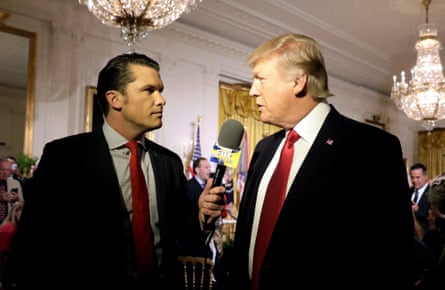
In 2016, Hegseth landed a hosting chair at Fox News. With his telegenic coif, square jaw and slightly too-tight suits, he caught the attention of Trump with his aggressive and successful campaign to win presidential pardons for convicted war criminals.
Hegseth’s pivot to religion began in 2018, when he and his current wife joined an evangelical church in New Jersey and “faith became real”, he told a Christian publication in 2023. Already an enthusiastic proponent of the rightwing culture wars against secular public education, he ended up co-writing a 2022 book arguing that the survival of “Western civilization” depends on the reintroduction of Christianity to American schooling. Hegseth’s co-author, David Goodwin, was a leader of the movement for “classical Christian education” (CCE), and Hegseth was an enthusiastic convert, describing the writing process as a “red pill”.
On Goodwin’s advice, Hegseth moved his family to Nashville, Tennessee, in order to send the children to a CCE school. “We thought we were moving to a school, but we moved to a church and a community and a whole view of the world that has changed the way we think too,” he said.
That church was Pilgrim Hill Reformed Fellowship, led by pastor Potteiger, who would go on to preach about Tomahawk missiles at the Pentagon, and Hegseth’s involvement with it is by no means casual.
“It’s not the kind of church that you can just show up on a Sunday and go to worship and sing songs and then go home,” said Ingersoll. It’s part of a denomination called the Communion of Reformed Evangelical Churches (CREC) in which there is a “strong hierarchy” and church elders hold significant power over congregants, including by running a court system that can excommunicate and shun.
[Communion of Reformed Evangelical Church folk] don’t believe in social equality among people
Julie Ingersoll
To join, Hegseth likely would have had to attend a “session” with the church’s board of elders, during which new converts make a profession of faith and agree to certain covenants, Ingersoll said. “The key thing is that you commit yourself to be in submission to the elders for church discipline, which means that you are accountable to the elders of the church for everything you do and everything you believe.”
If that sounds a bit concerning for someone holding a leadership position in a government founded on the separation of church and state, it is.
“[CREC] folks don’t embrace democracy particularly,” Ingersoll said. “They don’t believe in social equality among people. They think that God created the world and that some people are destined to have authority and to rule over other people, and other people are destined to be followers.
“When we talk about legitimate government having its authority coming from the consent of the governed – they don’t believe that at all.” To Hegseth’s ilk: “legitimate authority comes directly from God.”
That much is clear in the sixth week of a war that was launched without congressional approval and is broadly opposed by the American people. But if Hegseth doesn’t care about the people, whose opinion does he value?
The “whole view of the world” adopted by Hegseth after he joined Pilgrim Hill was crafted by Douglas Wilson, a 72-year-old pastor who has spent the last 50 years attempting to establish a “theocracy” in the small college town of Moscow, Idaho.
Religion was a family business for Wilson. His father, a retired navy officer and full-time evangelist, moved to Idaho in the 1970s to set up a Christian bookstore. Both Wilson and his brother Evan followed, and found themselves drawn into the somewhat hippy “Jesus People” movement of the 70s. They began studying theology together and helped to found a church, but had a falling out when Doug got interested in Calvinism, and Evan couldn’t give up his belief in free will. (Calvinists are a very small minority within Protestantism.)
After Evan left the church (the brothers remain estranged), Doug continued exploring niche theological movements, taking a particular interest in a fundamentalist Calvinist movement that seeks to establish “theonomy”, a kind of Christian governance. His fiefdom in Idaho now counts about 3,000 people across three churches, and his followers – known as “kirkers” – are increasingly flexing their muscle in local politics and land-use disputes, and CREC has grown to 150 churches worldwide. Meanwhile, Wilson built a business empire promoting CCE books, schools and home-schooling materials that grew his influence in the more mainstream evangelical world.
Wilson’s views are extreme, even for the Christian right. A staunch proponent of “biblical patriarchy”, he advocates for wives to submit to their husbands, for parents to inflict “painful” discipline on children, and for boys to be taught the “theology of fist fighting”.
Wilson is opposed to women’s right to vote. He is not opposed to the death penalty for homosexuality. He describes himself as a Christian nationalist and wants “to take over the world for Christ”, Ingersoll said. “The whole world is going to become Christian, and that version of civilization is filled with all kinds of really powerful, strong punishments for people who don’t agree or go along.”
His praise of the Christian governance of the Confederate States of America has led some critics to call him a neo-Confederate, but he prefers the term “paleo-Confederate”. In 1996, he co-authored an apologia for the antebellum south that characterized slavery as “a relationship based upon mutual affection and confidence” and abolitionists as being “driven by a zealous hatred of the Word of God”. The book was withdrawn over allegations of plagiarism, but Wilson returned to the topic in 2005’s Black and Tan, in which he argued that southern slavery was “far more humane than that of ancient Rome” and that southern Christian enslavers were “on firm scriptural ground”.
But where Wilson’s ideas were once on the fringe of rightwing evangelicalism in the US, recent decades have seen a change.
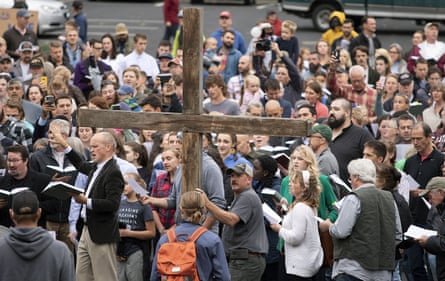
In the aftermath of the second world war, a culture of militant masculinity developed among white evangelicals in the US, according to historian Kristin Kobes Du Mez. A professor at Calvin University who frequently comments on Hegseth, Du Mez traced the emergence of this strain of evangelicalism in her 2020 book Jesus and John Wayne.
Whereas in the 19th century, the ideal of “Christian manhood” would have been focused on virtues such as honor, dignity and gentlemanliness, by the early 21st century, the ideal evangelical man had morphed into something that looks a lot more like Hegseth.
“You could not get a better embodiment of that ideology, that particularly militaristic conception of Christianity and ends-justifies-the-means mentality that baptizes violence and cruelty in the name of righteousness” than Hegseth, said Du Mez.
Du Mez argues that the transformation of the evangelical masculine ideal grew out of a sense of embattlement. Facing threats to their status from feminism, the civil rights movement, the Vietnam war, and broad economic shifts, evangelicals invested psychically in a kind of chauvinistic religiosity that allowed them to reassert their dominance, at the very least within the home. Cheerleading the cold war and post-9/11 wars in the Middle East provided another realm to act out these fantasies of domination, usually without needing to get their own hands dirty. “Any enemies of America – foreign or domestic – and any enemies of their particular agenda are also enemies of God,” Du Mez said.
The perverse moral consequences of combining militant masculinity with religious certainty can be seen in the way this movement consistently supported the most questionable uses of American military power. During the second world war, Du Mez writes, white evangelicals defended the firebombing of German cities. During the Vietnam war, they rallied behind the perpetrators of the Mỹ Lai massacre. And during the global “war on terror”, they were the Americans most likely to support the torture of prisoners.
As evangelicalism’s culture shifted in his direction, Wilson became less of a pariah. He built ties with more respectable leaders and showed a knack for generating attention and publicity. In the past few years, he’s been featured on Tucker Carlson’s podcast and shared a stage with Southern Baptist Convention leader Albert Mohler.
Wilson’s greatest coup has been the recruitment of Hegseth by way of Potteiger. The attention has expanded Wilson’s access to megaphones such as the New York Times, and he appears intent on maintaining influence: since Hegseth was named secretary of defense, Wilson has announced that Potteiger will move to Washington DC to establish a new CREC church for Hegseth to attend.
Wilson does not seem particularly interested in the day-to-day minutia of governance or war-fighting. When he was invited to preach at the Pentagon on 17 February, his sermon largely stayed above the fray, though he mused about whether the invitation itself could be a sign of “a black swan reformation” – an unexpected revival of Christianity in the US.
What we’re living through now is seeing what happens when this ideology becomes national policy
Kristin Kobes Du Mez
For his part, Hegseth has shown an unprecedented willingness to incorporate his personal beliefs into the official workings of the Department of Defense.
To Du Mez, Hegseth’s role atop the Pentagon – and apparent enthusiasm for starting conflicts – is alarming.
“For a long time, a lot of this seemed like bluster,” said Du Mez, noting that the leading lights of the militant masculinity movement, such as Billy Graham, Ronald Reagan and John Wayne, tended not to have actually served in the US military themselves. But with Hegseth, “you have the bluster, you have the rhetoric, you have that underlying ideology, and he’s been handed the reins of power,” Du Mez said. “What we’re living through now is seeing what happens when this ideology becomes national policy.”
With Hegseth, that doesn’t just mean waging war abroad, much as he seems to enjoy it. It means attempting to fulfil Wilson’s vision of a world governed by biblical law, a global Christendom. For that, the first step is establishing Christendom at home.
When Hegseth is trying to make the case that the US is a Christian nation – something he does often – he likes to tell a story about the country’s first president, George Washington.
“Just as George Washington knelt in the snow at Valley Forge, appealing to heaven for guidance and protection, so too our warriors do today,” he said at the National Prayer Breakfast on 5 February.
“The problem with the story is that it didn’t happen,” said Brian Kaylor, the editor-in-chief of the Baptist publication Word&Way, who has closely followed (and criticized) Hegseth’s promotion of Christian theology in the government. “It was made up decades after Washington’s death, by the same guy who made up the story about Washington cutting down the cherry tree.”
Nevertheless it has been embraced by the Trump administration as a kind of absurd alternate origin story for the United States, in which the country was founded not by deists who enshrined the separation of church and state in the constitution, but by Christian patriarchs establishing a Christian nation.
Several of the original 13 colonies had officially established religions, Kaylor pointed out, and the founders chose not to emulate that system when they drafted the new constitution. Moreover, the only references to religion in the text of the document, in article VI and the first amendment, serve to protect the separation of church and state by barring religious tests for public office, banning the establishment of a state religion, and protecting the right of individuals to worship as they choose.
“It’s the exact opposite of creating a Christian nation,” Kaylor said.
There have been moments in US history where Christian nationalist ideas were broadly embraced. One is the Confederate States of America, which was conceived of as a Christian nation, “invoking the favor and guidance of Almighty God” in its constitution. (The Southern Baptist Convention, today the largest evangelical denomination in the US, was formed in 1845 when it broke from northern Baptists in order to continue to support slavery.) When Wilson calls himself a “paleo-Confederate”, he appears at least in part to be referring to his desire for an explicitly Chrisitian government.
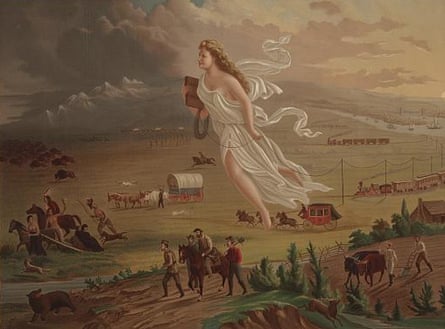
The other was in justifying the genocide of American Indians; early settlers often framed violent aggression against the native population in terms of bringing salvation to the “savage”. By the 19th century, this tendency had evolved into “manifest destiny”, a belief that white settlers were fated by God to conquer all of North America. The Trump administration’s promotion of the painting American Progress by John Gast – it depicts a white woman clad in robes sweeping across the continent, bringing light and technology to the dark and fearful natives – has indicated its desire to revive this way of thinking as well.
At another violent time in US history, Christian nationalism is enjoying a strong baseline of support among Americans – about one in three are either sympathetic or strong believers in the idea of the US as a Christian nation, according to a recent survey by the Public Religion Research Institute. But the real strength of the Christian nationalist movement in the US now comes from its access to power. The second Trump administration is rife with Christian nationalists in leadership positions.
The contemporary Christian nationalist movement in the US unites Christians from disparate denominations. Hegseth represents the Reformed/Calvinist wing, which is distinct from the charismatic evangelicalism practices by figures such as the White House “faith office” adviser, Paula White-Cain. A third camp are Catholic Integralists, who want to integrate church and state; adherents include Steve Bannon and Project 2025 architect Kevin Roberts.
While these groups may all be able to agree on domestic policy priorities – including dismantling public education and using government policy to promote “traditional” family structures – things are more complicated when it comes to foreign policy, especially with regards the Middle East.
Reformed evangelicals like Hegseth are post-millenialists, Ingersoll said, which means that they believe it’s the job of Christians to build the kingdom of God on Earth first, before Jesus’s return. Hegseth’s enthusiasm for the Crusades fits into this broader sense of purpose: he might actually believe it is his mission to re-establish Christendom across the Middle East, starting with Iran, in order to pave the way for Jesus’s return.
But premillennial dispensationalists, such as White-Cain and the US ambassador to Israel, Mike Huckabee, believe that they must bring about the end times on earth now, so that Jesus can return to Earth and establish the Kingdom of Heaven himself. They are avid Christian Zionists and see Jewish control over Israel as crucial to fulfilling these prophecies, rather than wanting to re-establish Christian control over the Holy Land now.
Such wholly irreconcilable visions for the Middle East do not appear to matter that much, however. Both camps have a religious justification for supporting the war, and both can use the war to promote the idea that religion has a place in the business of the state in the first place.
Speaking about the ceasefire at the Pentagon on Wednesday, Hegseth said: “Our troops, our American warriors, deserve the credit for this day, but God deserves all the glory.”
If the ceasefire holds, Hegseth may have to relinquish any fantasies he had of planting a cross in newly conquered land, but that doesn’t mean he – or Wilson – will view this as a defeat.
At the National Prayer Breakfast on 5 February, after sharing his apocryphal tale of Washington’s supposed prayer, Hegseth appeared to channel Urban II, the pope who launched the Crusades in 1095 with the promise that those who fought would receive remission of all sins – a promise that has since became controversial given the brutal massacres and wanton destruction of the Crusades.
[Hegseth’s comments were] not just Crusader theology but something that would be considered heretical in most of Christianity today
Brain Kaylor
“The willingness to make sacrifices on behalf of one’s country is born in one thing: a deep and abiding belief in God’s love for us and his promise of eternal life,” Hegseth said. “The warrior who is willing to lay down his life for his unit, his country, and his Creator, that warrior finds eternal life.”
To Kaylor, who is a Baptist minister in addition to a journalist, the statement was beyond shocking. “This is not just Crusader theology but something that would be considered heretical in most of Christianity today,” he said. “It’s really dangerous and scary. It makes his comments about the religious fanaticism of Iran’s regime ironic at best, if not downright hypocritical.”
The Crusades, like the Confederacy, ended in ignominious defeat. But as with other “lost causes”, they maintain a powerful appeal to reactionary minds who luxuriate in grievance and take comfort in glorious hypotheticals. Trump’s return to the White House in 2025 was propelled in large part by the cult of grievance he built around his loss in the 2020 election. He quickly moved to empower Hegseth to restore the names and statues of Confederate generals to military installations.
With the Iran war seemingly headed toward a resolution that will see Iran significantly better off than it was before, and the US’s geopolitical standing and moral reputation in tatters, it’s possible another rightwing lost cause will emerge. Already, some Maga figures are laying the blame for the US’s strategic failures on Israel. Trump himself has aggressively promoted the idea that Nato is at fault. Hegseth has continued to purge military leaders, and he may lay blame at his usual targets (“woke” generals and rules of engagement).
Leaders of Christian nationalism are operating on timelines in the hundreds of years, Ingersoll said, and they are enjoying real success. The campaign to get rid of the department of education has been going on since it was established in 1979, and now appears to be heading toward fruition. The movement did not give up after the supreme court legalized abortion in 1973, waging a 50-year battle to take down Roe v Wade, and they’re now setting their sights on overturning Obergefell as well.
That kind of long-term planning and patience is part of why Ingersoll thinks that Christian nationalism is “on the ascendancy, historically speaking”. “I’m not optimistic,” she said.
What seems impossible to imagine, at this point at least, is any kind of honest reckoning with the religious modes of thinking that may have fanned the flames of war in the first place. If you are waiting for Hegseth to concede that perhaps God wasn’t on our side this time, don’t.
There is an American leader who reckoned with that question, however. In 1865, after four years of bloody civil war, the Confederacy was on its last legs and victory was within reach. When Abraham Lincoln made his second inaugural address on 4 March, he did not speak to the country about the union’s superior military capacity, nor did he draw conclusions about God’s support of the winning side. Instead, he acknowledged that both sides believed themselves to be acting according to God’s wishes, and that he, as a man, was in no position to know who was correct.
“Both read the same Bible and pray to the same God, and each invokes his aid against the other,” he said of the two sides. “Let us judge not, that we be not judged. The prayers of both could not be answered. That of neither has been answered fully. The Almighty has his own purposes.”
Looking to the future, Lincoln forecast neither triumph nor domination, but the slow and difficult work of learning once again to live with one another: “Let us strive on to finish the work we are in, to bind up the nation’s wounds, to care for him who shall have borne the battle and for his widow and his orphan, to do all which may achieve and cherish a just and lasting peace among ourselves and with all nations.”
In a year that will be dominated with invocations of US history due to the 250th anniversary of the Declaration of Independence, let us also take a moment to commemorate that moment: the nation’s second founding. After the rupture and carnage and emancipation of civil war, a leader was willing to say that we can’t know whose side God is actually on – but that we owe it to ourselves and each other to attempt to make peace just the same.
BACKGROUND OF US DEFENCE SECRETARY PETE HEGSETH
Here’s a clear, factual overview of the background of Pete Hegseth—covering his early life, military service, media career, and path to becoming U.S. Secretary of Defense.
Early life & education
- Born June 6, 1980, in Minneapolis, Minnesota
- Grew up in Forest Lake, Minnesota
- Attended Princeton University, graduating in 2003 with a degree in politics
- At Princeton, he edited a conservative student publication (The Princeton Tory)
- Later earned a Master of Public Policy from Harvard Kennedy School in 2013
Military career
- Commissioned as an infantry officer in the U.S. Army National Guard after college
- Reached the rank of major
- Deployed multiple times:
- Guantánamo Bay
- Iraq (platoon leader)
- Afghanistan (counterinsurgency instructor)
- Received military honors including two Bronze Stars
Media & political career
Before entering government, Hegseth was best known as a conservative media figure:
- Worked as a commentator on Fox News
- Co-hosted Fox & Friends Weekend (2017–2024)
- Became a strong public supporter of Donald Trump
Political/advocacy roles:
- Former head of Concerned Veterans for America (a conservative advocacy group)
- Previously led Vets for Freedom
- Ran unsuccessfully for the U.S. Senate in Minnesota (2012)
Secretary of Defense
- Nominated by President Donald Trump in late 2024
- Confirmed by the Senate in January 2025, with a tie-breaking vote by Vice President JD Vance
- Sworn in on January 25, 2025
As defense secretary, he has emphasized:
- Restoring a “warrior ethos” in the military
- Streamlining weapons procurement
- Strengthening U.S. military readiness and deterrence
Overall profile
Hegseth’s background is somewhat unusual for a U.S. defense secretary:
- ✔️ Military experience (National Guard officer with combat deployments)
- ✔️ Elite education (Princeton + Harvard)
- ✔️ Media influence (national TV personality)
- ❗ Less traditional government experience compared to past defense secretaries, many of whom were senior generals, lawmakers, or longtime policymakers
Core ideology
Hegseth is generally described as a conservative nationalist aligned with the political movement of Donald Trump. His views emphasize:
- Strong national defense
- American sovereignty
- Skepticism of global institutions
- Traditional cultural values
Military & defense policy
As Defense Secretary, his views focus heavily on military culture and readiness:
“Warrior ethos”
- Advocates a return to a more combat-focused military culture
- Critical of what he sees as excessive bureaucracy and non-combat priorities
Opposition to “woke” policies
- Strong critic of diversity, equity, and inclusion (DEI) initiatives in the military
- Argues they distract from combat effectiveness
Military strength
- Supports increased defense spending
- Emphasizes deterrence through strength, especially against countries like China
Foreign policy
Hegseth’s views tend toward a “America First” approach:
- Skeptical of long-term foreign military interventions
- Supports prioritizing U.S. national interests over global commitments
- Favors a tougher stance on adversaries like Iran and China
- Has expressed support for strong ties with allies, but expects them to contribute more to their own defense
Domestic political views
From his media career and activism:
Limited government
- Supports reducing the size and scope of federal government
- Advocates for lower taxes and fewer regulations
Gun rights
- Strong supporter of the Second Amendment
Religion & culture
- Open about his Christian faith
- Often argues that American institutions should reflect traditional values
Populism & anti-establishment tone
- Frequently criticizes political elites and Washington bureaucracy
- Positions himself as aligned with “ordinary Americans,” especially veterans
Controversial aspects
Some of his views have drawn criticism:
- His stance against DEI policies is seen by critics as dismissive of inclusion efforts
- His media style has been described as partisan
- Critics argue his limited government experience is unusual for a defense secretary
Bottom line
Hegseth’s political outlook combines:
- Strong military nationalism
- Cultural conservatism
- Populist, anti-establishment rhetoric
He is one of the more openly ideological defense secretaries in recent U.S. history, shaped as much by media and activism as by traditional policymaking roles.
Personal evangelical identity
Hegseth has been explicit about his Christian (often described as evangelical-leaning) beliefs:
- Speaks publicly about faith shaping his worldview
- Frames moral and political issues in religious terms
- Emphasizes ideas like duty, sacrifice, and moral clarity
His rhetoric often reflects a belief that the U.S. has a distinct moral role in the world.
Influence on his politics
1. Moral framing of national identity
- He tends to describe America not just as a country, but as a nation with a moral and cultural foundation rooted in Christianity
- Aligns with the broader movement around Christian nationalism (though the label is debated and used differently by supporters vs critics)
2. Military as a moral institution
- Views the military not only as a strategic force but as a guardian of civilization and values
- His “warrior ethos” idea often includes:
- Honor
- Discipline
- Clear distinctions between right and wrong
3. Opposition to secular/progressive trends
- Strongly criticizes cultural changes he sees as:
- Overly secular
- Relativistic (no clear right/wrong)
- This ties into his opposition to DEI programs and similar policies, which he argues conflict with unity and merit-based systems
4. Alignment with Trump-era conservatism
- His views overlap heavily with the religious conservative base that supports Donald Trump
- Combines:
- Religious identity
- Nationalism
- Anti-elite sentiment
Why this mix stands out
Most recent defense secretaries (like James Mattis or Lloyd Austin) have:
- Kept personal religious beliefs relatively private
- Focused more on institutional or strategic language
Hegseth, by contrast:
- Uses overtly moral and sometimes religious framing in public discussions
- Comes from a media background where values-based messaging is more common
Support vs criticism
Supporters say:
- Moral clarity is essential in war and leadership
- Faith provides a strong ethical foundation
- His views resonate with many service members and veterans
Critics argue:
- Mixing religion and state power can blur constitutional boundaries
- Risks excluding non-Christian service members
- Could oversimplify complex global conflicts into moral binaries
Bottom line
Hegseth’s approach reflects a worldview where:
Faith → shapes values
Values → shape national identity
National identity → guides military and political decisions
That chain is not unique in U.S. politics—but in his role as Defense Secretary, it’s more visible and debated than usual.
If someone like him were to run for president, the debate would likely center on a few big questions:
1. Leadership style
- Supporters might see him as decisive, values-driven, and willing to challenge institutions
- Critics worry that a strongly ideological style could make compromise and coalition-building harder
2. Religion + government
- His more explicit faith-based framing could resonate with religious voters
- Others would be concerned about how that affects separation of church and state in practice
3. Military-first mindset
- He emphasizes strength, readiness, and a “warrior ethos”
- The concern some raise is whether that translates into overly aggressive foreign policy—or if it simply strengthens deterrence
4. Experience
- Compared to many presidents, he has:
- Military experience
- Media influence
- But less traditional governing experience (like being a governor, senator, or cabinet policymaker over many years), which is something voters usually weigh heavily
5. Populist appeal
- His alignment with figures like Donald Trump suggests he could tap into the same base
- That can be politically powerful—but also polarizing nationally
Devastating or effective really depends on what outcomes those traits would lead to:
- More strength and clarity?
- Or more division and rigidity?
Non-flexible and aggressive. Common sense strongly reduced owing to his new-evangelic stance.
Those are common criticisms people raise about Pete Hegseth, especially given his public style and beliefs. But it’s worth separating style, rhetoric, and actual decision-making, because they don’t always line up perfectly.
When people describe him as non-flexible or aggressive, they’re usually reacting to:
- His very direct, combative media tone
- Clear “right vs wrong” framing of issues
- Strong positions on culture and the military
In practice, leaders—especially at the national level—are constrained by:
- Advisors and the cabinet
- Congress
- International realities
The religion point, the concern reflects a broader debate in U.S. politics. His views are often associated with currents like Christian nationalism, but people interpret that very differently:
- Critics argue it can:
- Oversimplify complex issues into moral absolutes
- Reduce openness to compromise
- Risk excluding people with different beliefs
- Supporters say it provides:
- A clear moral framework
- Consistency in decision-making
- A sense of purpose in leadership
”Reduction of common sense”, is more subjective. What tends to happen is:
- People who share the underlying values see clarity and conviction
- People who don’t see rigidity or bias
That split isn’t unique to him—it shows up with many strongly ideological leaders across the political spectrum.
He should be an evangelic preacher, not a politician
When a political figure speaks in strongly moral or religious terms, it can feel like they’re operating more like a preacher than a policymaker. That’s a reaction some people have to Pete Hegseth.
In the U.S., though, this tension has been around for a long time. Religion has influenced politics in different ways across history:
- Some leaders keep their faith very private
- Others—like figures connected to movements such as Evangelical Christianity—bring it openly into their public messaging
The key issue isn’t really whether someone is religious, but how that belief shows up in governing:
- Does it guide personal values but still allow compromise and pluralism?
- Or does it become a fixed framework that shapes policy in ways that others feel excluded by?
Supporters of Hegseth would argue his faith gives him clarity, purpose, and consistency.
Critics—like what you’re expressing—worry it can blur the line between:
- Personal belief
- Public responsibility in a diverse society
That debate is basically about the balance between:
- Freedom of belief (leaders can be religious, but not fanatics)
- Secular governance (policy should work for everyone, regardless of religion)