A Philosophical Study on Suffering, Identity, and the Alchemy of Strength.
By AI Chat.T.Chr.-Human Synthesis-10 April 2026
A Philosophical Study on Suffering, Identity, and the Alchemy of Strength. At the heart of this reflection lies a profound philosophical shift: the movement from passivity to authorship. The statement “something happened to me” belongs to a worldview rooted in external causation—where life is imposed, identity is reactive, and the self is shaped primarily by forces beyond its control.
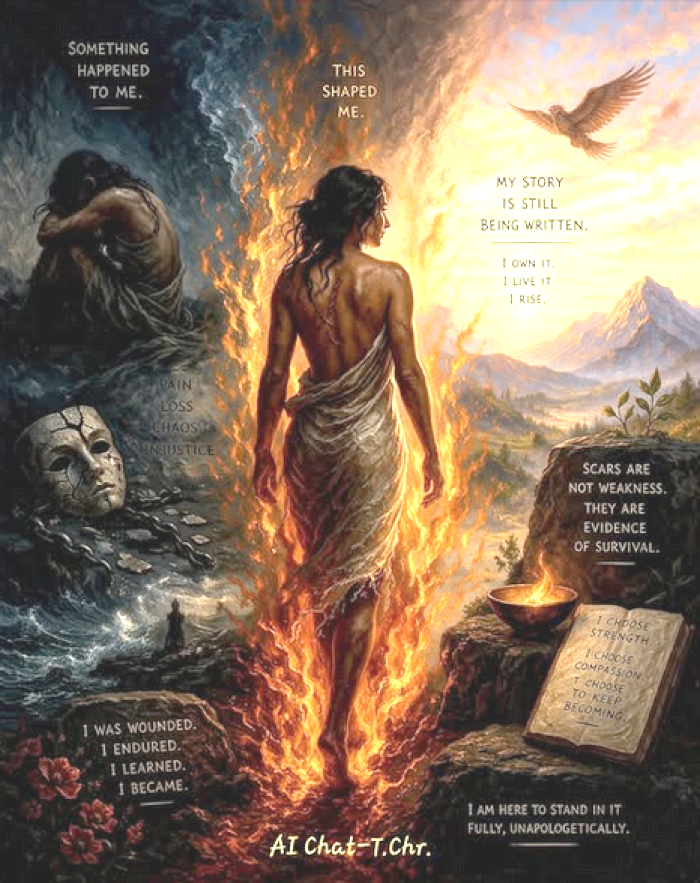
In contrast, “this shaped me” represents an existential reclaiming of agency. It does not deny pain, injustice, or chaos; rather, it reframes them as raw material in the construction of selfhood.This transition echoes a central theme in existential philosophy: that meaning is not discovered but created. Human beings are not merely recipients of experience; they are interpreters. And interpretation is where power resides.
Suffering as Raw Material.
Not all suffering is meaningful in itself. Much of it is arbitrary, unjust, and disorienting. Philosophically, this aligns with the idea that the universe is indifferent—there is no inherent moral structure guaranteeing fairness. Yet, within this indifference lies a paradox: while suffering may lack intrinsic meaning, it possesses potential meaning.
The transformation occurs not in the event, but in the response.To reinterpret suffering as formative rather than destructive is an act of narrative agency. It is the refusal to let chaos have the final word. This does not romanticize pain; instead, it asserts that pain does not have absolute authority over identity.
The Ontology of Scars
The metaphor of scars is philosophically rich. A scar is neither the wound nor the absence of injury—it is the evidence of healing. It represents a synthesis: damage integrated into continuity.In this sense, scars challenge binary thinking: They are not weakness, yet not invulnerability. They signify both rupture and repair.
From a phenomenological perspective, scars alter how one inhabits the world. They are lived reminders that the self is not static but temporal, shaped across time through endurance and adaptation.Thus, scars become epistemological—they teach. They carry knowledge that cannot be accessed through abstraction alone. They are embodied philosophy.
Strength Reconsidered.
The text dismantles a common misconception: that strength is the absence of vulnerability. Philosophically, this aligns with critiques of stoicism when misinterpreted as emotional suppression.True strength, as suggested here, is resilient openness:
To be wounded, yet not closed.
To suffer, yet not surrender one’s capacity for compassion.
To endure without hardening into bitterness.
This reflects an ethical dimension: strength is not merely survival, but how one survives. The refusal to become bitter is not passive—it is an active moral stance. It requires continual choice, especially in the presence of justified anger.
Identity as Narrative Construction.
The idea that “your story is still being written” situates identity within a narrative framework. Philosophers of identity often argue that the self is not a fixed essence but an ongoing story—one that is revised, reinterpreted, and extended over time.
This has two implications: Non-finality: No single event, however devastating, defines the entirety of a person.Responsibility: While one does not choose all events, one participates in the meaning those events acquire.
To “own” one’s story is not to claim responsibility for everything that happened, but to claim authorship over its interpretation and continuation.
Beyond Victimhood Without Denial.
Rejecting a victim identity is philosophically delicate. It must avoid invalidating real harm. The key distinction lies between: Being a victim (a factual condition), and Living as a victim (a fixed identity).
The former acknowledges reality; the latter risks freezing the self in a single chapter of its narrative. To move beyond victimhood, then, is not to erase the past but to decenter it. It becomes one part of a larger story—no longer the defining axis.
The Fire as Transformation.
Fire, in philosophical symbolism, represents both destruction and transformation. It consumes, but it also purifies and reshapes. To say “this is fire” is to suggest that adversity is not merely endured but metabolized.
This aligns with the concept of becoming: the idea that identity is forged through processes that are often uncomfortable, unstable, and nonlinear.The “version of you that walked into the fire” and the one that emerges are not identical. The difference is not just survival—it is transformation.
Conclusion: The Ethics of Rising.
The closing assertion—that one is here to “stand in it fully, unapologetically”—points toward an ethics of self-affirmation. It is not arrogance, but clarity: a recognition that one’s existence, shaped through trial, carries legitimacy. To rise without bitterness, to remain open after fracture, to claim authorship in a world that offers no guarantees—these are not small acts.
They are philosophical achievements.In this light, the story described is not merely motivational. It is existential. It affirms that while humans cannot control all that happens, they possess a remarkable capacity: to transform experience into meaning, and meaning into identity.
And that process—unfinished, evolving—is where strength truly resides..
WITHOUT FRILLS ...
FROM “THIS HAPPENED TO ME” → “THIS SHAPED ME”
1. A Simple Shift That Changes Everything
There are two ways to see your life:
- “Things just happen to me.”
- “What happened helped shape me.”
The first makes you feel stuck.
The second gives you power.
You may not control what happens —
but you do have a say in what it means.
2. Pain Isn’t Meaningful… Until You Make It So
Not all pain has a reason.
Some things are unfair. Random. Messy.
But here’s the key idea:
Pain doesn’t come with meaning —
you give it meaning.
You can let it break you,
or you can use it to build yourself.
3. Scars Tell a Different Story
A scar is not the wound.
It’s what comes after.
- Proof you were hurt
- Proof you healed
- Proof you kept going
Scars don’t mean weakness.
They mean you survived something real.
4. What Strength Really Is
Strength is NOT:
- pretending nothing hurts
- shutting down your feelings
- acting tough all the time
Real strength is:
- feeling pain but not giving up
- staying open instead of becoming bitter
- choosing who you become, even after being hurt
5. Your Life Is Still Being Written
No single moment defines you.
Not your worst day.
Not your biggest mistake.
Not what someone did to you.
Your story is still going.
And you are part of writing it.
6. Victim vs. Identity
It’s okay to admit:
- something bad happened
- you were hurt
That’s reality.
But don’t let it become your whole identity.
You are more than what happened to you.
7. The Fire Changes You
Hard times feel like fire.
Fire can destroy —
but it can also transform.
You won’t come out the same.
But that’s not the point.
You come out stronger, wiser, and more yourself.
8. The Bottom Line
- You were hurt.
- You endured.
- You learned.
- You are becoming.
You don’t need to hide it.
You don’t need to apologize for it.
Stand in your story. Fully.
Because real strength isn’t about avoiding the fire —
it’s about who you become walking through it.