MIDDLE EAST CEASEFIRE THREATENS TO UNRAVEL AS ISRAEL ASSAULTS LEBANON AND IRAN BLOCKS OIL TANKERS

By Guardian-Julian Borger/Andrew Roth/David Smith-Wed 8 Apr 2026 23.10 BST
Inclusion of Lebanon is significant difference in interpretation of truce agreed at 11th hour on Tuesday. The fate of the two-week ceasefire in the Iran conflict looked in peril on Wednesday as both sides gave divergent versions of what had been agreed, Israel intensified its bombing campaign in Lebanon and Iran halted the passage of oil tankers because of an alleged Israeli ceasefire breach.
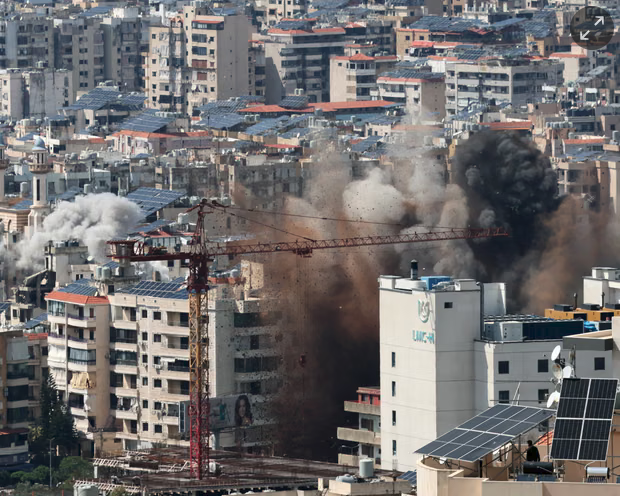
Iran and Pakistan, which brokered the 11th-hour truce, both asserted that the ceasefire included Lebanon. Israel’s prime minister, Benjamin Netanyahu, disagreed and Israeli forces unleashed their heaviest attack of the war so far on more than 100 targets, killing at least 254 people. Donald Trump, after initially remaining silent, said Lebanon was “a separate skirmish” and not part of the deal.
The scale of Israel’s attacks on Wednesday were condemned as “horrific” by UN rights chief Volker Turk.
“Such carnage, within hours of agreeing to a ceasefire with Iran, defies belief. It places enormous pressure on a fragile peace, which is so desperately needed by civilians,” he said.
In a sharply worded statement, Iran’s parliament speaker Mohammad Bagher Ghalibaf said Israel and the US had violated several clauses of the provisional ceasefire, and decried Israel’s aggressive bombing of Lebanon and a US demand that Iran should have no right to enrich its own uranium.
“In such [a] situation, a bilateral ceasefire or negotiations is unreasonable,” the statement read.
While the statement did not announce Iran’s rejection of the ceasefire, it nonetheless indicated that tensions were strained less than 24 hours after Trump had announced that a ceasefire agreement had been reached.
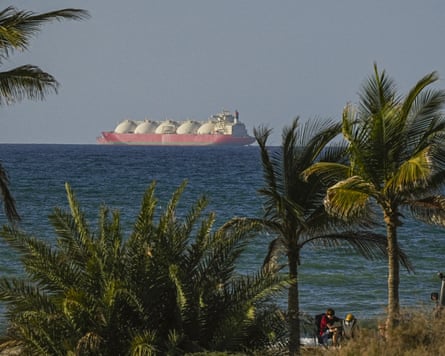
Iran’s Fars news agency said oil tankers passing through the strait of Hormuz had been stopped as a result of Israel’s “ceasefire breach”.
Iran was due to have reopened the strait during the two weeks of the ceasefire, and the oil price had dropped sharply below $100 a barrel in the hours after the truce was announced, prompting a global stock market surge.
The news did not bring any immediate relief for the hundreds of laden tankers trapped in the Gulf by the conflict, which were awaiting approval from insurers before beginning to move and reported continued interference with their satellite navigation systems.
The White House called the reports from Iran’s state media about the closure of the strait of Hormuz “false” and said Trump expected it to reopen “immediately, quickly and safely”, as the US signalled continued hope in the ceasefire even as it threatened to unravel.
Vice-president JD Vance said he believed the differing views on whether the ceasefire included Lebanon came from a “legitimate misunderstanding”.
“I think the Iranians thought that the ceasefire included Lebanon and it just didn’t,” he said. “We never made that promise.”
Israel had offered to “check themselves a little bit in Lebanon” to aid the US negotiations, he added, but would not include it in the ceasefire.
In Israel, opposition politicians led by Yair Lapid have criticised Netanyahu for failing to deliver the conclusive victory he had promised in the war and for delivering instead a “diplomatic disaster” that had eroded the trust between Israel and the United States.
“We still have objectives to complete – and we will achieve them either by agreement or by resuming the fighting,” Netanyahu said in a statement on Wednesday evening.
Marine traffic has continued at a trickle through the Hormuz strait but at a far lower rate than before the war. Five vessels were confirmed as having crossed the strait on Wednesday, four of which were Iranian and heading into the Gulf from the east, while the fifth was Greek-owned.
AXSMarine, a French-founded global marine software and tracking company, said it was “unlikely to see a sudden flurry of vessels rushing for the strait given Iran’s conditions that passage had to be approved by its armed forces. “It is not the same as an open strait,” it said.
The United Arab Emirates claimed its air defences had intercepted 17 ballistic missiles and 35 drones, apparently fired by Iran over the course of the day after the ceasefire announcement. Iran was also reported to have attacked a Saudi oil pipeline to the Red Sea hours after the truce was announced.
Iran’s Islamic Revolutionary Guard Corps (IRGC) claimed on Wednesday to have struck several targets across the region with missiles and drones, including what the IRGC said were oil facilities of US companies in Yanbu, the Saudi Red Sea port and pipeline terminal.
Trump conveyed a different version of the agreement in early Wednesday morning social media posts from the one he had suggested as he announced the ceasefire on Tuesday night.
In the first version, he referred to Iran’s 10-point proposal as a “workable basis on which to negotiate”, and focused on an agreement to reopen the strait of Hormuz.
The statement caused surprise in Washington as Iran’s 10 points differ widely from US objectives and include a right to enrich uranium, the full lifting of sanctions, the payment of war reparations and a scheme giving Iran and Oman joint control of the strait.
Karoline Leavitt, Trump’s press secretary, said during a press conference on Wednesday: “The Iranians originally put forward a 10-point plan that was fundamentally unserious, unacceptable and completely discarded. The idea that President Trump would ever accept an Iranian wishlist as a deal is completely absurd.”
On Wednesday morning, Trump implied that the ceasefire was based on an entirely different 15-point proposal from the US, claiming many of the points had “already been agreed to”.
He insisted there would be no enrichment of uranium and that the US and Iran would work together to unearth the Iranian stockpile of 440kg of highly enriched uranium (HEU), which Trump called “nuclear dust”, enough fissile material for a dozen nuclear warheads.
Leavitt said a US negotiating team led by Vance, as well as Trump’s envoys Steve Witkoff and Jared Kushner would travel to Islamabad in Pakistan for talks set to begin this weekend. The negotiations with an Iranian delegation – expected to include its foreign minister, Abbas Araghchi – will begin on Saturday.
Iran has published two different versions of its interpretation of the agreement. The Farsi version included an acceptance of Iran’s right to enrich uranium. The English version did not.
Araghchi confirmed Trump’s claim that the strait of Hormuz would be reopened during the two weeks of the ceasefire but said shipping would have to apply for safe passage through coordination with Iran’s armed forces.
Iran’s military closed the strait – a freely navigable waterway before the war – in retaliation to the US-Israeli attack on Iran on 28 February and is now charging tankers a $2m-a-ship toll to pass through.
Tehran’s apparent interpretation of the ceasefire is that it will allow all shipping to pass but keep the toll in place, eventually sharing the income with Oman as a co-custodian of the strait.
Pakistan is expecting to host talks on Friday to start to cement the ceasefire into a more durable peace agreement, but on Wednesday the White House had yet to confirm attendance. The gaps to be bridged appeared as broad as ever, and certainly wider than at the last talks before the war, on 26 February in Geneva, where Omani mediators and British observers reported significant progress.

Any operation to extract or destroy the uranium, thought to be stored in scuba tank-sized canisters and buried down deep shafts under mountains, would be long, complicated and risky. Trump opted not to pursue such a mission in the course of the five weeks of conflict, ultimately claiming he did not care about the HEU as it could be monitored remotely by satellite.
The chair of the joint chiefs of staff, Gen Dan Caine, said US forces remained poised for a return to combat. “A ceasefire is a pause, and the joint force remains ready if ordered or called upon,” Caine told reporters.
He said the US air campaign in Iran had achieved its military objectives, striking more than 13,000 targets, destroying roughly 90% of Iran’s navy and 95% of its naval mines.
Hegseth claimed the US and Israel had “finished completely destroying Iran’s industrial base” with a final wave of 800 airstrikes overnight on Tuesday. He listed the Iranian leaders killed in the war, including the supreme leader Ali Khamenei, and claimed that his son and successor, Mojtaba Khamenei was “wounded and disfigured”. The defence secretary claimed, without evidence, that Iran had “begged for this ceasefire”.
The Tehran government portrayed the truce in similarly triumphalist terms to its population. “America was forced to accept a ceasefire,” said Ali Akbar Velayati, a senior politician and foreign policy adviser to the supreme leader, according to official media. “In the new geometry of power in the world, Iran will play a role as the axis of the Islamic pole.”
Trump has been angered by the refusal of several western allies to support his war against Iran. Leavitt told reporters that the president planned to discuss the possibility of the US leaving Nato when he met with the alliance’s secretary general, Mark Rutte, on Wednesday.
Asked whether the president would raise the prospect of withdrawing from Nato, Leavitt replied: “It’s something the president has discussed and I think it’s something the president will be discussing in a couple of hours with secretary general Rutte.”
After the meeting, Rutte told CNN that he believes some Nato countries were tested and failed through the course of the war, but that the “large majority of European nations has been helpful with basing, with logistics, with overflight.”