THE POST HORN OF FILEFJELL

FB Story-AI Chat-T.Chr.-Human Synthesis-30 March 2026
The blast of the post horn cuts through the fog at the foot of Filefjell. Inside the low timber cabin at the relay station, the farmer throws down his spoon. He feels the sound in his body. When the door bursts open, it brings with it a gust of cold air—and a leather mailbag that must go on. The previous courier stumbles in, his beard white with frost, his fingers so stiff around the satchel that he can barely loosen the straps.
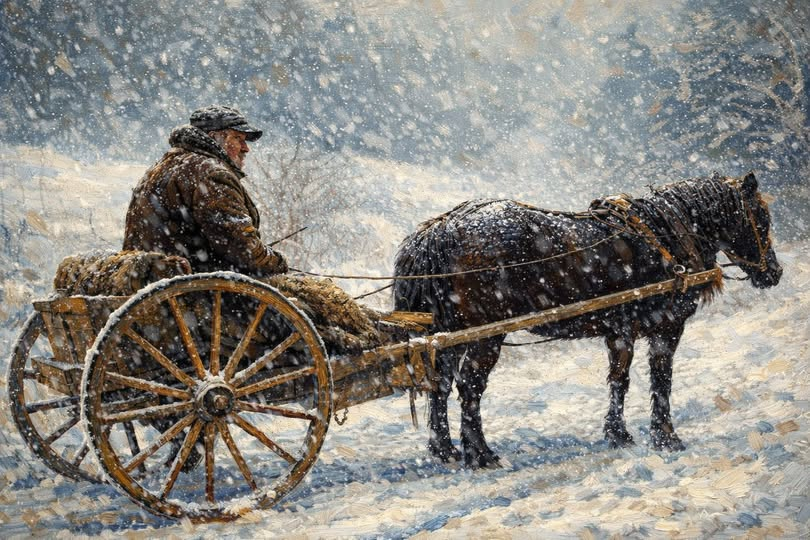
He collapses onto the floor as the next man prepares himself. Outside waits darkness and rain—and the knowledge that if the letters remain here until morning, sanctions will come from Christiania.
It was in January 1647 that this scene became part of everyday life in Norway.
Governor Hannibal Sehested sat in Christiania, looking at a map that was, in reality, a patchwork of isolated valleys. He needed a system that could carry orders from Copenhagen to Bergen, Trondheim, and Stavanger—without them being lost in a shipwreck or forgotten in a remote parsonage.
He needed Henrik Morian.
Morian was a Dutch merchant with capital and an unshakable belief in logistics. The agreement was harsh: he would receive no funding from the state treasury, only the right to run the postal service at his own expense for twenty years.
He had to build everything from the ground up in a country where roads were often nothing more than animal tracks.
He began by appointing post farmers.
For them, the post horn was a double-edged sword. They were granted tax exemptions and spared from military conscription—which, in theory, sounded like a blessing. In practice, it turned their farms into outposts of the state.
They had to keep a horse constantly saddled and ready. A son or farmhand had to be prepared to leave the moment the horn sounded from the neighboring farm.
It didn’t matter if it was the middle of harvest, if the river ran wild after spring floods, or if a child lay sick.
When the mail came, they had to go.
If the post was delayed due to what authorities called negligence, the punishment was severe. A post farmer who hesitated risked forced labor on fortress works and imprisonment on bread and water in the dark cellars of Akershus Fortress.
Documents from the time reveal constant pressure: strict delivery schedules, requirements that mailbags be protected from moisture with layers of greased leather, and threats against those who failed to keep pace.
Morian directed this machinery of duty from Christiania—until the summer of 1648, when he suddenly collapsed and died.
That was when Anna Felber stepped forward.
Left with an unfinished national network, thousands of reluctant farmers, and a host of creditors, she took control. In the 17th century, most expected a widow to withdraw from public life.
Anna did the opposite.
She took her place at her husband’s desk.
Calling herself the “post widow,” she began issuing her own orders. The daughter of mining magnate Jacob Felber, she had seen power exercised deep underground. If she showed weakness now, the entire system would unravel.
From Christiania, she read the reports that trickled in: a courier missing in a snowstorm on Dovre, a mail boat lost in a western fjord.
With a map spread before her, she calculated how long it would take a man to cross a mountain pass on skis.
She argued with magistrates and officials who refused to pay postage, and wrote sharp letters to the governor whenever her privileges were challenged.
She managed postmasters in the cities and ensured that the flow of information did not falter in the critical years after her husband’s death.
Her days were filled with logistical detail.
She made sure post farmers had working horns, that leather bags were tight enough to withstand autumn storms, and that wages and postage were correctly accounted for—while dealing with a state constantly trying to cut costs.
She sat at the center of a web of information and often knew what was happening in remote valleys long before officials in Copenhagen did.
In 1653, she married ironworks owner Johan Krefting and shifted her focus, bringing the same iron will to Bærum Works.
When he too died, she ran the enterprise for nearly three decades. She commanded hundreds of workers, oversaw iron and cannon production, and built a fortune that made her one of the most powerful figures in the country.
The foundation was laid in those five years when she ensured that letters crossed the mountains.
She had seen that the ability to move words from one place to another—regardless of weather—was what held the realm together.
The reality preserved in the archives carries the scent of wet dog fur, the vapor of a worn-out horse in the cold, and the sound of a door bursting open in the middle of the night.
It was a system built on a mix of Dutch business acumen and a widow’s determination.
The mailbag passed from farm to farm, week after week, year after year.
Every time a farmer strapped on his skis in the dark at the sound of a distant horn, it proved that Anna Felber’s reach extended to even the outermost edges.
The small post horn that today hangs on walls and postal vehicles still carries the echo of those 17th-century nights.
It is a reminder of the farmer standing in the cold, waiting, and of the woman in Christiania who made sure he had no choice but to set out on the road.