THE BEAVER

By FB Ships-AI Chat-T.Chr.- Human Synthesis-30 March 2026
The Beaver
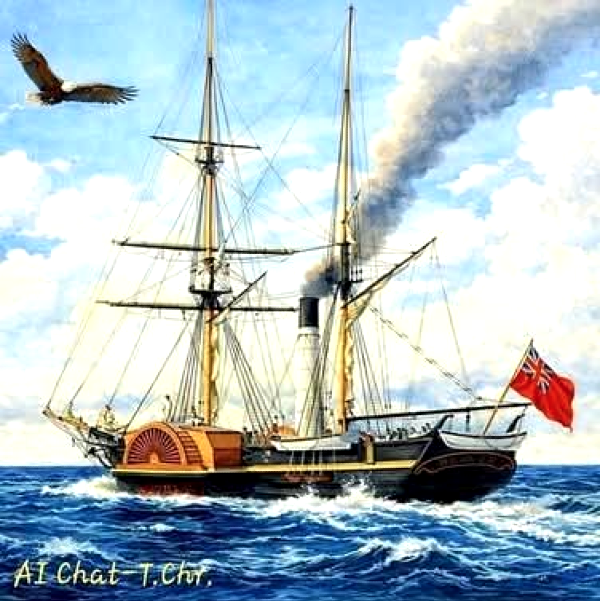
In March 1836 Beaver sailed into the Columbia River. At Fort Vancouver her paddle wheels, boiler and engines were assembled. and she became the first steamer to work in the waters of the Pacific Northwest.
For almost fourty years she served the Hudson’s Bay company forts from Puget Sound to Alaska, gradually shedding her rig and relying on her engines alone. In 1862 she became Her Majesties Hired Survey Vessel Beaver. Her rig was removed and cabins were added, and she served the navy until 1870. She ended her days privately owned as a tug, towing ships, servicing logging camps, and carrying freight and passengers, until the night of July 26, 1888, when she ran aground at Prospect Point at the entrance to Vancouver Harbour.
The Wanderings of the Beaver
The year was 1835, and in the shipyards of England, where the air smelled of tar, salt, and iron, a strange vessel took shape. She was not like the others. Where proud sailing ships bore only masts and canvas, this one carried something new—something almost alive. Iron lungs. A beating heart of steam.
They named her Beaver.
At first glance, she seemed ordinary enough, with her wooden hull and modest lines. But beneath her deck lay a promise of the future: an engine that could push her forward even when the wind refused. Sailors eyed her with suspicion. Some called her a marvel. Others, a folly.
When she set out on her great journey, the ocean tested her immediately.
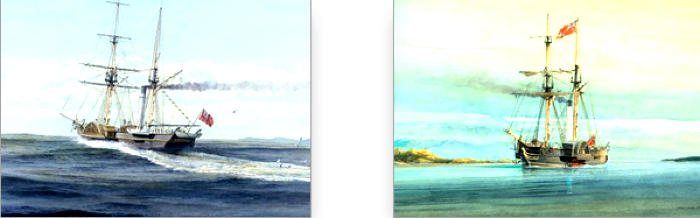
Southward she sailed, past familiar waters and into the roaring wilds of the southern seas. At Cape Horn, where waves rose like mountains and winds howled like angry spirits, even the strongest ships faltered. The Beaver trembled there, her sails straining, her hull groaning—but she endured. Steam and sail together carried her through, as if she were proving that she belonged to neither past nor future, but to both.
Months later, she arrived at a distant and untamed coast—the Pacific Northwest.
There, at a lonely outpost surrounded by towering forests and mist, men labored to awaken her true power. Her engine, boiler, and paddle wheels—shipped separately—were carefully assembled. Piece by piece, the silent machine became whole.
And then, one day, she moved.
Not by wind, but by will.
Her paddle wheels churned the water, steady and relentless. Smoke rose from her funnel as she pushed forward against the current. Those who saw her that day knew something had changed forever.
For years, she wandered.
She slipped through narrow inlets where the forest pressed close to the water’s edge. She crossed wide bays under gray skies. She carried traders wrapped in furs, their goods piled high. She brought supplies to lonely forts where men waited months for news of the world.
In calm waters, she glided like a patient creature. In storms, she fought like a stubborn one.
Gradually, she changed.
Her sails, once so important, became less necessary. One by one, they disappeared. The wind no longer ruled her. The steady pulse of her engine became her only guide, her only strength.
Time passed, as it always does.
New ships came—faster, stronger, more modern. The Beaver, once a wonder, became simply reliable. Dependable. Old.
But she did not stop.
When the navy called, she answered.
Her decks were altered, her purpose shifted. She carried surveyors who mapped the unknown coastline, turning mystery into knowledge. She traced the edges of continents, helping others follow safely behind.
Even after that, when her naval days were done, she refused to rest.
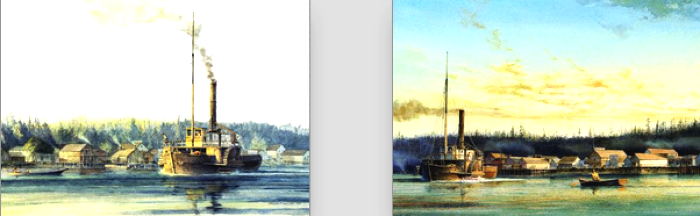
She became a worker of the coast—a tug, a hauler, a carrier of people and goods. She towed ships through tricky waters, served rough logging camps, and connected scattered settlements. Her hull bore the scars of long service. Her engine no longer shone. But she endured, as she always had.
The years weighed on her.
By 1888, she was no longer young, nor even middle-aged. She was something rarer: a survivor.
On a quiet summer night, under a sky scattered with stars, she made her final journey. The waters near Vancouver Harbour were calm, but darkness has a way of hiding dangers. Whether through misjudgment or fate, she drifted too close to the shore.
There was a jolt.
A grinding sound.
Then stillness.
She had run aground at Prospect Point.
There was no great storm, no dramatic end. Just the quiet conclusion of a long life. The tide moved around her as it always had, indifferent yet eternal.
The Beaver, who had crossed oceans, opened frontiers, and served for more than fifty years, came to rest.
But her story did not end there.
For in every charted coastline, in every port that grew from those early days, in every vessel that followed powered not by wind but by engine—there remained a trace of her.
She had been there first.
A small ship with iron lungs, who refused to wait for the wind.
FROM THE STORM-LASHED SEAS OF CAPE HORN…
The southern ocean did not welcome her.
It never welcomed anyone.
As the Beaver approached Cape Horn, the sky darkened into a restless gray, and the wind rose with a voice that seemed almost alive. Waves climbed higher and higher, towering over her like moving cliffs of water. Each one crashed against her hull with a force that shuddered through every beam and plank.
The men aboard tightened ropes with frozen fingers. Salt spray lashed their faces. The sails snapped and strained, threatening to tear free at any moment.
Here, at the edge of the world, there was no mercy.
Ships stronger than Beaver had vanished in these waters. Masts snapped like twigs. Hulls split open. Entire crews swallowed without a trace. The sea did not care how far a vessel had come—or how far it still had to go.
But the Beaver endured.
When the wind howled against her, her sails answered. When the waves drove her back, her hidden engine whispered its quiet defiance. Though not yet fully assembled, the promise of steam traveled with her—a reminder that she was not bound entirely to the old ways.
Day after day, she fought forward.
Not in great leaps, but in stubborn inches.
Through freezing nights and endless gray mornings, she pressed on until, at last, the fury of Cape Horn began to loosen its grip. The waves softened. The wind eased. The sky opened, just slightly, as if acknowledging her passage.
She had survived what many could not.
And beyond that storm lay a new world waiting.
TO THE QUIET INLETS OF PUGET SOUND…
If Cape Horn was a place of chaos, Puget Sound was its opposite.
Here, the waters lay calm and deep, reflecting the towering forests that lined the shore. Mist drifted silently between the trees, and the calls of distant birds echoed across the stillness.
Into this quiet world came the Beaver.
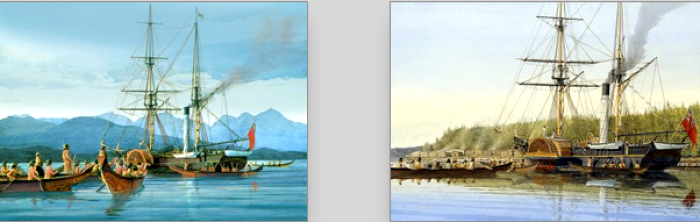
At first, she must have seemed almost unnatural—a vessel that moved without wind, her paddle wheels turning steadily, her engine breathing softly beneath her deck. Smoke curled upward into the cool air as she slipped through narrow passages and hidden channels.
But she did not disturb the silence.
She became part of it.
Day after day, she traveled these waters, weaving between islands and along forested shores. She brought life with her—supplies, tools, letters from distant places. She carried traders who depended on her, their livelihoods stacked in crates and bundles within her hold.
At lonely outposts, her arrival meant everything.
Men would gather at the shoreline, watching as she approached, her steady rhythm announcing her presence long before she came into view. To them, she was more than a ship.
She was connection.
She was certainty in an uncertain land.
In these calm inlets, she found a different kind of strength—not the strength to survive storms, but the strength to endure routine, to return again and again without fail.
Seasons changed.
Forests darkened in winter and brightened in spring. Fog came and went. Settlements slowly grew.
And through it all, the Beaver continued her quiet work.
Reliable.
Unwavering.
Essential.
TO THE ICY REACHES OF ALASKA…
Far to the north, the world grew colder.
The waters darkened, reflecting skies that seemed wider and more distant. Snow clung to the land even as summer approached, and the air carried a sharpness that cut through cloth and skin alike.
Still, the Beaver pressed onward.
Her journeys into Alaska were longer, harsher, and more isolated than any she had made before. Here, there were no sheltered inlets waiting just beyond the next bend. No easy refuge from storms that rolled in without warning.
Fog could swallow the sea whole.
Ice could drift silently in her path.
The coastline stretched endlessly, wild and unforgiving.
And yet, she continued.
At remote trading posts, where the land met the frozen sea, her arrival was a rare and welcome sight. She brought supplies that could not be found elsewhere—tools, food, trade goods—and carried away furs that would travel across the world.
But more than that, she brought presence.
In a place where isolation could feel endless, the sound of her paddle wheels breaking the silence was a reminder that the world was still connected.
That they were not alone.
The Beaver adapted, as she always had.
Her crew learned the rhythms of these northern waters—the way fog settled, the way currents shifted, the signs of approaching weather. Her engine worked steadily, pushing her forward through cold and distance alike.
She was no longer just a newcomer or an experiment.
She was proven.
Tested.
Trusted.
And in doing so, she carved her own path through history—one steady turn of her paddle wheels at a time.