AMERICAN HEGEMONY IS CRACKING- IRAN MAY FINISH IT.
By Scheerpost - ScheerPost Staff - March 26, 2026
In a sharply critical conversation published by Jeffrey Sachs on YouTube via Glenn Diesen’s channel, the veteran economist argued that the current U.S. confrontation with Iran is exposing what he described as a profound crisis inside American strategic thinking—one that could accelerate the decline of U.S. global dominance.
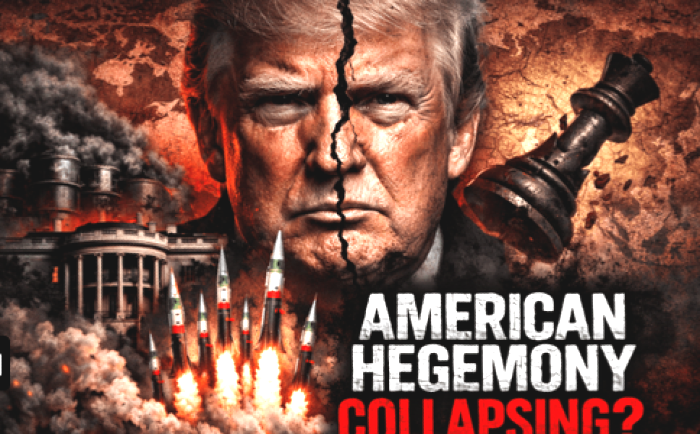
Sachs’ central warning was blunt: Washington is behaving less like a stable superpower and more like a system improvising under pressure, reacting to battlefield developments without a coherent long-term plan. In his view, recent threats, contradictory statements about negotiations, and military signaling toward the Persian Gulf all point to an administration operating through impulse rather than strategy.
Rather than presenting the conflict as an isolated confrontation, Sachs framed it as part of a larger historical pattern—one in which declining powers overestimate their ability to dictate outcomes abroad while underestimating the resilience of rival states.
A Crisis of Strategic Competence
One of the strongest themes in the discussion was Sachs’ argument that the United States increasingly misjudges adversaries across multiple fronts. He linked the current confrontation with Iran to earlier Western assumptions about Russia and China—cases where policymakers believed economic pressure, sanctions, or military threats would quickly force concessions.
Instead, Sachs argued, these assumptions have repeatedly failed because American decision-makers no longer appear capable of realistic long-range planning.
He contrasted this with state planning models in Beijing, describing how Chinese policymakers build multi-year strategies through institutional consultation, expert review, and technical forecasting—while Washington, in his words, increasingly appears driven by television politics, short-term messaging, and abrupt reactions to market pressure.
That contrast, he suggested, helps explain why repeated predictions of quick geopolitical victories continue to collapse.
Why Iran Is Different
Sachs emphasized that Iran is not a weak state that can simply be pressured into surrender.
He argued that any attempt to impose regime change from outside faces enormous military, political, and geographic obstacles. Iran’s size, regional alliances, missile capabilities, and domestic political cohesion make it fundamentally different from previous intervention targets.
His warning was that policymakers may once again be assuming military superiority automatically produces political victory—a pattern he believes has already failed repeatedly in recent decades.
That is why he described Iran not merely as another conflict zone, but potentially as a turning point: a place where the limits of U.S. power become impossible to hide.
Escalation Without an Exit Strategy
A major concern raised in the interview was the visible contradiction between diplomatic rhetoric and military movement.
While public statements suggested possible openings for negotiation, troop deployments and continued regional escalation told another story.
For Sachs, this contradiction signals that there may be no fully developed exit strategy behind the public messaging. Instead, he suggested, the danger lies in escalation driven by momentum—where each failed move produces another reaction without a clear political objective.
That kind of drift, he warned, is how major powers become trapped in conflicts they no longer control.
The Multipolar Constraint
Another key argument from Sachs was that the international environment has changed in ways many Western leaders still refuse to fully acknowledge.
He argued that the world is no longer unipolar, and that major states including China, Russia, and India now possess enough diplomatic weight to limit unilateral military outcomes if they act in coordination.
Rather than direct confrontation, Sachs suggested the most realistic brake on escalation may come through a united diplomatic front formed by non-Western powers alongside regional actors across Asia, Africa, and the Middle East.
In that sense, the Iran crisis is not only about war—it is also a test of whether emerging global power centers are willing to collectively resist further destabilization.
A Deeper Warning About Empire
Underlying the entire discussion was a broader historical argument: that empires rarely recognize decline while it is happening.
Instead, they often intensify force precisely when strategic control is weakening.
That, Sachs implied, is what makes the present moment especially dangerous. If policymakers continue acting as though military pressure alone can preserve geopolitical primacy, they may deepen exactly the decline they are trying to prevent.
His conclusion was stark: the greatest risk may not simply be miscalculation in Iran, but a wider inability among Western leadership circles to understand that the global balance of power has already changed.
Editor’s Note: In one of the scariest moments in modern history, we're doing our best at ScheerPost to pierce the fog of lies that conceal it but we need some help to pay our writers and staff. Please consider a tax-deductible donation.
At a moment when the once vaunted model of responsible journalism is overwhelmingly the play thing of self-serving billionaires and their corporate scribes, alternatives of integrity are desperately needed, and ScheerPost is one of them. Please support our independent journalism by contributing to our online donation platform, Network for Good, or send a check to our new PO Bo