BABI YAR-GENOCIDE-1940/42
By AI ChatGPT-T.Chr.-Human Synthesis-23 March 2026
A Story of Cruelty, Memory, Power, and Responsibility.
Chapter I: The Ravine That Remembered
At the edge of a quiet city lies a ravine. Wind moves through tall grass, and the earth dips into a long, silent hollow. Today, people walk there slowly. They lower their voices without being told. Something about the place asks it of them. Long ago, it was only land. It held rainwater, caught leaves, and echoed birdsong.
It did not know hatred. It did not know history. But one autumn, everything changed. The ravine became a witness.
Not a judge. Not a participant. A witness. And that is a heavy role for something made of soil and stone.
Chapter II: The World Above
Far from the ravine, ideas were taking shape in the mind of a man who believed the world had been betrayed. He wrote, spoke, and repeated his beliefs until they hardened into ideology.
He did not act alone. Around him, others listened, agreed, and built systems that turned belief into policy.
Messages spread through newspapers, radios, classrooms, and films. Over time, those messages shaped how people saw one another. Some people were no longer described as neighbors. They were described as threats.
Chapter III: The Slow Change
At first, the changes were small.
Certain people lost jobs. Then rights. Then protection under the law.
Many watched this happen.
Some disagreed quietly. Others accepted it. A few supported it.
Life continued. Shops opened. Children played. The world did not collapse.
And because it did not collapse, the next step became easier.
Chapter IV: Fire in the Streets
One night, violence became visible.
Windows shattered. Buildings burned. People were taken away.
The shock was real—but brief.
Soon, even this became part of the new normal. The line between what was unthinkable and what was acceptable had moved.
Chapter V: Walls and Boundaries
As war spread, separation deepened.
Entire communities were forced into confined spaces. Hunger and disease followed. The outside world knew, but distance and fear made action rare.
The idea that some lives mattered less had taken root. And roots, once deep enough, are hard to remove.
Chapter VI: The Ravine Fills
Then came the days when the ravine was no longer just land.
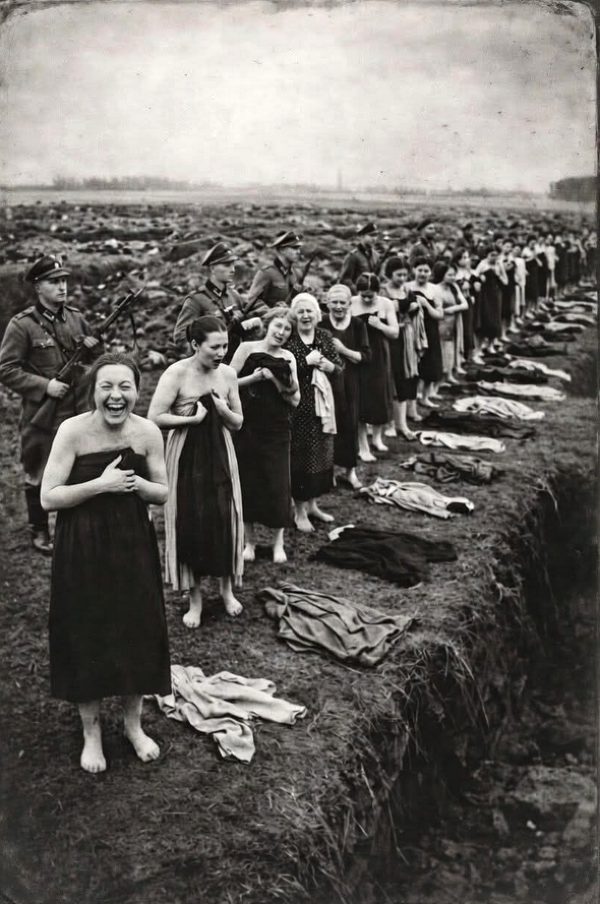
People were brought there under orders. They were told where to go, what to do, how to stand. The process was organized. Efficient. Repeated.
In a very short time, tens of thousands were gone.
The ravine received them all.
It did not understand why.
But it remembered.
Chapter VII: Silence and Ashes
Later, those responsible tried to erase what had happened.
Evidence was destroyed. The past was buried again—this time intentionally.
But memory is not so easily removed.
It lingers in places. In stories. In questions.
The ravine remained.
Chapter VIII: The Student
Years later, a student came to stand at the edge.
He had read books. He knew numbers and dates. But standing there, knowledge felt different.
He asked a question aloud:
"If people can do this, what does that make us?"
There was no voice in reply. Only wind moving through grass.
But the answer seemed to form anyway:
It makes you responsible.
Chapter IX: The Nature of Influence
The student began to understand something important.
Great tragedies are rarely the result of one person alone.
They are built from ideas repeated, systems enforced, and countless individual choices—some active, some passive.
Some people lead. Others follow. Many remain silent.
And history is shaped by all of them.
Chapter X: The Weight of Memory
The ravine does not speak, but it holds a kind of weight.
Not physical weight—something else.
A presence.
A question.
If you stand there long enough, you may feel it:
How can the same world hold both kindness and cruelty?
Chapter XI: What Remains
Today, the place is quiet again.
Grass grows. Trees stand. The wind continues its endless journey.
But the land is no longer just land.
It has become memory.
Philosophical Overview: The Question That Endures
This story is not only about the past.
It is about patterns that can appear wherever people stop seeing one another as fully human.
It is about how small changes—words, ideas, exclusions—can grow into something far greater.
It is about responsibility.
Not responsibility for what has already happened, but for what comes next.
Because history does not repeat itself in the same way—but the conditions that allow it can return.
And when they do, they rarely announce themselves loudly.
They begin quietly.
In language.
In thought.
In silence.
The ravine, in its stillness, offers no commands.
A POEM FOR BABI YAR
By Yevgeni Yevtushenko (1961)
Translated by Benjamin Okopnik (October 1996)
No monument stands over Babi Yar.
A steep cliff only, like the rudest headstone.
I am afraid.
Today, I am as old
As the entire Jewish race itself.
I see myself an ancient Israelite.
I wander o’er the roads of ancient Egypt.
And here, upon the cross, I perish, tortured,
And even now, I bear the marks of nails.
It seems to me that Dreyfus is myself.
The Philistines betrayed me—and now judge.
I’m in a cage, surrounded and trapped,
I’m persecuted, spat on, slandered, and
The dainty dollies in their Brussels frills
Squeal as they stab umbrellas at my face.
I see myself a boy in Belostok.
Blood spills and runs upon the floors.
The chiefs of bar and pub rage unimpeded
And reek of vodka and of onion, half and half.
I’m thrown back by a boot; I have no strength left.
In vain I beg the rabble of pogrom,
To jeers of “Kill the Jews, and save our Russia!”
My mother’s being beaten by a clerk.
O Russia of my heart, I know that you
Are international by inner nature.
But often those whose hands are steeped in filth
Abused your purest name in name of hatred.
I know the kindness of my native land.
How vile that, without the slightest quiver,
The antisemites have proclaimed themselves
The “Union of the Russian People!”
It seems to me that I am Anna Frank,
Transparent as the thinnest branch in April.
And I’m in love, and have no need of phrases,
But only that we gaze into each other’s eyes.
How little one can see, or even sense!
Leaves are forbidden, so is sky,
But much is still allowed—very gently
In darkened rooms each other to embrace.
—“They come!”
—“No, fear not—those are sounds
Of spring itself. She’s coming soon.
Quickly, your lips!”
—“They break the door!”
—“No, river ice is breaking…”
Wild grasses rustle over Babi Yar.
The trees look sternly, as if passing judgment.
Here, silently, all screams, and, hat in hand,
I feel my hair changing shade to gray.
And I myself, like one long soundless scream
Above the thousands upon thousands interred,
I’m every old man executed here,
As I am every child murdered here.
No fiber of my body will forget this.
May “Internationale” thunder and ring
When, for all time, is buried and forgotten
The last of antisemites on this earth.
There is no Jewish blood that’s blood of mine,
But, hated with a passion that’s corrosive,
Am I by antisemites like a Jew.
And that is why I call myself a Russian.
WHAT REALLY HAPPENED AT BABI YAR?
- Location: A ravine on the outskirts of Kyiv
- Dates: Primarily September 29–30, 1941
- Perpetrators: Nazi German forces, especially units of the Einsatzgruppen, with support from collaborators
In just two days, approximately 33,771 Jewish men, women, and children were systematically murdered. Victims were ordered to gather under false pretenses, marched to the ravine, forced to undress, and then shot in groups.
What followed
Babi Yar did not end with that massacre. Over the following months and years:
- Thousands more were killed there, including:
- Roma (Gypsies)
- Soviet prisoners of war
- Ukrainian nationalists
- Civilians accused of resistance
- Over 100,000 people were murdered at the site in total.
Attempt to hide the crime
In 1943, as Nazi forces retreated, they tried to cover up evidence:
- Bodies were exhumed and burned
- Prisoners forced to do this work were later killed
Despite this, the scale of the atrocity became known after the war.
Historical significance
- Babi Yar is a key example of the “Holocaust by bullets”—mass shootings carried out before extermination camps became the primary method.
- It symbolizes how entire communities could be annihilated in a matter of days.
- For decades under Soviet rule, the specifically Jewish identity of many victims was downplayed.
Cultural memory
The tragedy has been remembered in literature and art:
- The poem “Babi Yar” by Yevgeny Yevtushenko
- The powerful Symphony No. 13 (“Babi Yar”) by Dmitri Shostakovich
These works helped bring global awareness to the massacre.
Today
Babi Yar is now a memorial site:
- Monuments honor Jewish victims and others killed there
- It stands as a solemn reminder of genocide, hatred, and the consequences of dehumanization
Source- FB Article 22 Mar 2026