IRAN ISSUES STATEMENT ‘FROM MOJTABA KHAMENNEI‘ AS ITS ATTACKS DISRUPT ENERGY MARKETS.
By Guardian- Tom Ambrose /Vivian Ho/Adam Fulton/Patrick Wintour/Dan Sabbagh - Thu 12 Mar 2026 17.06 GMT
Message read out by newsreader calls for national unity and says that all US bases in the region should close or face attacks.
- Iran escalates attacks on infrastructure and transport across the Gulf
- How have you been affected by the latest Middle East events?
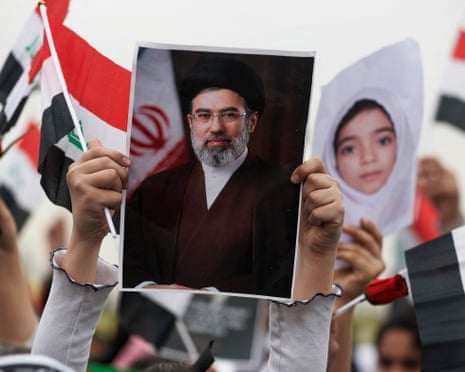
Statement released 'from new supreme leader'
In his first public remarks as Iran’s supreme leader, Ayatollah Mojtaba Khamenei apparently called for national unity and said that all US bases in the region should close or face attacks.
The strait of Hormuz will remain closed in order to pressure Iran’s enemies, Khamenei reportedly said. He was not seen in the broadcast and the statement was delivered by a newsreader.
Iran wants good relations with its neighbouring countries, Khamenei’s statement said, and asked them to close down their US bases as that is what Iran is targeting.
Updated at 14.44 GMTnow17.06 GMT
Iran wants to ensure that a war will not be imposed on it again in the future, deputy foreign minister Majid Takht-Ravanchi told AFP, as the conflict raged with the United States and Israel.
“We want to see that war is not going to be imposed again on Iran,” said Takht-Ravanchi in an interview with AFP in Tehran.
“When the war started last June, after 12 days there was so called cessation of hostilities... but after eight or nine months, they regrouped and they did it again,” he said, referring to the US and Israel.
“We do not want to be treated like this again in the future.”

Patrick Wintour
Iran issued its first message in the name of its new supreme leader, Mojtaba Khamenei, on Thursday, saying it would keep the strait of Hormuz closed and continue to attack US bases in the region.
The missive was read out on state TV rather than delivered live or on video, however, and will do little to satisfy those seeking proof that the son of the late Ayatollah Ali Khamenei is actually alive.
In the message, Khamenei said he would demand compensation from the US for its attacks, and that if Washington refused he would order the destruction of its assets equivalent to the amount Iran is owed.
With doubts circulating about his health after the lethal attack on his father’s compound on the first day of the US-Israeli assault, the message read out on state TV is bound to be examined closely for the first clues of the kind of leadership the previously backroom politician intends to provide.
Described as a hardliner close to the Islamic Revolutionary Guards Corps, Khamenei, 56, said little in his message about the recent internal divisions in the country save to praise “the masses of people who have gathered in magnificent assemblies to reaffirm their allegiance to the system”.
“There must be no harm to the unity of the nation among the individuals and groups of the nation which usually becomes specially evident in times of hardship,” he said, calling for “points of disagreement” to be overlooked. He also showered praise on the Iranian people for standing up to the aggressor, saying it had brought admiration from friends and astonishment from enemies.
Iran vows to fight on in first message issued in name of Mojtaba Khamenei
Patrick Wintour
Oman’s foreign minister, and the mediator in the US Iran nuclear talks, has claimed the US will not achieve as much through war as it could have achieved in the peace talks.
Badr bin Hamad Al Busaidi was speaking to Omani reporters in Muscat and appears to challenge the premise that the war is about Iran’s nuclear program, arguing it was designed to weaken Iran politically.
In the official account of the meeting it is said “in describing the background of the war, the minister stated that the decision was not fundamentally linked to the Iranian nuclear program”.
He noted that recent negotiations had reached a very advanced stage, including an Iranian pledge not to possess nuclear material capable of producing a bomb, a commitment not to accumulate or store enriched materials and to convert existing stockpiles into irreversible fuel.
He emphasised that the United States could not have obtained greater concessions through war than those achieved through negotiation.
He added that the true objective of the war was to weaken Iran, reshape the region, and advance the normalisation process within a broader context that also included attempts to prevent the establishment of a Palestinian state and to weaken any country or institution that supports or stands with the Palestinian statehood project.
In response to a question about Oman’s position on the ‘peace council’, he stated that Oman would not join the council and would not normalise relations with Israel.
The minister considered the American and Israeli attacks on Iran a new link in a “dangerous chain of violations witnessed in recent years” and said they threatened to undermine the legal framework that had provided protection and stability to the countries of the region for decades.
The Israeli military said it had begun a wave of strikes across Beirut on Thursday, after it warned residents of a central neighbourhood of the Lebanese capital it would target a building there.
“The IDF has begun a wave of strikes targeting Hezbollah terrorist infrastructure across Beirut,” a military statement said, as AFPTV footage showed a strike hitting a central Beirut building.
Italy is temporarily withdrawing all personnel from a military base in Iraqi Kurdistan which came under a drone attack, completing a retreat that was already underway, ministers said on Thursday.
“A retreat was already planned” before Wednesday’s attack that caused no injuries, defence minister Guido Crosetto told Italian news programme TG1, a withdrawal confirmed by foreign minister Antonio Tajani.

Dan Sabbagh
Vladimir Putin’s “hidden hand” lies behind Iran’s military methods, the UK defence secretary, John Healey, has said, after a night in which drones struck a camp used by western forces in Erbil, northern Iraq.
Healey was speaking after British officers at the UK’s military headquarters in north-west London had told him that Iranian and Iranian proxy drone pilots were increasingly adopting tactics “from the Russians”.
Iran has already fired more than 2,000 Shahed drones – long-range weapons heavily used by Russia against Ukraine – across the Middle East in response to the US-Israeli attack launched on 28 February.
Lt Gen Nick Perry, the chief of joint operations, told Healey it appeared that Russia had since passed back tactical advice to Iran and its proxies on how to fly them.
Iranian drone pilots were now “flying them much lower, and therefore they are more effective” in hitting targets, Perry said. That had “proven problematic”, he said, because Shahed drones were becoming one of Tehran’s more effective weapons as the conflict heads towards a third week.
Putin’s ‘hidden hand’ lies behind Iran’s drone tactics, UK defence secretary saysRead more1h ago15.12 GMT
The International Maritime Organization (IMO) will convene an “extraordinary session” next week to discuss threats to shipping in the Middle East and particularly in the strait of Hormuz, the agency said Thursday.
The meeting, scheduled for 18-19 March at the IMO headquarters in London, was requested by several council members.
The IMO’s secretary-general Arsenio Dominguez has held briefings with industry groups and member states to discuss developments in the US-Israel war in Iran over the past two days, the statement added.
Understanding what is happening in the Middle East is more important than ever. It’s the Guardian’s job to keep a close focus on events in the region for our global audience.
With reporters sharing live updates around the clock, we’re well-placed to provide comprehensive, fact-checked reporting and to help our audience understand every major development. But we can’t do it without your support.
We rely on the generosity of our readers, whose backing helps to keep our correspondents on the ground and our reporting free from commercial or political influence.
We appreciate that not everyone can afford to pay for news, but if you can, can we count on your support? Here are three good reasons to make the choice to fund us today:
1. Our quality, investigative journalism is a scrutinising force.
2. We are independent and have no billionaire owner dictating what we do – your money directly powers our reporting.
3. It doesn’t cost much, and takes less time than it took to read this message.
Choosing to back us on a monthly basis makes the most impact, meaning we can continue to cover the story from every angle: the conflict, the plight of those affected and what it all means for the future of the region – and the world.
Support $5/monthlyRecommendedSupport $15/monthlyUnlock All-access digital benefits:
- Far fewer asks for support
- Ad-free reading
- Unlimited access to the Guardian app
- Exclusive newsletter for supporters
- Unlimited access to the Feast App
Support with another amountContinue