THE 1953 IRANIAN COUP

By Nkarura Kishoyian - Human Synthesis - 09 March 2026
The History They Never Teach in School. In 1953, the world witnessed one of the most consequential covert operations of the 20th century an event that reshaped Iran’s future and exposed the ruthless mechanics of global power politics. The operation was known as the 1953 Iranian coup d'état, carried out under the secret codename Operation Ajax.
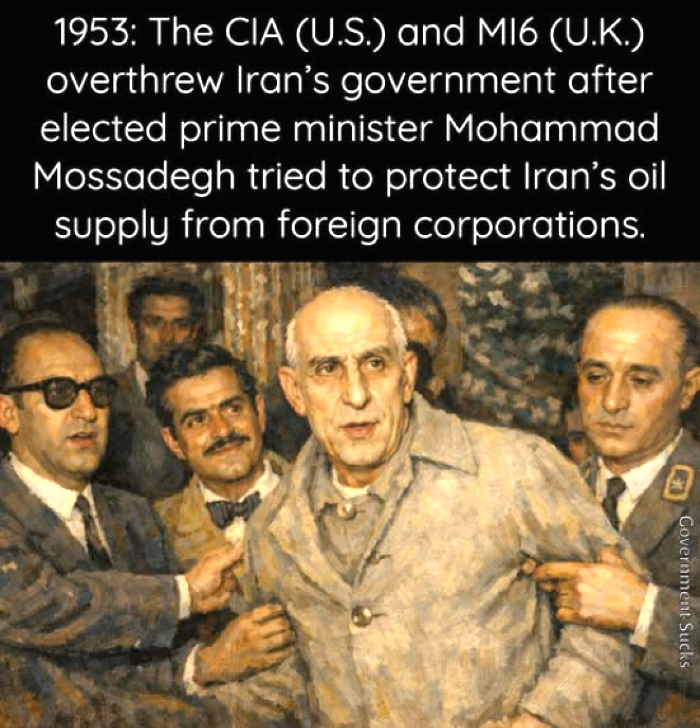
At the center of this story was Iran’s democratically elected prime minister, Mohammad Mosaddegh a nationalist leader determined to reclaim his country’s sovereignty.
The Fight for Iran’s Oil
For decades, Iran’s most valuable resource oil had been controlled largely by a British company, the Anglo-Iranian Oil Company (which later became BP). Despite sitting on vast reserves, the Iranian people saw only a small fraction of the profits. Mosaddegh believed this arrangement was a continuation of colonial exploitation. In 1951, he made a historic decision: he nationalized Iran’s oil industry. For Iranians, this was a moment of pride and sovereignty. For Western powers, it was a threat. Britain feared losing its most profitable foreign asset, and the United States worried that instability in Iran might push the country closer to the Soviet Union during the tense years of the Cold War.
The Secret Plot
Unable to regain control through diplomacy or economic pressure, Britain turned to its ally across the Atlantic. Together, the Central Intelligence Agency (CIA) and Britain’s Secret Intelligence Service began planning a covert operation to remove Mosaddegh.
Their strategy was multi-layered:Funding anti-government protests.
Spreading propaganda through newspapers and radio. Bribing politicians and military officers. Creating chaos to make Mosaddegh appear incapable of governing. The ultimate goal was to restore Iran’s monarchy under Mohammad Reza Pahlavi, known as the Shah, who was seen as more cooperative with Western interests. The CoupIn August 1953, the plan went into action.
Protests erupted in the streets of Tehran. Some were genuine, but many were organized and financed by foreign intelligence networks. Elements within the Iranian military, encouraged and supported by CIA operatives, moved against Mosaddegh’s government. Within days, the elected prime minister was overthrown. Mosaddegh was arrested, tried, and placed under house arrest for the rest of his life. The Shah returned to power, now backed firmly by Western governments.
The Consequences .
What followed was more than two decades of authoritarian rule.Under the Shah, Iran became one of Washington’s closest allies in the Middle East. Oil flowed once again into Western markets, and Iran became a strategic pillar in U.S. regional policy. But internally, the Shah’s government relied heavily on repression. His secret police, the SAVAK, became infamous for surveillance, imprisonment, and torture of political opponents.
The resentment that built over years of political repression, economic inequality, and foreign interference eventually exploded in 1979 during the Iranian Revolution. Led by the cleric Ruhollah Khomeini, millions of Iranians rose up and overthrew the monarchy. The Shah fled the country, ending a dynasty that had ruled Iran for decades. For many Iranians, the revolution was not simply about religion or ideology it was about reclaiming national dignity after the humiliation of foreign intervention in 1953.
From 1953 to Today
The consequences of that coup are still unfolding today.The leadership that emerged from the 1979 revolution built its identity around resistance to Western domination. The memory of how foreign intelligence services once overthrew their democracy remains deeply embedded in Iran’s political consciousness. That historical wound continues to shape the tensions we see today between Iran and Western powers, as well as with Israel. To understand the current confrontations, the regional proxy conflicts, and the ongoing hostilities that periodically erupt into war, one must go back to 1953.
The overthrow of Mosaddegh planted the seeds of distrust that still define Iran’s relationship with the West.What some call geopolitics today is, for many in Iran, unfinished history. The 1979 revolution was therefore seen by its supporters as the completion of a struggle that began when Iran first tried to control its own resources. In their eyes, it was the moment the country finally broke free from the shadow of the coup. Whether one agrees with Iran’s current leadership or not, the lesson remains powerful: nations rarely forget when their sovereignty is taken from them.
And sometimes, decades later, history returns to collect its debt.
