MIDDLE EAST CRISIS LIVE: ISRAEL LAUNCHES ’WAVE OF STRIKES’ ON TEHRAN AND TREATHENS TO ASSASSINATE NEW LEADER.
By Guardian - Taz Ali /Kate Lamb - Wed 4 Mar 2026 11.54 GMT
Tehran yet to choose replacement for late Ali Khamenei as US-Israeli war on Iran enters fifth day.
Summary of developments so far
- Israel said it had launched a “broad wave of strikes” against government targets in Tehran, including the presidential office. A loud blast was reported in the north-east of Tehran this morning, as explosions rocked Iranian cities for a fourth night.
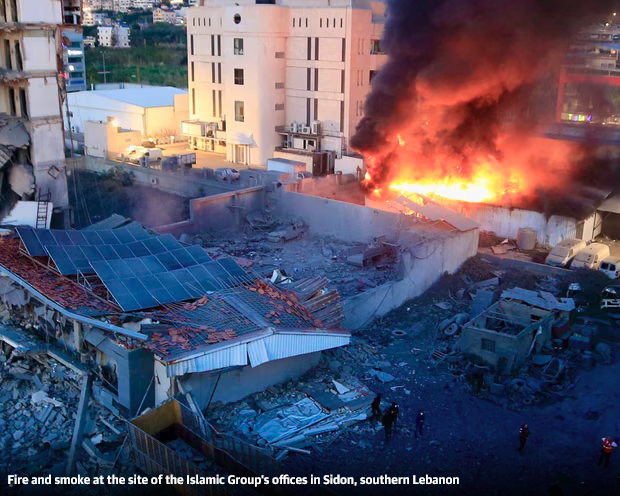
- Israel’s bombardment of Lebanon continues, with strikes reported in the southern Beirut suburb of Dahiyeh, seen as a support base for the militant group Hezbollah.
- Iran continues to launch retaliatory strikes, with Iran’s Islamic Revolutionary Guard Corps (IRGC) saying it fired about 40 missiles at US and Israeli targets.
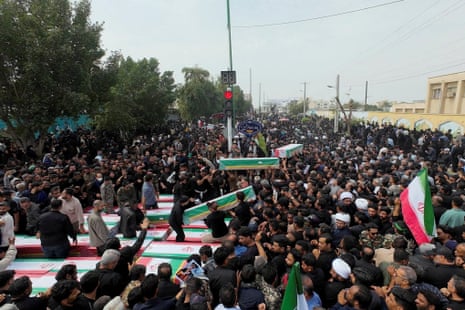
- A funeral ceremony is to be held in Tehran for supreme leader Ayatollah Ali Khamenei, according to state media. Supporters of the late Khamenei, who was killed in the US-Israeli strikes on Saturday, will gather at the prayer hall of the Grand Mosalla of Tehran tonight at 10pm (6.30pm GMT) to begin a three-day commemoration ceremony.
- Khamenei’s son, Mojtaba Khamenei, 56, has emerged as the frontrunner to replace his father as Iran’s supreme leader, the New York Times has reported, citing Iranian officials. Israeli defence minister Israel Katz said his military will attempt to kill any Iranian leader appointed to succeed Khamenei.
- Global oil and gas prices have spiked as the war has halted energy exports from the Middle East. Iran has attacked ships and energy facilities, closing navigation in the Gulf and forcing production stoppages from Qatar to Iraq.
- The conflict has caused turbulence on global markets. In Tokyo, the Nikkei 225 continued to fall on Wednesday, and was down about 3.9% during early trading. In Seoul, the Kospi – which dropped 7.2% on Tuesday – fell by a further 8.1% before trading was suspended on Wednesday. But Wall Street looks set to open only marginally lower in New York, according to pre-market trading data.
- The US navy could begin escorting oil tankers through the strait of Hormuz if necessary, President Donald Trump said on Tuesday, in one of the administration’s most aggressive steps yet to attempt to contain soaring energy prices sparked by the war.
- The US military has claimed that the number of strikes carried out on Saturday in the first 24 hours of its war on Iran was nearly double that of the “shock-and-awe” strikes on Iraq in 2003, and that nearly 2,000 targets had been hit so far in Iran. Cooper also said the US was also sinking “all of the Iranian navy” and had already destroyed 17 Iranian ships.
- Lebanon’s health ministry said on Wednesday that Israeli strikes on two towns south of Beirut killed six people and wounded eight. Aramoun and Saadiyat are both towns outside Hezbollah’s traditional strongholds. At least 30,000 people have been displaced in Lebanon, according to the UN, after heavy Israeli airstrikes.
A missile launched from Iran toward Turkish airspace was destroyed by Nato defence systems, Turkish officials said.
In a statement, the Turkish defence ministry said:
A ballistic munition launched from Iran, which was detected passing through Iraqi and Syrian airspace and heading towards Turkish airspace, was engaged in a timely manner by Nato air and missile defence assets stationed in the eastern Mediterranean and rendered inactive.
Nearly 150 missing after Iranian warship sinks near Sri Lanka - report
Nearly 150 people are potentially missing after an Iranian warship sank near Sri Lankan waters, according to reports.
The Sri Lankan navy rescued 32 people from the the 180-crew frigate Iris Dena after it reportedly issued a distress call this morning 25 miles south of the southern port of Galle, Sri Lanka’s foreign minister, Vijitha Herath, said.
A defence official told AFP news agency: rescuers were “keeping up a search, but we don’t know yet what happened to the rest of the crew”.
It remains unclear how many people were on board the vessel, or what caused it to sink.
Who is Motjaba Khamenei? The son of late supreme leader Khamenei seen as potential successor
Patrick Wintour
Motjaba Khamenei, the second son of the assassinated Ali Khamenei, is being heavily tipped to succeed his father as supreme leader of Iran, pitching a hardliner into the task of steering the Islamic republic through the most turbulent period in its 48-year history – and a powerful signal that it at present has no intention of changing course.
No official confirmation has been given, and the announcement may be delayed until after the funeral of Ali Khamenei. The son is believed to have been the choice of the Islamic Revolutionary Guards Corps (IRGC), and the Israeli defence minister, Gideon Saar, has warned he will be assassinated.
Rigid in his anti-western views, he is not the candidate that Donald Trump would have wanted. Marco Rubio, the US secretary of state said on Tuesday Iran was run “religious fanatic lunatics”, and Khamenei’s appointment is hardly likely to dispel that opinion.
The choice of supreme leader is made by the 88-strong assembly of experts who, in this case, were picking from a field of six possible candidates. His election would be a powerful if unsurprising symbol that the government is not looking seek to accommodate with America.
There has been speculation stretching back more than a decade that Khamenei would be his father’s successor, and that grew when Ebrahim Raisi, the elected president and favourite of Ali Khamenei, was killed in a helicopter crash.
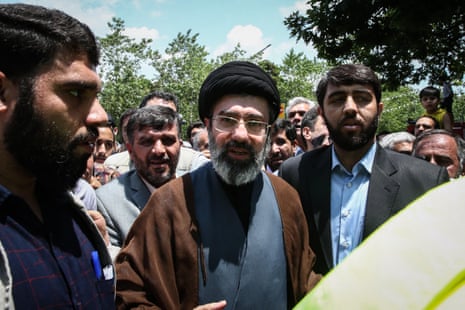
Mojtaba Khamenei was born in 1969 and studied theology after graduating from high school. At the age of 17, he went to serve in the Iran-Iraq war, but it was not until the late 1990s that he came to be recognised as a public figure in his own right.
After the landslide defeat of Khamenei’s preferred candidate, Ali Akbar Nategh Nouri, in the 1997 presidential election, where he won only 25% of the final vote, various conservative Iranian groups realised the need to make changes to their structures and Mojtaba Khamenei was central to that project.
He was also seen as instrumental by reformists in suppressing the protests in 2009 following allegations that the presidential election had been rigged, with his name chanted in the streets as one of those responsible. Mostafa Tajzadeh, a senior member of Iran’s reformist parties who was imprisoned after the vote, alleged that his and his wife Fakhr al-Sadat Mohtashamipour’s legal case was under the direct supervision of Mojtaba Khamenei.
In 2022, he was given the title of Ayatollah – essential to his promotion - and by then he was a regular figure by his father’s side at political meetings, as well as playing an influential role in the Islamic Republic’s Broadcasting Corporation, the government’s official media outlet that is often criticised for churning out dull political propaganda many Iranians reject in favour of overseas satellite channels. He has also played a central in the administration of his father’s substantial financial empire.
His closest political allies are Ahmad Vahidi, the newly appointed IRGC commander Hossein Taeb a former head of the Intelligence Organisation (IRGC-IO), and Mohammad Bagher Ghalibaf, the current speaker of the parliament .
His rumoured appointment and its hereditary nature has long been resisted by reformists. Mir Hossein Mousavi, referring to the long history of rumours about Mojtaba Khamenei succeeding his father as leader, wrote in 2022 : “News of this conspiracy have been heard for thirteen years. If they are not truly pursuing it, why don’t they deny such an intention once and for all?”
The assembly of experts in response denounced “meaninglessness of doubts” insisting it would only select “the most qualified and the most suitable”.
Israel on Tuesday struck the building in Qom, one of Shia Islam’s main seats of power, where the assembly was scheduled, but the building was empty, according to IRGC-affiliated media.
Iran state funeral for Khamenei postponed - report
Iran’s Tasnim news agency has reported that the funeral ceremony for supreme leader Ayatollah Ali Khamenei that was supposed to take place tonight in Tehran has been postponed.
The news agency published a statement from the Islamic propagation coordination council of Tehran province, which said the funeral was delayed to allow time for expanded infrastructure due to “overwhelming demand”.
The statement read:
The Tehran Grand Mosque was scheduled to host our dear people from tonight for a farewell to the pure body of the martyred cleric and our great Imam, but due to the overwhelming demand from across the country and the widespread desire of the people for a grand attendance at this ceremony, as well as the need to provide the necessary infrastructure, the event has been postponed.
Given the high volume of requests to attend this ceremony and the need to prepare adequate facilities to host the people, it was decided that the event would be held at a more suitable time.
UN 'deeply disturbed' by reports of Iran school strike that killed 160 children
A UN body said it was “deeply disturbed” by the deaths of children during the war in the Middle East, after the bombing of a girls’ school in southern Iran.
More than 160 children were reported killed after the Shajareh Tayyebeh girls’ school in Minab was hit on Saturday, the first day of the US-Israeli attacks against Iran.
The UN Committee on the Rights of the Child said: “This is a reminder that children are among the most vulnerable in armed conflicts, and must never be treated as collateral damage.”
US secretary of state Marco Rubio said on Monday that the country’s forces “would not deliberately target a school”, while Israel commented that it would investigate the incident.
Donald Trump ‘really does not care’ if Iran play at World Cup 2026
Donald Trump has said he does not care whether Iran participates in this summer’s World Cup, which is being jointly hosted by the US, Mexico and Canada.
“I really don’t care. I think Iran is a very badly defeated country. They’re running on fumes,” Trump told Politico.
Iran was the only nation missing from a Fifa planning summit for World Cup participants held this week in Atlanta, deepening questions over whether the country’s team will compete on US soil this summer amid an escalating regional war.
Donald Trump ‘really does not care’ if Iran play at World Cup 2026

Lisa O’Carroll
The EU has hit back at Donald Trump’s threats to halt all trade with Spain over its decision not to allow the US use its military bases for Iran bombing missions.
The EU said it expected the US president to “honour” its bloc-wide tariff deal concluded last year but hinted at the possibility of retaliatory measures if Trump did isolate Spain in a revenge move.
“The Commission will ensure that the interests of the European Union are fully protected. We stand in full solidarity with all Member States and all its citizens and, through our common trade policy, stand ready to act if necessary to safeguard EU interests,” said trade spokesperson Olof Gill
“Trade between the European Union and the United States is deeply integrated and mutually beneficial.
“Safeguarding this relationship, particularly at a time of global disruption, is more important than ever and clearly in the interest of both sides.
“The EU and the United States concluded a major trade deal last year. The European Commission expects the United States to fully honour the commitments” undertaken in the joint statement of last August.
The EU is continuing to honour its part of that deal, allow many US goods into the bloc tariff free, even though the US supreme court ruled Trump’s 15% tariffs on EU goods were illegal.
Ben Doherty
Canadian prime minister Mark Carney has softened his support for US and Israeli strikes on Iran, saying while he welcomes end of Ayatollah Ali Khamenei’s regime - “the principal source of instability and terror in the region” - he does not believe the attacks on Iran were legal, and they represent “another example of the failure of the international order”.
Carney is visiting Australia, where he will address parliament - partly on a trade mission, but also to help build cooperation between so-called middle powers. Carney has spoken previously about ‘variable geometry’ - the building of a variety of international coalitions to address specific issues.
Speaking at the Lowy Institute in Sydney, Carney’s position on the strikes on Iran was tempered from his initial forthright support.
“Canada supports the United States acting to prevent Iran from obtaining a nuclear weapon,” he said on Saturday.
On Wednesday night in Sydney, he said the Iranian regime and its proxies had murdered hundreds of Canadians over years, and “caused untold suffering for millions of people in the Middle East and beyond”.
He said Canada stood with the people of Iran in their struggle against the regime’s oppression, and “supported the imperative of neutralising this grave global threat”.
“But we also take this position with some regret, because the current conflict is another example of the failure of the international order, despite decades of UN Security Council resolutions, the work of the International Atomic Energy Agency in a succession of sanctions and diplomatic frameworks, Iran’s nuclear threat remains, and now United States and Israel have acted without engaging the UN or consulting with allies, including Canada.
“The question is: where to from here? Given we have a rapidly spreading conflict and growing threats to civilian life across the region, Canada reaffirms that international law binds all belligerents.”
Carney said the US and Israeli strikes appeared to be unlawful, in that they were not made with Security Council support, or in the face of imminent threat.
“The action that was taken, we weren’t consulted on it. There was not a process, a broader process for it. It would appear, prima facie... to be inconsistent with international law.”
The Guardian’s expert news coverage is funded by people like you, not a billionaire owner. Readers who choose an All-access digital subscription make the most impact and enjoy great benefits in return. Will you join them today?
Understanding what is happening in the Middle East is more important than ever
It’s the Guardian’s job to keep a close focus on events in the region for our global audience.
With reporters sharing live updates around the clock, we’re well-placed to provide comprehensive, fact-checked reporting and to help our audience understand every major development. But we can’t do it without your support.
We rely on the generosity of our readers, whose backing helps to keep our correspondents on the ground and our reporting free from commercial or political influence.
We appreciate that not everyone can afford to pay for news, but if you can, can we count on your support? Here are three good reasons to make the choice to fund us today:
1. Our quality, investigative journalism is a scrutinising force.
2. We are independent and have no billionaire owner dictating what we do – your money directly powers our reporting.
3. It doesn’t cost much, and takes less time than it took to read this message.
Choosing to back us on a monthly basis makes the most impact.