‘A FEEDBACK LOOP WITH NO BRAKE‘:HOW AN AI DOOMSDAY REPORT SHOOK US MARKETS
By Guardian-Aisha Down and Dan Milmo-Tue 24 Feb 2026 15.17 GMT
Shares in Uber, Mastercard and American Express fall on back of apocalypse scenario posted on Substack. US stock markets have been hit by a further wave of AI jitters, this time from yet another viral – and completely speculative – warning about the impact of the technology on the world’s largest economy.
The latest foreboding is from Citrini Research, a little-known US firm that provides insights on “transformative ‘megatrends’”. Its post on Substack, which it called a “scenario, not a prediction”, rattled investors by portraying a near future in which autonomous AI systems – or agents – upend the entire US economy, from jobs to markets and mortgages.

Citrini’s scenario begins now and ends in June 2028, with US unemployment cresting over 10% and an Occupy Silicon Valley movement setting up camp outside OpenAI and Anthropic’s offices. In the interim, a series of events triggered by the widespread use of AI agents guts software companies and ripples outwards, hitting private credit and mortgages, and leading to an unchecked downward spiral.
Speculative as it is, the scenario has unnerved investors. The S&P dropped more than 1% on Monday, and the software component of the index fell to its lowest level since Trump’s “liberation day” tariff announcement in April. Doubtless some of the wobble is attributable to Trump’s latest tariffs, but Uber, American Express, Mastercard and DoorDash, specifically named in Citrini’s report, all lost between 4% and 6%.
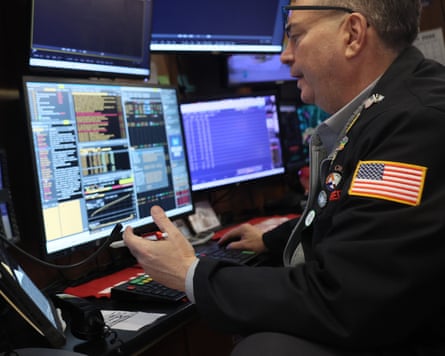
“It’s real doomsday porn stuff, which is always lapped up by readers and market commentators and the press,” said Neil Wilson, an analyst at Saxo Capital Markets. “I don’t think it’s necessarily going to play out as they see it, but it’s a bit of a wake-up call that the economy already no longer resembles the one just a few years ago.”
Citrini’s scenario evolves as follows:
1. AI agents remove all ‘friction’ in the economy
The scenario begins with AI agents undergoing a “jump in capability”. This has already happened. Citrini refers to Anthropic’s Claude Code and OpenAI’s Codex, both of which have wowed users with their performance in recent months.
The agents dent software-as-a-service companies such as Monday.com, Zapier and Asana, because they offer businesses a cheaper way to do in-house tasks , for example, managing databases and organising workflows. This forces businesses such as Oracle that rely on long-term contracts with customers into “a race to the bottom” on pricing.

Meanwhile the AI agents wreak havoc elsewhere. The scenario imagines every consumer deciding to use their own personal agent to transact and conduct business. This completely sidelines companies that monetise “friction” in the economy, such as travel and estate agencies that operate as middlemen in processes such as booking holidays or buying property.
Instead of using DoorDash, developers – and civilians – code up their own food delivery apps, all of which compete, fragment the market, and destroy the margins of legacy businesses. Business for Uber and other ride-sharing apps also evaporates. Instead of using Visa and Mastercard, AI agents decide to do all business in cryptocurrency, because transaction costs are cheaper. This guts traditional payment providers.
To Citrini, this is a logical endpoint for tireless AI agents that have the time and capability to optimise everything. “Habitual app loyalty, the entire basis of the business model, simply didn’t exist for a machine,” it writes.
In the real world, Uber, DoorDash, Mastercard and American Express shares have all fallen this week on the back of this scenario.
2. Mass white-collar unemployment
Traditional narratives about progress envision the latest technologies creating new jobs as they destroy others. Not so with AI.“AI is now a general intelligence that improves at the very tasks humans would redeploy to. Displaced coders cannot simply move to “AI management” because AI is already capable of that,” Citrini writes.Instead, white-collar workers redeploy en masse into unstable, gig-economy jobs – the writers describe a hypothetical friend of theirs laid off from Salesforce driving for Uber. This in turn suppresses wages in the sector. The layoffs meanwhile drive down consumer spending. Companies, suffering from weakening demand, decide to invest not in workers but in more AI.This is “a feedback loop with no natural brake”, Citrini writes. The consequences are far-reaching when the wallets of the 10% of US workers who account for 50% of consumer spending suddenly snap shut.
3. Ripples out into the broader economy
The scenario imagines that job losses and the evisceration of software companies will ripple out into broader markets in two ways: through defaults in private credit and a mortgage crisis.Private credit firms, or lenders that are not banks, have been involved in restructuring a number of software businesses in recent years, taking out loans based on those businesses’ predicted annual revenue far into the future. The example Citrini gives is how Hellman & Friedman and Permira, an asset manager, took Zendesk, a software company, private in 2022 for $10.2bn (£7.6bn). The acquisition included a loan structured around the assumption that Zendesk’s revenue would be stable.
After AI agents, that assumption is no longer holds.This leads to “the largest private credit software default” in history. It should be contained to software, writes Citrini, but it isn’t, because the capital on the balance sheets of the asset managers includes life insurance policies and “the savings of American households”.Regulators downgrade this software debt, which contributes to a 2027 crash.Meanwhile, there is a mortgage crisis. White-collar workers no longer have white-collar jobs and are unable make repayments on their home loans. “People borrowed against a future they can no longer believe in,” writes Citrini.
4. Downward spirals
All this makes the negative feedback loop worse.The first-order spiral is companies laying off workers, which weakens demand and consumer spending, which in turn leads companies to invest in more AI and lay off more workers.The second-order spiral is that the private credit turmoil and mortgage concerns mean that markets tighten, consumer confidence is shaken, there are more layoffs and more mortgage impairment. “Each reinforces the other,” writes Citrini.No financial policy tools exist to address this, because the crisis that is happening in the real economy – job losses and suppressed wages and spending – is not a result of tight financial conditions that central banks can address, but of investment in AI, which makes “human intelligence less scarce and less valuable”.The upshot is a crash in late 2027, driven by the mortgage markets. It wipes out 57% of the S&P.
5. Occupy Silicon Valley and Ghost GDP
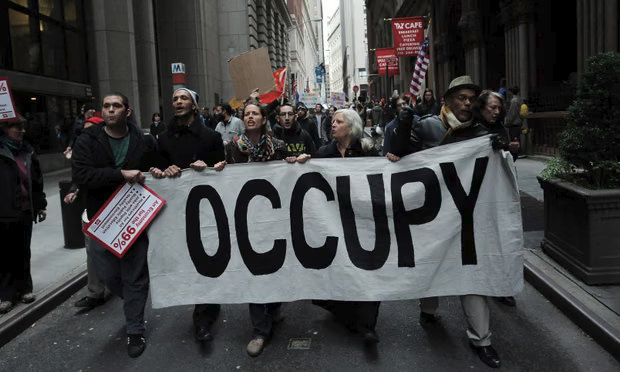
Protesters take part in an Occupy Wall Street rally near the New York Stock Exchange in November 2011. Photograph: Justin Lane/EPA
Citrini imagines the crash will throw governments into a crisis they will be unable to manage.
“The system wasn’t designed for a crisis like this. The federal government’s revenue base is essentially a tax on human time. People work, firms pay them, the government takes a cut,” it writes.
“The government needs to transfer more money to households at precisely the moment it is collecting less money from them in taxes.”
AI companies, however, are doing well. The big-tech players who build and sell AI models are making fabulous sums. Because their companies make up a large share of the markets, the economy looks great on paper.
Citrini has a term for this: ghost GDP, that is “output that shows up in the national accounts but never circulates through the real economy”.
The social fabric frays and a movement styled after Occupy Wall Street blockades the offices of AI firms for weeks on end.
Citrini’s scenario ends with a caution: “This is the first time in history the most productive asset in the economy has produced fewer, not more, jobs. Nobody’s framework fits, because none were designed for a world where the scarce input became abundant. So we have to make new frameworks. Whether we build them in time is the only question that matters.”
The impact of the Citrini scenario has startled some commentators, including experts who say AI tools are not yet capable of enacting it. Stephen Innes, a managing partner at SPI Asset Management, says AI thought pieces have become market movers.
“We have watched this market absorb wars, sticky inflation, banking tremors and tariff theatrics with a shrug, yet a widely circulated Substack thought piece is enough to knock it sideways,” he said.