BITTER DISPUTE BETWEEN TRUMP AND EU OVER GAZA’S FUTURE BREAKS OUT INTO THE OPEN
By Guardian- Patrick Wintour in Munich-Fri 13 Feb 2026 17.51 GMT
EU’s head of foreign policy claims ‘Board of Peace’ is vehicle for Trump with no accountability to Palestinians or UN. A bitter dispute between Europe and the US over the future of Gaza has broken out into the open, with the EU’s head of foreign policy, Kaja Kallas, warning that Donald Trump’s “Board of Peace” was a personal vehicle for the US president that removed any accountability to Palestinians or the United Nations.
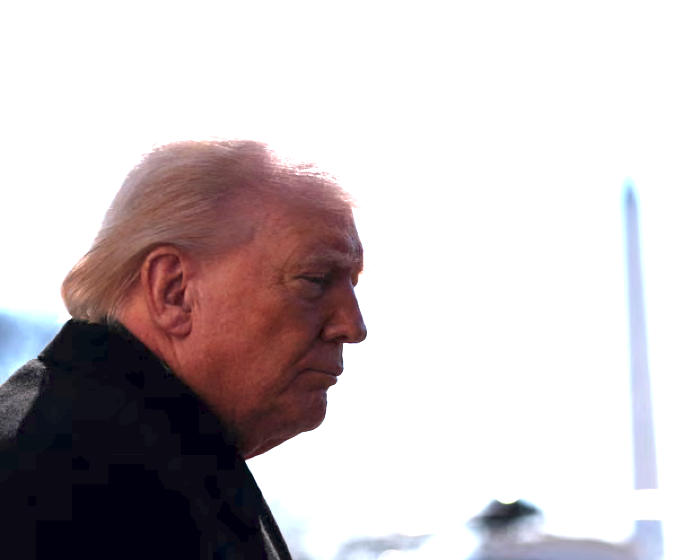
Spain’s foreign minister, José Manuel Albares, also accused Trump of trying to bypass the original UN mandate for the board, and said Europe, one of the chief funders of the Palestinian Authority, had been excluded from the process.
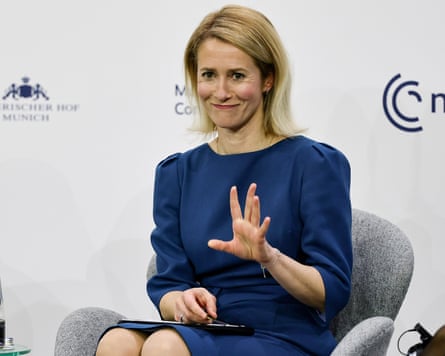
Speaking at the Munich Security Conference on Friday, Kallas said the original purpose of the UN resolution and mandate had been to help Gaza through a Board of Peace, but this had been subverted since the board’s charter now made no reference to Gaza or to the UN.
She said it was true that the UN security council resolution “provided for a Board of Peace for Gaza, but it also provided for it to be limited in time until 2027, it provided for the Palestinians to have a say, and it referred to Gaza, whereas the statute of the Board of Peace makes no reference to any of these things”.
She added: “So I think there is a security council resolution but the Board of Peace does not reflect it.”
The Democratic senator Chris Murphy expressed fears that the board was constructed in a way that there were no controls to prevent billions in reconstruction funds ending up in the hands of Trump’s friends and cronies.
The comments mark the first time differences over Trump’s project have spilled into the open at such a high level, and underline the tensions about the state of the ceasefire in Gaza, and the meeting of the Board of Peace due to take place in Washington next week.
Speaking at a side event, the Trump-appointed high representative for Gaza, Nickolay Mladenov, tried to steer clear of the controversy and focus on the immediate tasks ahead.
“All of this needs to move very fast. If we do not, we are not going to implement the second phase of the ceasefire but the second phase of the war,” he said.
Mladenov said he was not willing to engage with allegations of an Israeli genocide, and said his focus was to improve humanitarian aid, decommission weapons from all factions, and end the division of Gaza itself in which part is run by Israel and part by Palestinians.
“If we do not address the issue of Hamas and Gaza itself divided into two parts, please tell me how we get to a two-state solution, because I do not see the pathway,” he said. ”We are setting ourselves up for complete and utter failure, and the price will be paid by both Israelis and Palestinians down the line.”
He warned aid, emergency recovery on the ground and security were needed immediately, adding: “None of this can be materialised until Gaza is one, and it is not yet one. For Gaza to be reconstructed we need to have the technocratic committee in Gaza and effectively governing, weapons decommissioned and Israeli withdrawal.”
In testy exchanges with Kallas, Mike Waltz, the US ambassador to the UN, attacked what he said was “hand-wringing” about the Board of Peace – and said the status quo of endless war, with Hamas in charge of Gaza, had to be broken.
He confirmed that Indonesia had agreed to contribute 8,000 troops to the International Stabilisation Force, and said more troop deployments were due to be announced in the coming week. He claimed that some countries were not comfortable putting billions of dollars for reconstruction through the UN system.
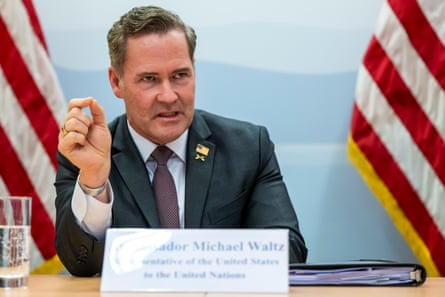
Describing Trump’s politics as “focused multilateralism”, he said it had been necessary to “put the UN on a diet and make it go back to basics of peacemaking”.
Mustafa Barghouti, a Palestinian activist, said he feared the discussions of plans for Gaza were losing any air of reality since “the whole of the West Bank has been made open for settlements and Israel is putting the final nail in the coffin of the Oslo accord. It is not just about accountability for genocide, but who is going to stop this process of killing the two-state solution.”
Congratulations on being one of our top readers globally – you've read 72 articles in the last yearArticle count
Now is not the time to look away
It’s the Guardian’s job to keep a close focus on events in the Middle East for our global audience.
With reporters sharing live updates around the clock, including from inside Gaza, we’re well-placed to provide comprehensive, fact-checked reporting to show the world what is happening in the region. But we can’t do it without your support.
We rely on the generosity of our readers, whose support helps to keep our correspondents on the ground and our reporting free from commercial or political influence.
We appreciate that not everyone can afford to pay for news, but if you can, can we count on your support? Here are three good reasons to make the choice to fund us today:
1. Our quality, investigative journalism is a scrutinising force.
2. We are independent and have no billionaire owner dictating what we do – your money directly powers our reporting.
3. It doesn’t cost much, and takes less time than it took to read this message.
Choosing to back us on a monthly basis makes the most impact, meaning we can continue to cover the story from every angle: the conflict, the plight of those affected and what it all means for the future of the region – and the world.
Support $5/monthlyRecommendedSupport $15/monthlyUnlock All-access digital benefits:
- Far fewer asks for support
- Ad-free reading
- Unlimited access to the Guardian app
- Exclusive newsletter for supporters
- Unlimited access to the Feast App
Support with another amountContinue
