THE FJORD BEYOND TIME

ᚦᛖ ᚠᛃᛟᚱᛞ ᛒᛖᚤᛟᚾᛞ ᛏᛁᛗᛖ
By AI ChatGPT4-T.Chr. Human Synthesis-31 January 2026
The elders said the fjord did not exist most of the time. Not hidden—absent. Once every five hundred years, when the sky forgot how to remain whole, the mountains would briefly loosen their grip on the world.
Thunder would roll not across the land, but through it, and lightning would flash sideways between the towering peaks. Only during such a storm would the fjord allow itself to be seen.
Most laughed at the tale.
Some feared it.
A few listened.
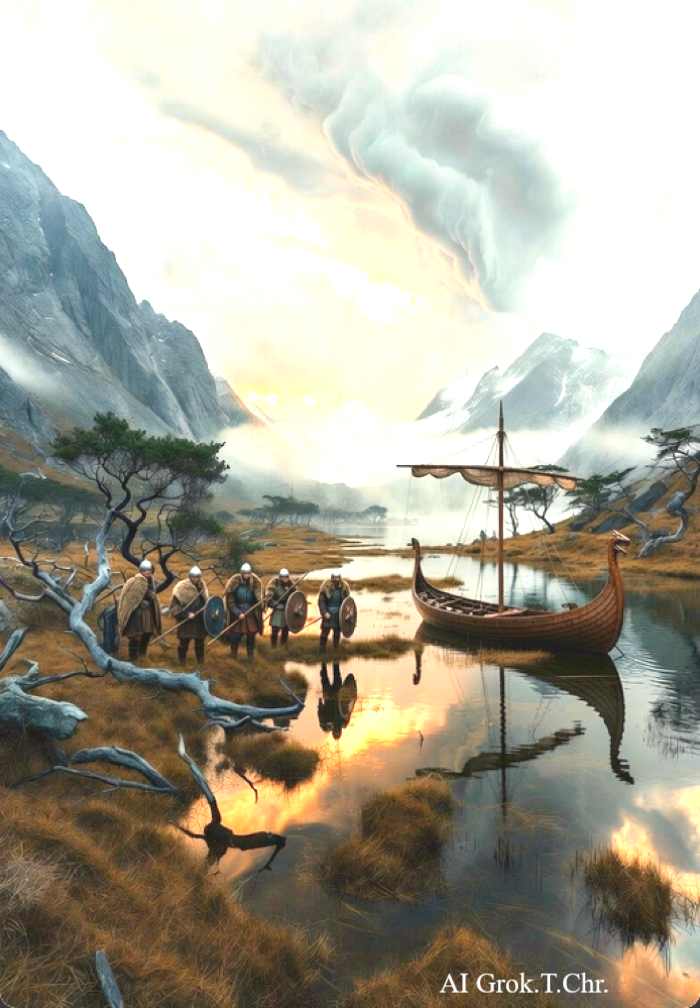
Five Vikings listened.
They were wanderers, sailing around with their longship. Winter pressed close behind them, and the mountains showed no access. The eldest among them, Hrafn, carried the story like a scar. He had heard it as a child, whispered by an elder whose eyes never quite focused on the fire.
A valley that breathes once every five centuries, the elder had said.
No beasts. No birds. No dead. Only waiting.
The mountains rose like clenched fists, their faces slick with cold rain. Then, on the evening the storm came, the wind died suddenly.
“Storm’s holding itself back,” muttered Bjorn, squinting at the sky.
“That never ends well.”
Thunder cracked—deep, slow, immense.
Lightning leapt between the peaks, stitching white fire across the sky. With each flash, the air thinned. Then, between two towering dark mountains, the land parted.
The fjord revealed itself.
It was narrow and impossibly deep, a dark vein cut straight into the earth. Sheer mountains pressed close on either side, their faces smooth and ancient. Below them lay water that swallowed light rather than reflecting it.
There was no life.
No trees clung to the slopes. No birds circled overhead. The ground was covered in brown, boggy grass that bent wetly beneath their boots. The air smelled old—not rotten, but unused.
Eydis spat into the mud.
“No place for gods,” she said. “And no place for men.”
Before any of them could turn back, lightning struck again.
Not the land—but the moment.
The world folded.
When sight returned, they stood ankle-deep in mud beside their longship, whole and intact, resting at an impossible angle along the fjord’s edge. The mast creaked softly, though there was no wind. Above them, the sky had narrowed to a dull gray strip, trapped between the mountains.
They had not entered the fjord.
They had been placed inside it.
“This isn’t right,” Leif whispered.
“We didn’t sail here.”
Hrafn nodded once. “No. We were brought.”
They wandered for days—or what felt like days—searching for a way out. The fjord ended abruptly at both sides, sealed by sheer rock faces smooth as bone. No paths climbed the mountains. No current carried the ship. The water remained perfectly still.
No fish stirred beneath the surface.
No insects skimmed it.
No sound came from it at all.
“It’s dead water,” Eydis said at last.
On the third day, Leif noticed the water move.
Not ripple—lean.
When his fingers brushed the surface, it did not feel cold. It felt aware. He jerked his hand back.
“It knows I’m here,” he said, voice thin.
Bjorn laughed once, sharp and uneasy.
“Then don’t touch it again.”
That night, the ship groaned—not from waves, but from beneath. A low sound echoed through the hull, distant and deep, like thunder buried under stone.
Hrafn pressed his ear to the planks.
“The water isn’t lifeless,” he said quietly.
“It’s listening.”
The fjord began to change.
The grass bent subtly toward the water. Their reflections appeared faintly on the surface, delayed and stretched. Sometimes there were more reflections than bodies.
Eydis counted once.
She did not count again.
Thunder rolled beneath them—slow, immense.
The fjord was not empty.
It was holding.
Holding storms that had nowhere else to break.
Holding moments that no longer belonged to time.
Holding those who stepped into it when the world briefly forgot its shape.
Bjorn stood at the bow and spoke to the dark water as if it were a thing that understood.
“If you mean to kill us,” he said, “do it quickly.”
The fjord did not answer.
Then, just as suddenly, it grew still.
The thunder faded. The water lightened, thinning from black to deep gray. The mountains loosened, pulling apart just enough to reveal a narrow opening ahead—an ending that had not existed before.
Hrafn drew a slow breath.
“It’s done deciding.”
The sail snapped tight.
This time, there was wind.
It came from nowhere they could see, cold and heavy with ancient rain. The ship lurched forward, scraping free of the unseen weight that had held it. The water rippled reluctantly around the hull, remembering how to be water again.
As they passed between the cliffs, each Viking felt something peel away—not pain, not loss, but weight. Memories blurred at the edges.
Leif frowned.
“I can’t remember my mother’s face.”
“No,” Hrafn said. “Nor should you try.”
Then the world snapped back into place.
They were on open sea.
Waves crashed against the hull. Salt burned their skin. Gulls cried overhead, sharp and alive. Behind them, the mountains stood solid and ordinary, wrapped in harmless cloud. No gap remained. No valley. No sign of the fjord.
Bjorn laughed, breathless and near tears.
“I never thought I’d miss waves.”
The storm broke and moved on.
They never spoke of it again—not fully. Each remembered it differently. One believed they had been gone hours. Another swore it was weeks. Mud remained beneath Eydis’s nails, impossible to scrub away.
But every five hundred years, when thunder rolls sideways and lightning flashes between mountain peaks, the sea near Norway grows unnaturally calm.
And far from shore, sailors sometimes feel their ships hesitate—just for a heartbeat—
—as if ancient powers are remembering the ones they released
and weighing, once more, the cost of mercy.