FOR WHO BELIEVE IN NATURE
By AI ChatGPT4-T.Chr.-Nature Believer-Anne Lien-Human Synthesis-30 Jan 2026
This text is a meditation written from inside contemporary life, not from a place of purity or distance. It does not accuse from above, but speaks while standing knee-deep in contradiction. Its tone is grieving, lucid, ashamed, and searching. At its core, it asks a question that modern society keeps postponing: What are we doing—and how did this become normal?
A philosophical reading
1. Development as unquestioned faith
The essay identifies a silent, powerful belief system that shapes our choices without ever being named. It does not appear in schoolbooks, creeds, or rituals, yet it governs everyday life:
Development. Growth. Acceleration.
Progress is treated as self-evidently good. Faster is better. More is necessary. New replaces old without pause. This belief does not explain why we move forward—it simply insists that we must. Development becomes direction without meaning, motion without reflection.
The result is a society that keeps going even when it no longer knows where it is going to.
2. Normality as moral shelter
A central theme is how destruction hides behind the word normal.
Driving cars that kill animals.
Clearing forests for cabins.
Capturing wild animals for entertainment.
Fireworks that terrify wildlife.
Markets designed to addict attention.
Consumption without end.
None of this appears exceptional. That is the danger.
The text suggests that once something is normal, it no longer needs to be justified. Ethics dissolve into routines. Responsibility is outsourced to systems. Harm becomes background noise.
No one needs to be cruel for the outcome to be cruel.
3. Humans as poorly adapted beings
Borrowing from The Velvet Queen, humans are described not as the crown of nature, but as its most awkward participants:
Impatient.
Sensory-deprived.
Unable to wait.
Unable to observe without interfering.
In stillness—at high altitude, in cold, in silence—our limitations are exposed. Intelligence has grown faster than wisdom. Control has replaced attentiveness. We move constantly, yet understand less and less of where we are.
4. The absence of guardians
One of the most painful realizations in the text is the collapse of the idea that someone is in charge.
No final authority steps in.
No one slams their hand on the table.
No one says “enough.”
Forests disappear.
Attention is commodified.
Desire is engineered.
And everything proceeds—legally, efficiently, normally.
This is not a failure of individuals, but of collective responsibility. Systems run themselves, and humans adapt to them rather than governing them.
5. Stillness as counter-movement
Against the constant stimulation of modern life, the practice shown in The Velvet Queen—waiting silently for days or weeks—becomes almost revolutionary.
Not producing.
Not consuming.
Not extracting.
Just watching.
Stillness is revealed as a forgotten human capacity, and perhaps the beginning of an ethic: seeing without taking, being present without demanding outcome.
6. No purity, only honesty
The author does not place herself outside the problem.
She scrolls.
Consumes.
Travels.
Wants comfort, beauty, speed.
This matters philosophically, because the text refuses moral purity. There is no clean position from which to judge. Modern life entangles everyone. The question is not who is innocent—but whether awareness can still matter.
7. Fitting in versus belonging
A key distinction is drawn between fitting in and belonging.
Modern society is excellent at teaching people how to fit in—through norms, trends, consumption, performance. But belonging—to place, to land, to the living world—has quietly eroded.
The unsettling question is not whether humans want to belong to nature, but whether nature still has room for us.
8. No ultimate reason—and the ethical weight of that
The text repeatedly returns to the idea that there may be no ultimate explanation. No final “because.”
Rather than collapsing into nihilism, this absence sharpens responsibility:
If nothing guarantees meaning,
then care becomes a choice, not an obligation.
Small acts—slowing down, listening, touching moss, floating in cold water, practicing gratitude—are not solutions. They are gestures of reconnection. Attempts to remember what we are part of.
9. Impermanence as perspective
The closing lines—borrowed from Tarjei Vesaas—place human life in its proper scale:
Under open sky. Over open abyss.
Like leaves, you and I—
trembling briefly,
and soon gone.
This is not despair. It is proportion.
And within that proportion lies a quiet hope:
that by remembering our fragility and our place, care might extend beyond ourselves again.
Not because we must.
But because we still can.
By Anne Lien – My niece.
But if we slow down a little—
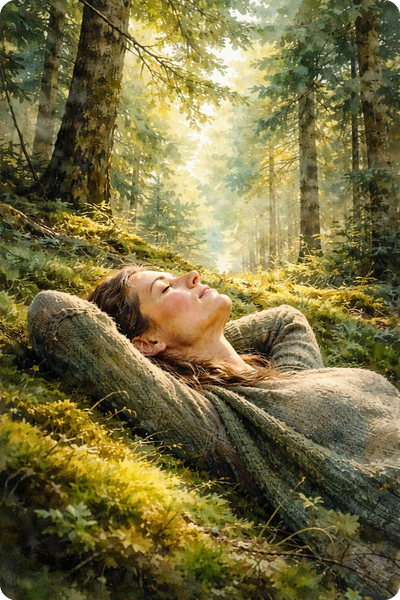
if we lie on our backs in the forest and stay there for a while, listening.
Roll over onto all fours and look more closely at what all that green in the moss is made of.
If we rub a juniper berry between finger and thumb and breathe it in.
If we walk calmly up onto the bare mountain and borrow a little strength from the wind up there in the heights.
If we shed our clothes and let the body float its way into the freedom of a crystal-clear mountain lake.
If we try humility.
If we try gratitude.
If we slow down a little—can we remember?
Reach something old inside ourselves?
Catch sight of what we are part of?
Love grows between us—it does—and if we spend enough time out there, perhaps love for the rest can return as well.
I believe that.
Even if we don’t know why, and even if there may be no “because,” or perhaps precisely because of that—
we can try to remember what we are part of, what we belong to.