5G, 6G, AND HEALTH
By AI ChatGPT4-T.Chr.-Human Synthesis-29 January 2026
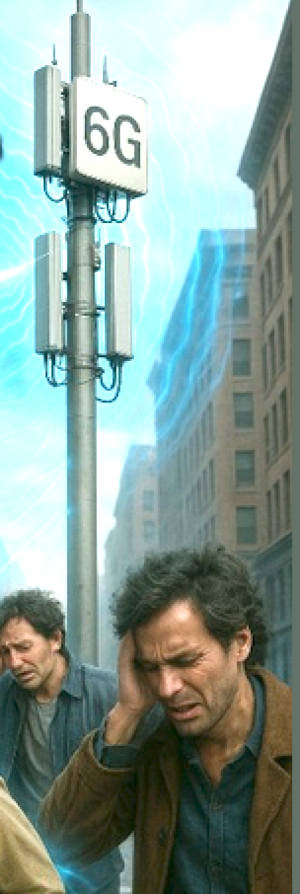
Living Near Mobile Network Masts – What We Know, What We Don’t. Questions about 5G and future 6G technology are understandable. Mobile communication systems are widespread, largely invisible, and constantly evolving. This has led to public concern—particularly about whether living close to a 5G mast or pole could cause harm, even if no immediate symptoms are felt.
Introduction
This document summarizes current scientific understanding, addresses common concerns (including military use of electromagnetic technologies), and discusses reported health symptoms in a careful and respectful way.
1. What Kind of Radiation Is 5G?
5G uses radiofrequency (RF) electromagnetic fields. These are:
- Non-ionizing radiation
- In the same category as radio, television, Wi-Fi, and 4G
- Fundamentally different from X-rays or gamma rays, which can damage DNA
Non-ionizing radiation cannot break chemical bonds or damage DNA.
2. Living Near a 5G Mast: What Does Exposure Look Like?
Public exposure near base stations is often misunderstood.
- Exposure drops rapidly with distance
- People living near masts usually receive less exposure than people who:
- Hold mobile phones close to their head
- Stream data for long periods
- Use phones in areas with poor signal coverage
Why?
Base stations distribute power over wide areas, while phones transmit at higher relative power right next to the body.
Measurements around 5G base stations typically show 1–10% (or less) of internationally allowed public exposure limits.
3. Safety Limits: Who Sets Them?
International exposure limits are set by organizations such as:
- ICNIRP (used by WHO, the EU, and many other countries)
- FCC (United States)
These limits include:
- Large safety margins (often 50× below levels known to cause heating effects)
- Protection for children, elderly people, and long-term exposure
Even continuous residence near a mast remains well within conservative safety boundaries.
4. “But What If We Don’t Feel Anything?”
This concern has been studied extensively.
- Many double-blind studies tested people who report sensitivity to EMF
- Participants could not reliably detect when RF exposure was on or off
- Symptoms occurred regardless of actual exposure
This points to a nocebo effect—real symptoms that are not caused by RF exposure itself.
Important:
This does not mean symptoms are imagined or dismissed. The suffering is real; the cause appears to be different from RF exposure.
5. Cancer, Long-Term Effects, and Children
This is the most studied area.
- Large population studies spanning 20–30 years
- No consistent link between base-station exposure and:
- Brain cancer
- Leukemia
- Neurological disease
- Countries with early and dense mobile-network adoption did not experience disease spikes
WHO position:
No adverse health effects have been established from exposure below guideline levels.
6. What Is Still Being Studied?
Scientific monitoring continues, including:
- Very long-term exposure (multi-decade)
- New modulation techniques
- Cumulative environmental exposure
So far, no findings have crossed established safety thresholds.
7. Practical Exposure Perspective
Although everyday exposure is already low:
- Use hands-free or speaker mode for long calls
- Avoid sleeping with a phone pressed against the head
- Strong signal coverage = lower phone transmission power
Ironically, poor coverage areas can result in higher personal phone exposure than living near a mast.
8. People With Symptoms Near Wi-Fi or 5G
Some individuals report pain and other symptoms near wireless sources. This condition is often referred to as:
Electromagnetic Hypersensitivity (EHS)
Common symptoms reported include:
- Headaches
- Burning or pressure sensations
- Fatigue
- Dizziness
- Sleep disturbances
- Brain fog, anxiety, heart palpitations
These symptoms can be severe and life-disrupting.
What research shows:
- Symptoms do not reliably increase during blinded exposure
- Symptoms often increase when exposure is believed to be present
- People cannot consistently tell whether signals are on or off
This suggests symptoms are not caused by RF energy itself, even though they are very real.
9. This Is Not “All in the Head”
That phrase is inaccurate and dismissive.
A better explanation:
- The nervous system enters a heightened threat state
- The body produces real pain, stress hormones, sleep disruption
- The trigger is perceived danger, not RF energy
Comparable conditions:
- Chronic pain syndromes
- Migraines
- Tinnitus
- PTSD-related physical symptoms
All are real and measurable.
10. Military Use of Electromagnetic Energy
The military does use electromagnetic systems as weapons—but these are not civilian 5G or 6G networks.
Example: Active Denial System (ADS)
- Uses millimeter waves (~95 GHz)
- Extremely high power
- Narrow, focused beam
- Rapidly heats the outermost skin layer
- Causes intense pain to force movement
ADS:
- Is not a communication system
- Is not 5G or 6G
- Operates at 10,000–100,000× higher power densities
- Is tightly controlled and rarely deployed
Civilian telecom systems cannot function as weapons without obvious, massive violations.
11. Why Confusion Persists
- Military secrecy
- Invisible technology
- Mistrust of institutions
- Online misinformation
- Real suffering seeking concrete explanations
These factors make fear understandable—but not scientifically supported.
Bottom Line
- ✅ Living near 5G masts has not been shown to cause harm
- ✅ Exposure levels are far below biological damage thresholds
- ✅ Symptoms experienced by some individuals are real, but not caused by RF energy
- ❌ Civilian 5G/6G is not comparable to military EM weapons
- 🔍 Ongoing research continues—and that is appropriate