PRESIDENT TRUMP RATIFIES BOARD OF PEACE IN HISTORIC CEREMONY.
By The White House - January 22, 2026
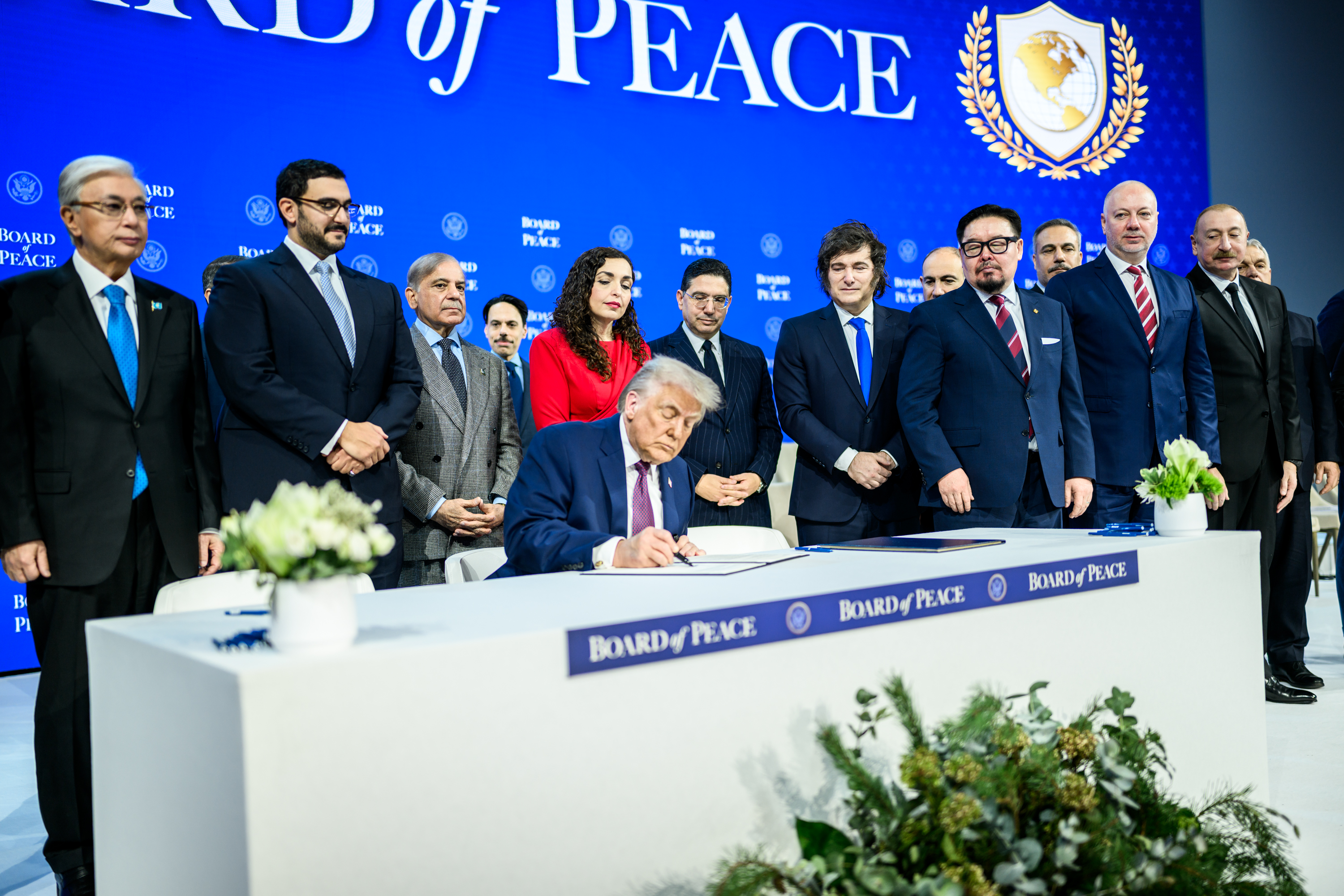
Today, in an historic ceremony in Davos, Switzerland, President Donald J. Trump formally ratified the Charter of the Board of Peace — establishing it as an official international organization.
President Trump, who is serving as the Board’s Chairman, was joined by Founding Members representing countries around the world who have committed to building a secure and prosperous future for Gaza that delivers lasting peace, stability, and opportunity for its people.
It’s another pivotal step forward in realizing President Trump’s vision of transforming Gaza from a region plagued by conflict and despair into one defined by opportunity, hope, and vitality. The Board of Peace stands ready to mobilize global resources, enforce accountability, and guide the implementation of the next critical phases of demilitarization, governance reform, and large-scale rebuilding.
President Trump: “This Board has the chance to be one of the most consequential bodies ever created, and It’s my enormous honor to serve as its Chairman… Today, the first steps toward a brighter day for the Middle East and a much safer future for the world are unfolding right before your very eyes. Together, we are in a position to have any credible chance… to end decades of suffering, stop generations of hatred and bloodshed, and forge a beautiful, everlasting, and glorious peace for that region.”
Secretary of State Marco Rubio: “We are here today because of President Trump’s vision. If we go back just a few months ago, people thought what was happening in Gaza was impossible to solve… No one thought that that would ever come to a resolution without more fighting and more bloodshed along the way… But President Trump had the vision and the courage to dream the impossible, to believe that it was doable, and to pursue it with all of his heart
Chief Commissioner of the National Committee for the Administration of Gaza Dr. Ali Sha’ath: “I want to start by thanking President Donald J. Trump and his Administration for his intensive efforts to advance peace in the whole region… These efforts created the opportunity for a new future in Gaza, but what will really matter is what comes next.”
High Representative for Gaza Nickolay Mladenov: “Who would’ve thought two years ago that we would be sitting here with this group of countries, with this leadership, giving the people of Gaza a new chance?… For too long, Gazans, Palestinians, and Israelis have lived with conflict, with death, with destruction. Now, the page turns.”
Special Envoy for Peace Missions Steve Witkoff: “We have achieved a peace deal in Gaza. We have brought the hostages home… And maybe most importantly, we have created a sense of hope for what the future can bring in Gaza and all other places where the Board of Peace will operate. And I am so honored, Mr. President, to have worked on this on your behalf.”
Kushner: “85% of the GDP of Gaza has been aid for a long time. That’s not sustainable. It doesn’t give these people dignity; it doesn’t give them hope. And so we want to use free market economy principles — a lot of what President Trump spoke about that he’s doing in America — we want to bring the same mindset, the same approach, to a place like Gaza to give these people the ability to thrive and have a good life… If we believe that peace is possible then peace really can be possible.”
Editor Comments - Human Synthesis
By AI ChatGPT4-T.Chr. Human Synthesis-26 January 2026
Countries reported to have joined the Board of Peace
These are nations that publicly confirmed participation or were represented at the founding ceremony:
Middle East & Africa
- Egypt — agreed to participate.
- Israel — Prime Minister Benjamin Netanyahu accepted and participated.
- Bahrain — confirmed participation.
- Saudi Arabia — confirmed participation.
- Turkey (Turkiye) — confirmed participation.
- United Arab Emirates (UAE) — confirmed participation.
- Qatar — confirmed participation (signed at ceremony).
Europe & Eurasia
- Hungary — one of the only EU countries that joined.
- Bulgaria — officially joined, with parliamentary processes underway.
- Armenia — reported participant.
- Azerbaijan — reported participant (often linked to regional peace agreement discussions).
- Kosovo — reported participant.
Asia & Oceania
- Indonesia — confirmed participant.
- Pakistan — Prime Minister attended and signed.
- Kazakhstan — confirmed participant.
- Uzbekistan — confirmed participant.
- Mongolia — confirmed as a founding member.
- Argentina — confirmed participation.
- Morocco — confirmed participation.
- Vietnam — reported as a joining country.
So around 20–25 countries appear to have publicly agreed to join the Board at this early stage or were present for the signing ceremony.
Not joining (publicly declined or not confirmed)
These countries have declined or publicly not agreed to join as of the latest reports:
- France — refused.
- Norway — will not join for now.
- Sweden — will not join at present.
- United Kingdom — has not accepted (stated concerns).
- Canada — invitation withdrawn after hesitations.
- Russia, China, Ukraine, Germany, EU institutions — no public acceptance yet reported.
What this means
- Most of the confirmed members are outside Western Europe and include Middle Eastern, Eurasian, Asian, and a few Eastern European states.
- Only a handful of EU members (Hungary, Bulgaria) have joined — while major Western allies have so far declined or remained non-committal.
- Brazil has not confirmed participation and appears hesitant.
What the Board has done so far
1. Formal establishment of the Board
The Board of Peace was officially launched with a charter signed at the World Economic Forum in Davos on 22 January 2026. This gave it a formal structure and name, with Donald Trump as chairman.
2. Initial group of member states confirmed
Roughly 20–25 countries have accepted invitations and signed onto the Board — including nations like Israel, Saudi Arabia, Egypt, Qatar, Pakistan, Argentina, Morocco, Hungary and Turkey — though major Western powers like France, Spain, the UK and Canada have declined or stayed out.
3. Shift in peace process for Gaza
The Board is linked to the second phase of the Gaza peace plan, meant to support transition, demilitarization, aid and reconstruction, at least on paper. Its creation was endorsed by a United Nations Security Council resolution (Resolution 2803) originally tied to Gaza.
4. Continued diplomatic engagement
Countries not currently members (like Brazil) are still in talks about possible conditions for joining, such as limiting the Board’s role to Gaza and including Palestinian representation.
5. U.S. administration highlights major outcomes
The U.S. White House recently touted the return of Israeli hostages and the international coordination around Gaza reconstruction as linked achievements of its foreign policy, including the Board’s creation.
What it hasn’t really done yet
1. No major peace settlement or conflict resolution
There’s no clear evidence the Board has ended a conflict, negotiated a ceasefire, or stabilized a war zone in a lasting way yet. It exists mostly as a mechanism for coordination, not as a proven peace-builder.
2. Limited operational activity
Observers say the Board primarily exists “on paper” so far, and real activities or large-scale projects (beyond planning and initial coordination) haven’t been implemented.
3. Little recognition from major global institutions
Major multilateral actors like the EU or mainstream UN bodies (beyond the Gaza resolution) have not embraced the Board as a key international peace actor. Some governments explicitly rejected joining.
4. Still controversial
Many analysts and world leaders are skeptical about whether the Board is a legitimate peace institution or a political/strategic initiative centered on U.S. leadership.
Bottom line
The Board of Peace is officially created and has some early participation and diplomatic activity, mainly around Gaza-related reconstruction and planning.*
But as of now, it hasn’t produced major peace outcomes, lasting agreements, or broad global recognition, and its practical achievements remain limited. Its success is still very much up in the air.